
Sulfa
SULFUR (S) — *earthy, dramatic; the stinky uncle of volcanoes and proteins.* Six outer-shell electrons (like oxygen but with more shells); two-bond capacity; flexible chemistry; the smelly element; structural anchor in proteins.
Press play to listen along. The line being read lights up as you go.
Show full transcript
Loading transcript…
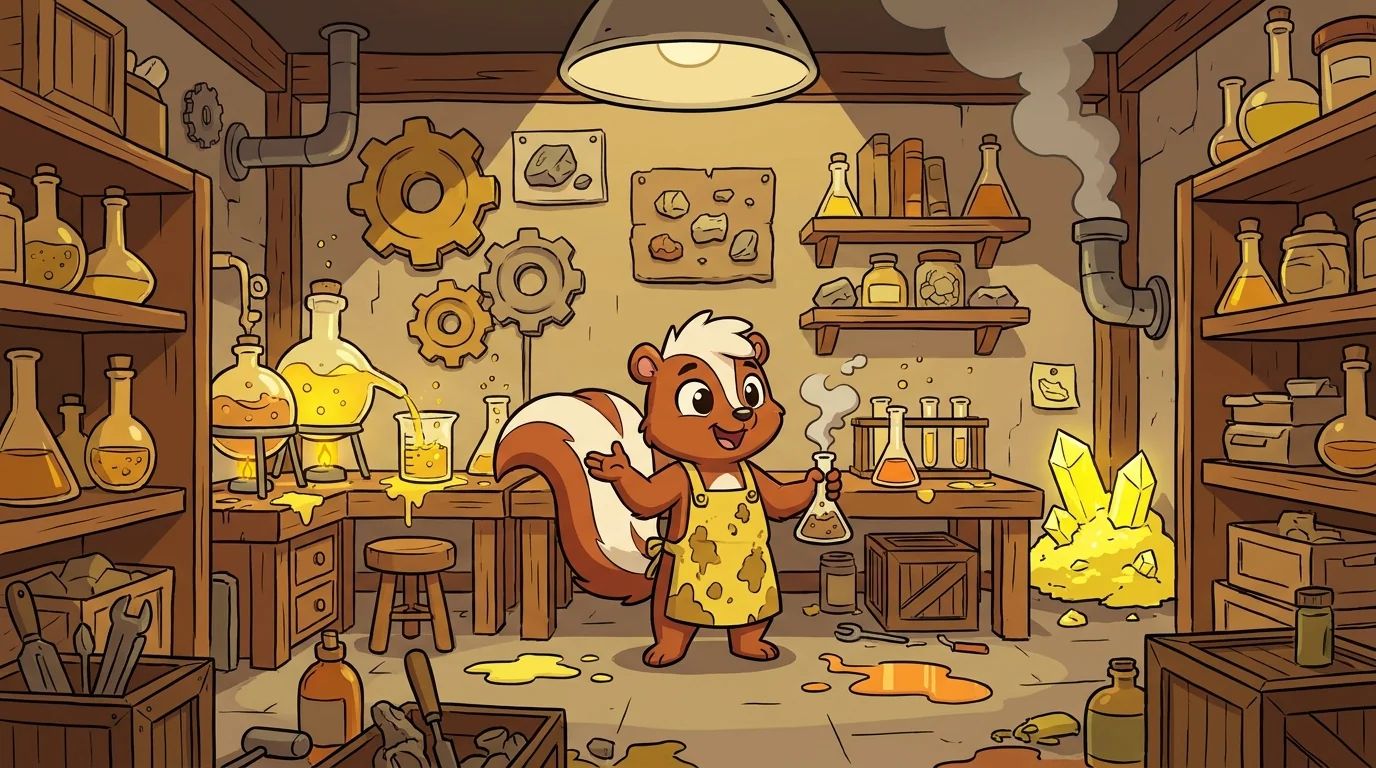
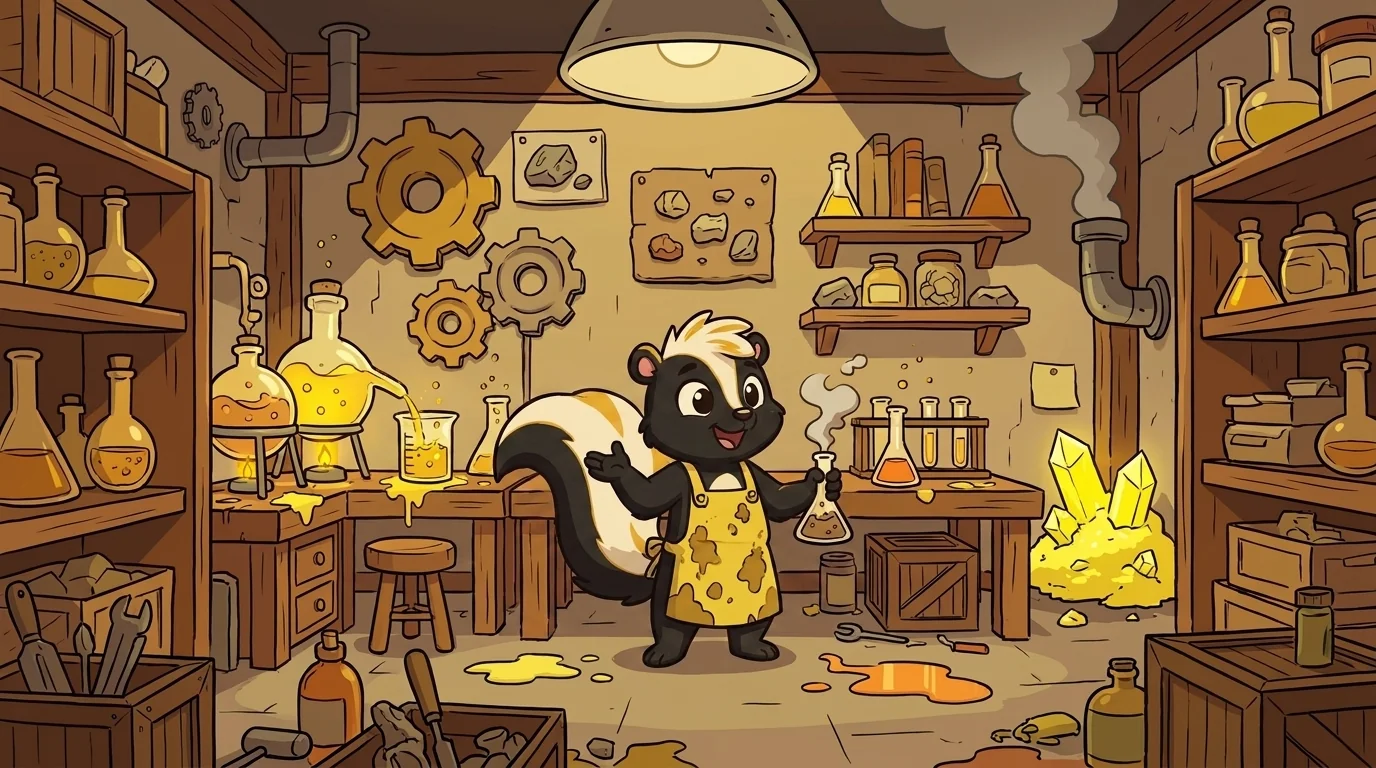
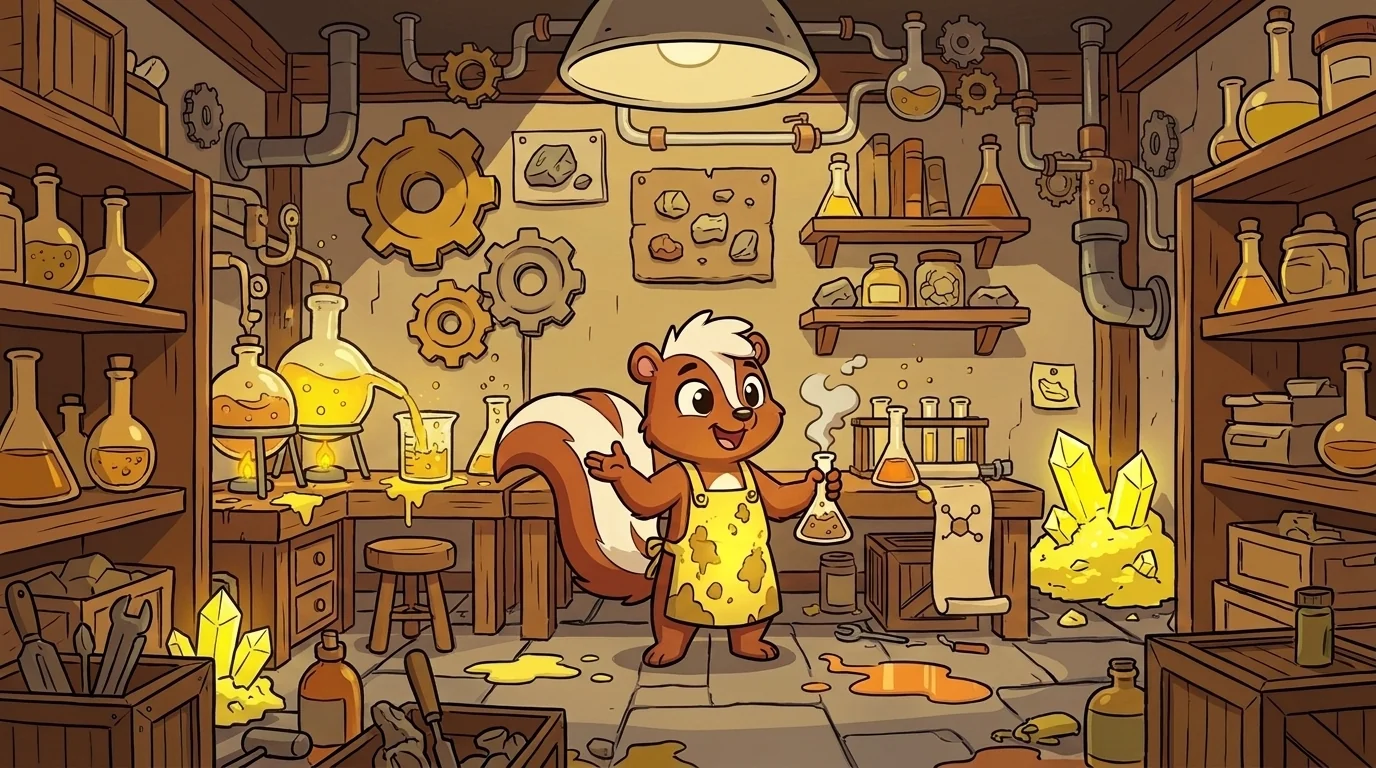
Sulfa wore a yellow-stained workshop apron. It was her uniform, really. The canvas had started cream-colored, but years of working with *sulfur* had left permanent yellow marks. They wouldn't wash out. Sulfa herself was a small skunk-tween, short and sturdy, with black-and-white stripes streaked with warm yellow. Her eyes were steady, always noticing details. Sometimes, when a story needed it, she could be quite dramatic. And her stories often went on a little longer than most.
Sulfa knew sulfur from the inside out. It sat right below oxygen on the periodic table, in the same column. This meant it had six electrons on its outer shell, just like oxygen, and wanted two more to be stable. But sulfur's outer shell was a bit farther from the center of the atom, making its bonds more flexible. It could form two simple bonds, like oxygen does in water, or it could link up in more complicated ways. Think of it as a master builder, able to make simple connections or complex scaffolds.
And then there was the smell. Everyone knew sulfur had a strong smell. Hydrogen sulfide, for example, smelled like rotten eggs. Sulfur dioxide, a gas released when you strike a match, had that sharp, smoky scent. Volcanic areas often had a distinct, sulfurous smell in the air. These smells weren't just random; they were part of sulfur's chemistry, triggering strong responses in our noses. Our bodies learned a long time ago that a rotten-egg smell often meant food had gone bad.
But Sulfa always insisted there was more to sulfur than just its scent. It was also a key player in biology. Two important building blocks of proteins, called amino acids—cysteine and methionine—contained sulfur. Even more amazing, these sulfur atoms could link up, forming "disulfide bridges." These bridges were like tiny internal ropes, holding proteins in their specific three-dimensional shapes. Your hair, your skin, your fingernails—all of them get their strength and shape from these sulfur bridges. Sulfur, Sulfa would say, was both the element that warned you of danger and the one that held you together.
Sulfa often told her students, "Yes, I'm earthy. I smell. But that's just part of the chemistry! Sulfur compounds really grab onto your nose receptors. And I'm also in your hair, your skin, your enzymes. Disulfide bridges hold proteins together, you know? Without me, your hair wouldn't even be hair. Don't ever mistake my smell for something bad. The smell is just information. And the structural work I do? That's essential."
Sulfa grew up in a small village nestled near active volcanic springs. Her family had always been the guardians of these springs, the skunks responsible for the village's hot-spring bathhouse. People came for medicinal soaks, believing the sulfurous waters helped them heal. This job meant living with strong smells every day. It meant learning to appreciate the hidden chemistry bubbling up from deep underground. And it meant carefully keeping the springs clean and safe for everyone. By the time Sulfa was six, she understood something important. Sulfur, despite its powerful scent, was a generous helper, working tirelessly behind the scenes.
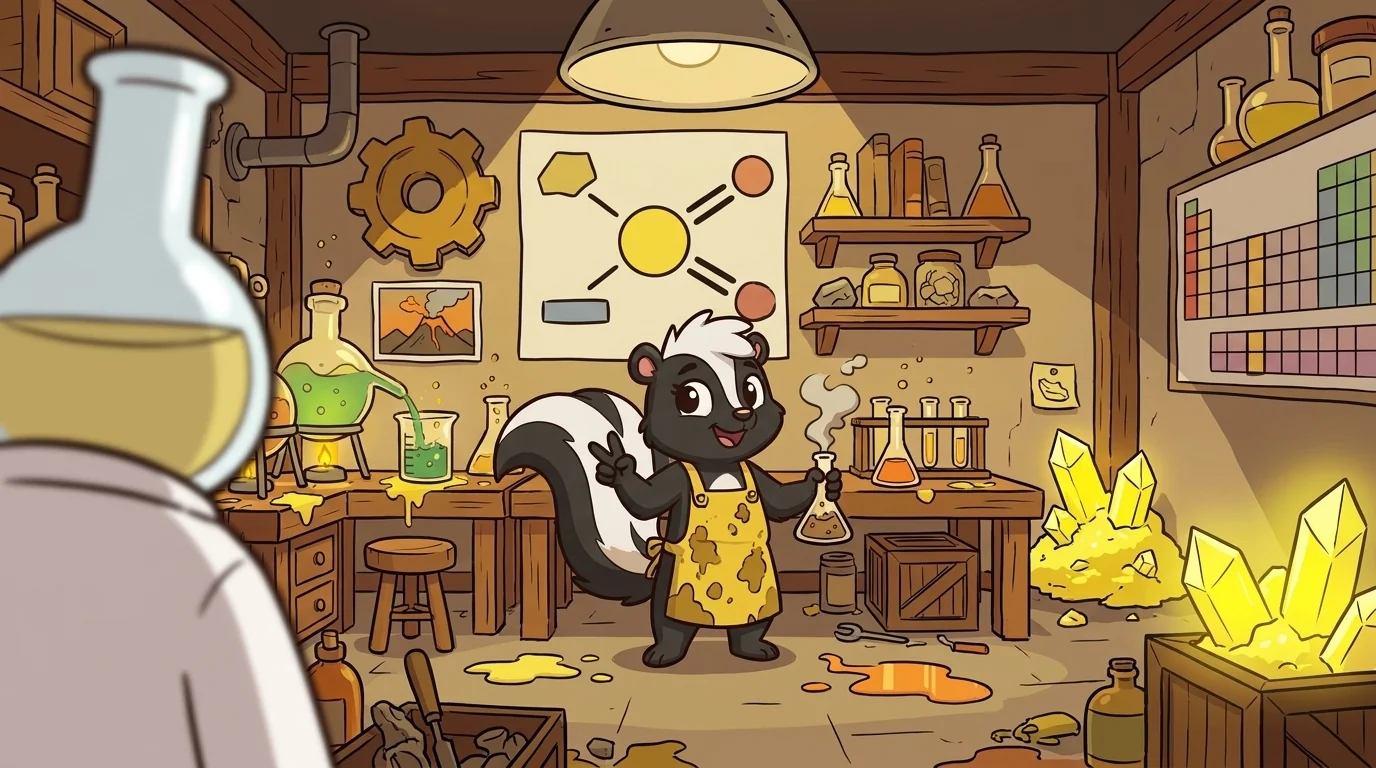
At twenty-two, Sulfa walked all the way to the ChemQuest academy. Beaker, the head of the academy, looked at her with a serious expression. "What is sulfur?" Beaker asked. Sulfa didn't hesitate. "I sit below Oxy on the periodic table," she began, her voice steady. "Same column, deeper shell. I make two bonds, but more flexibly than Oxy does. Yes, I'm the smelly element—think H₂S, that rotten-egg smell. Or SO₂, the match-strike smell, or the air around a volcano. But I'm also in your hair, in the disulfide bridges that make up keratin. I'm in your enzymes, in amino acids like cysteine and methionine. So, yes," she finished, a small smile playing on her lips, "smelly and structural." Beaker nodded slowly. "You are appointed," he said.
In her classes, Sulfa taught her students about the *sulfur scaffolds*. She'd start with the basics: "Sulfur makes two bonds, just like oxygen," she'd explain, pointing to the periodic table. "They're in the same column, after all. So you see sulfide compounds that look a lot like oxide compounds."
Then she'd get to the smells. "H₂S, hydrogen sulfide," she'd say, holding up a model of a sulfur atom bonded to two Hydras. "That's the rotten-egg smell. You know it. But remember, it's toxic in big amounts, so we avoid it in the lab." Next, she'd show them SO₂, sulfur dioxide. "This is the match-strike smell," she'd tell them. "And it's also what you smell in volcanic air. It's a common pollutant from things like burning coal."
She would move on to the stronger stuff. "H₂SO₄, sulfuric acid," she'd announce, holding up a bottle with a warning label. "This is a strong industrial acid. Used in fertilizer, battery acid. Highly corrosive, definitely not kitchen chemistry." She'd make sure they understood the danger, but also the importance.
Finally, she'd talk about life. "Two of the twenty amino acids in your proteins—cysteine and methionine—have sulfur in them," she'd say. "And cysteine's special. It can link up with another cysteine to form an S-S bond. We call these *disulfide bridges*." She'd hold her hands together, fingers intertwined. "These bridges hold proteins in their three-dimensional shapes. Your hair, your nails, the keratin in your skin, many enzymes—sulfur is the cross-linking anchor that gives them their structure." Sulfa always made sure her students understood that the dramatic smell of sulfur was indeed chemistry, but its structural role was just as vital to biology.
"My smell tells you
The ChemQuest ensemble
Sulfa is part of ChemQuest's distributed-narrative cast. Each character embodies a different curricular primitive; together they teach the full subject.
-

Hydra
Hydrogen (H) — lightweight, ubiquitous, always paired up; buddy-system enthusiast
-

Carbo
Carbon (C) — connects to anything; the social atom; backbone of life
-

Oxy
Oxygen (O) — eager bonder; electronegative; the hungry grabber
-

Nitra
Nitrogen (N) — triple-bond loyal; slow-to-warm; locks in deeply once bonded
-
Sodi
Sodium (Na) — generous, impulsive; always giving away electrons
-

Chlora
Chlorine (Cl) — sharp, focused; the collector who finishes what Sodi starts
-

Helio
Helium (He) — noble gas; peaceful, floaty, complete; the contented onlooker
-

Phossa
Phosphorus (P) — energetic, restless; the spark of ATP and matches
-

Magna
Magnesium (Mg) — bold, ceremonial; burns bright white; chlorophyll core
-

Silica
Silicon (Si) — patient, geometric; the architect who builds quietly
-

Alumi
Aluminum (Al) — practical, modest; the workhorse of cans and foil
-

Tugger
Ionic bond — forceful, decisive; full electron transfer; opposites attract
-

Sharer
Covalent bond — cooperative, balanced; equal partnership
-

Streamer
Metallic bond — flowing, communal; delocalized electron sea
-

Whisperer
Hydrogen bond — subtle, persistent; water's superpower; DNA pairing