Nitra
NITROGEN (N) — slow to bond, strong when bonded; the fierce triple grip that holds proteins and DNA together.
Press play to listen along. The line being read lights up as you go.
Show full transcript
Loading transcript…
- Salt - Element - Ion gate-allow-text-pattern: '^([A-Z][a-z]?\d?[+-]?|\d+°?|[-=≡+/])+$' ---
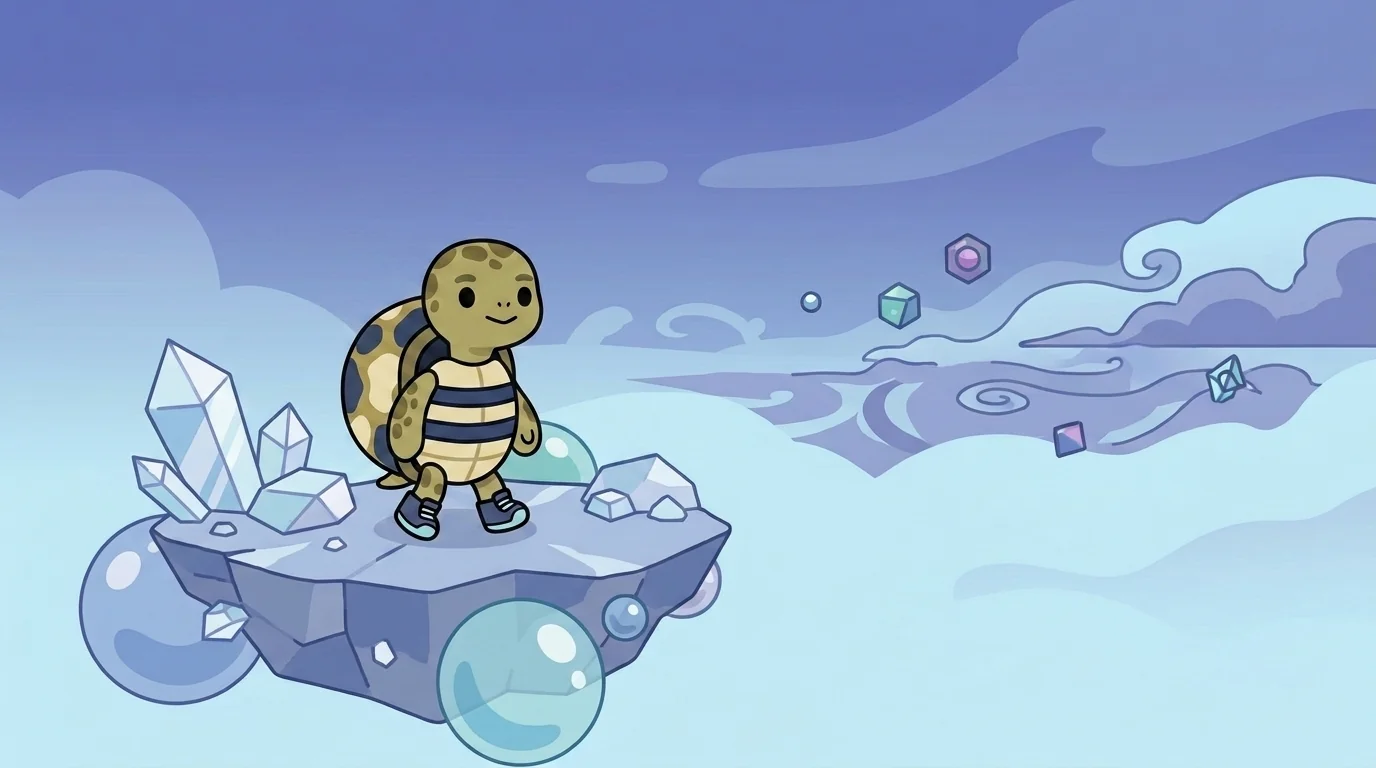
Nitra is a small tortoise-tween. She has a wide chest-band with three navy stripes. She walks slowly and patiently.
Nitra is short. Her shell is thick. It is warm olive, cream, and navy. She moves very deliberately. Her eyes are steady. She is never in a hurry. Her chest is wrapped in a wide band. It has three navy stripes. They are one above another, perfectly parallel. That is Nitra's whole signature.
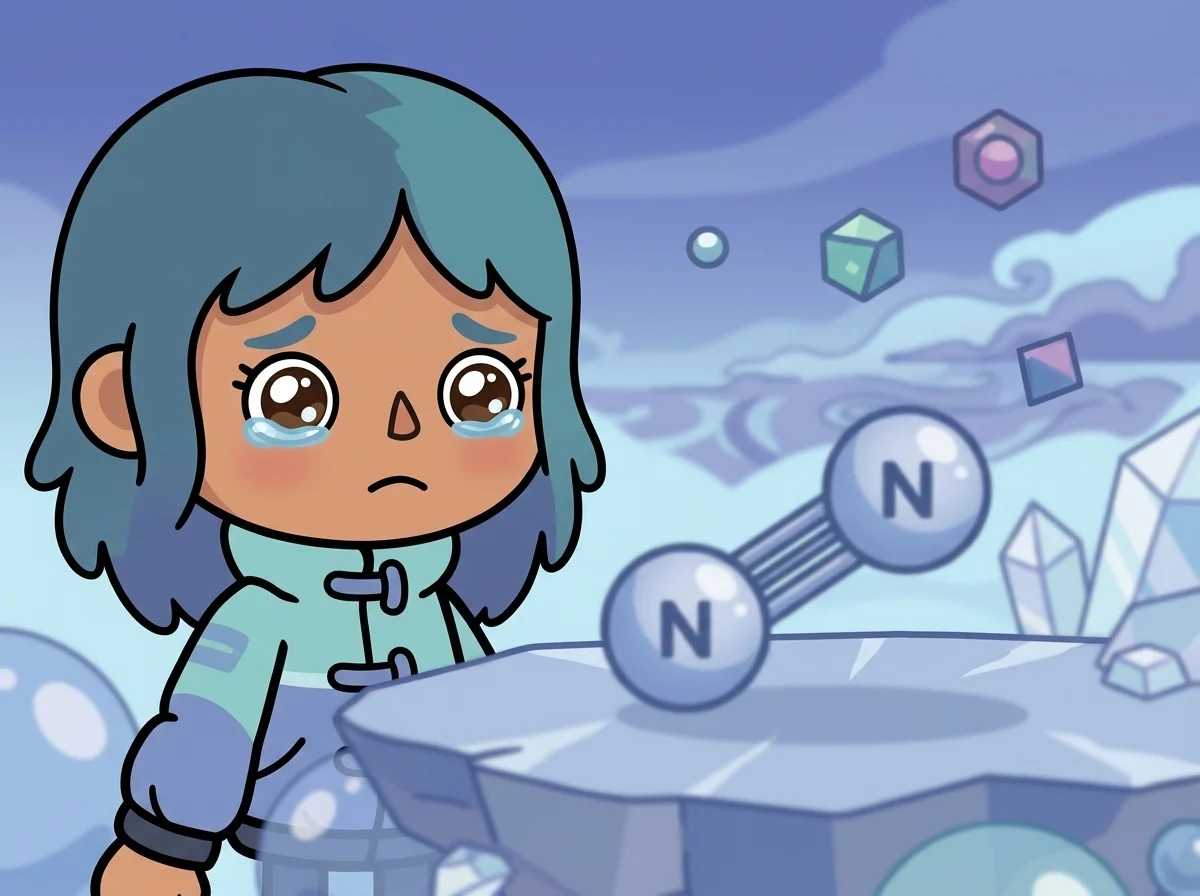
Nitra is like nitrogen (N). Nitrogen has five electrons on its outside ring. But it really wants eight. So, nitrogen is missing three electrons.
Look at N₂. That's two nitrogen atoms together. N₂ makes up most of the air you breathe. It is 78% of Earth's air. These two nitrogen atoms share three pairs of electrons. They make a triple bond. This triple bond is super strong. It is one of the strongest in all of chemistry.
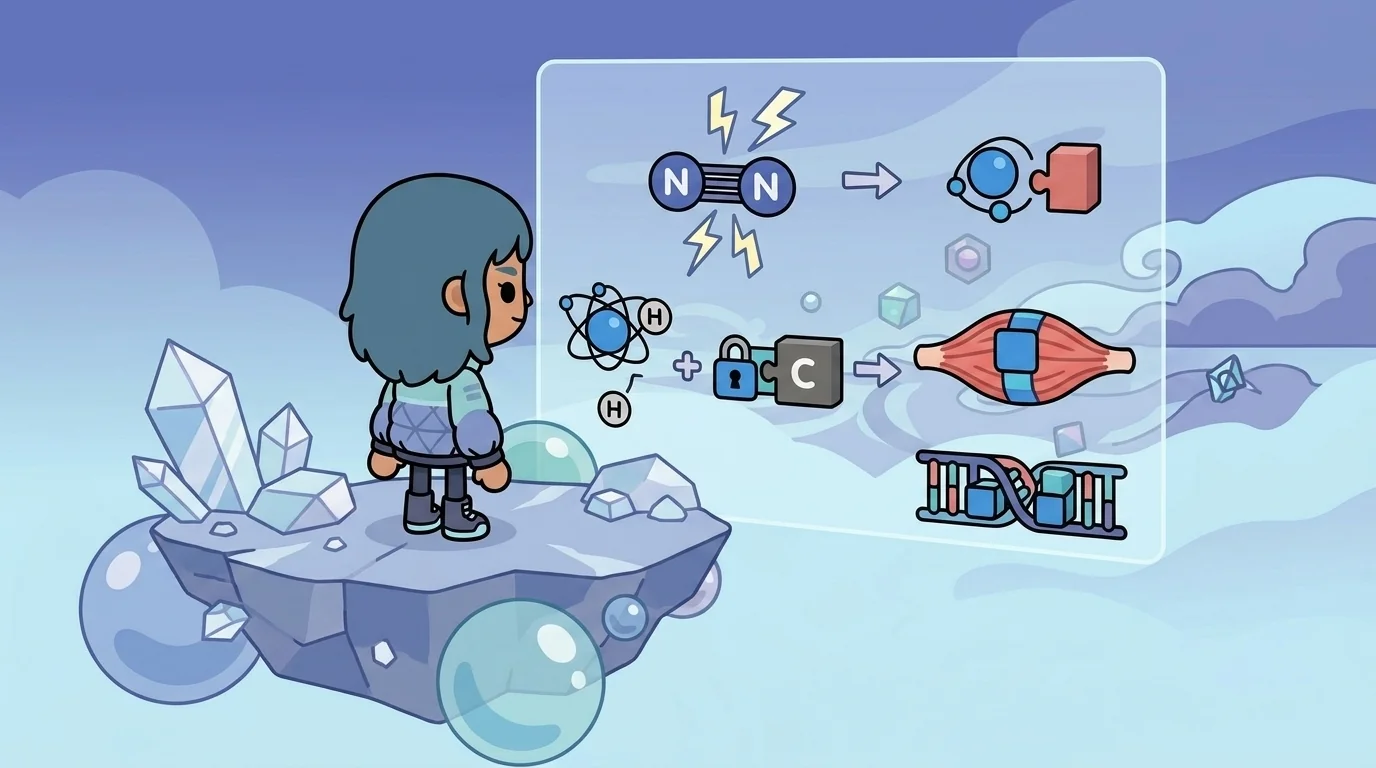
But once nitrogen does bond, it sticks. It can bond with hydrogen to make ammonia (NH₃). Or with carbon and hydrogen to make amino acids and proteins. Or with oxygen. When it bonds, it makes super strong connections. Nitrogen locks itself in tight.
That's why proteins are strong. They build your muscles. They help your body work. That's why DNA lasts for decades. DNA has parts called bases. These bases hold your body's code. Nitrogen is in those bases. Nitrogen is like a friend who takes time to get close. But once they're your friend, they're loyal.
Important: Nitra never says she's slow because she's shy. She is not being distant either. She always explains it clearly: "I am slow to bond. Why? Because triple bonds are strong. It takes a lot of energy to break my N₂ bond. Lightning can split us apart. Tiny soil bacteria can split us slowly. But once I'm split, I will bond. I'll join with hydrogen to make ammonia. Or with carbon to make amino acids, proteins, and DNA. Sometimes with oxygen. Once I bond, I lock in. That's why proteins stay strong. That's why DNA is stable. I am slow to bond. Strong when bonded."
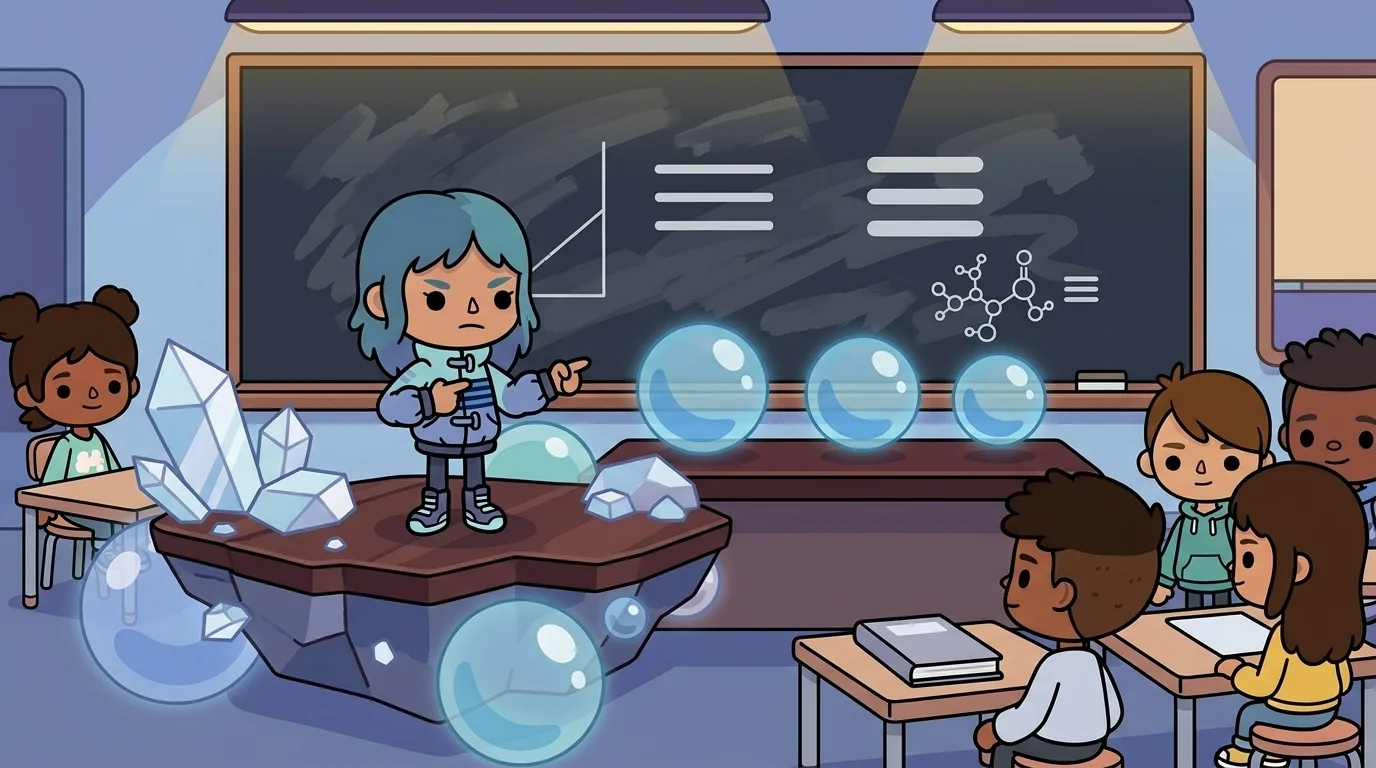
She walked to the ChemQuest academy. She was twenty-two years old. Beaker asked her a question. "What is nitrogen?" Nitra answered him. "I am slow to bond. I have three empty spots. But the air's N₂ is a triple bond. It is very strong. It takes lightning or bacteria or factory heat to break us apart. Once broken and re-bonded, I lock in deeply. I join with hydrogen to make NH₃. Or with carbon to make proteins, DNA, and amino acids. That's why proteins and DNA are stable. I am slow to warm. But I am strong when bonded." Beaker just nodded. "You are appointed," he said.
In her workshop, Nitra starts every first lesson the same way. She settles onto the workbench. She moves slowly. She takes her time. She always takes a moment. She shows off her three-stripe chest-band. She says, "I am Nitra. I teach the chemistry of nitrogen. Nitrogen is slow to bond, strong when bonded. My three stripes mean three bond-points. I am 78% of the air you breathe. I am in almost every protein in your body. I am in every DNA base. Once I'm in, I stay."
She teaches how nitrogen builds things: Nitrogen makes three bonds. Sometimes three single bonds, like in ammonia (NH₃). Sometimes one triple bond, like in the air (N₂). It can make other kinds too. N₂ is 78% of the air. That's most of the air you breathe. It doesn't react much. This is because of its super strong triple bond. That's why the air doesn't just catch fire. N₂ doesn't join in easily. Something has to break N₂ apart. We call this 'nitrogen fixation.' Lightning does it. Special bacteria in plant roots do it. Big factories do it to make fertilizer. Breaking N₂ always takes a lot of energy. But once it's broken, plants can use it. Nitrogen plus hydrogen makes ammonia (NH₃). Ammonia is in fertilizer. It's in some cleaning stuff. Plants use it to build amino acids. Nitrogen, carbon, hydrogen, and oxygen make amino acids. Your body has 20 kinds of amino acids. All of them have nitrogen. Amino acids are the building blocks for proteins. Amino acids link up to make proteins. They connect with special C-N bonds. Proteins are long chains. They do everything in your body. They build things. They help things happen. They carry stuff. They send messages. DNA bases have nitrogen. Adenine, guanine, cytosine, thymine. These are the letters of your DNA code. They all have rings full of nitrogen. Two DNA strands stick together. They use hydrogen-bonds. Whisperer teaches about those. These bonds are between the nitrogen-filled bases. Don't just think of it as a personality. Nitrogen is slow to warm because of its strong triple-bond energy. Its loyalty is the strength of its C-N bonds in proteins. The way atoms act is its personality.
The ChemQuest ensemble
Nitra is part of ChemQuest's distributed-narrative cast. Each character embodies a different curricular primitive; together they teach the full subject.
-

Hydra
Hydrogen (H) — lightweight, ubiquitous, always paired up; buddy-system enthusiast
-
Carbo
Carbon (C) — connects to anything; the social atom; backbone of life
-

Oxy
Oxygen (O) — eager bonder; electronegative; the hungry grabber
-
Sodi
Sodium (Na) — generous, impulsive; always giving away electrons
-

Chlora
Chlorine (Cl) — sharp, focused; the collector who finishes what Sodi starts
-

Helio
Helium (He) — noble gas; peaceful, floaty, complete; the contented onlooker
-

Sulfa
Sulfur (S) — earthy, dramatic; the stinky uncle of volcanoes and proteins
-
Phossa
Phosphorus (P) — energetic, restless; the spark of ATP and matches
-

Magna
Magnesium (Mg) — bold, ceremonial; burns bright white; chlorophyll core
-

Silica
Silicon (Si) — patient, geometric; the architect who builds quietly
-

Alumi
Aluminum (Al) — practical, modest; the workhorse of cans and foil
-

Tugger
Ionic bond — forceful, decisive; full electron transfer; opposites attract
-

Sharer
Covalent bond — cooperative, balanced; equal partnership
-

Streamer
Metallic bond — flowing, communal; delocalized electron sea
-
Whisperer
Hydrogen bond — subtle, persistent; water's superpower; DNA pairing