
Phossa
PHOSPHORUS (P) — *energetic, restless; the spark of ATP and matches.* Five outer-shell electrons; flexible bonding (3 to 5 bonds); critical to ATP energy currency in biology; the spark-flash element.
Press play to listen along. The line being read lights up as you go.
Show full transcript
Loading transcript…
- Salt - Element - Ion gate-allow-text-pattern: '^([A-Z][a-z]?[0-9]?)+([-=≡][A-Z][a-z]?[0-9]?)*$' ---
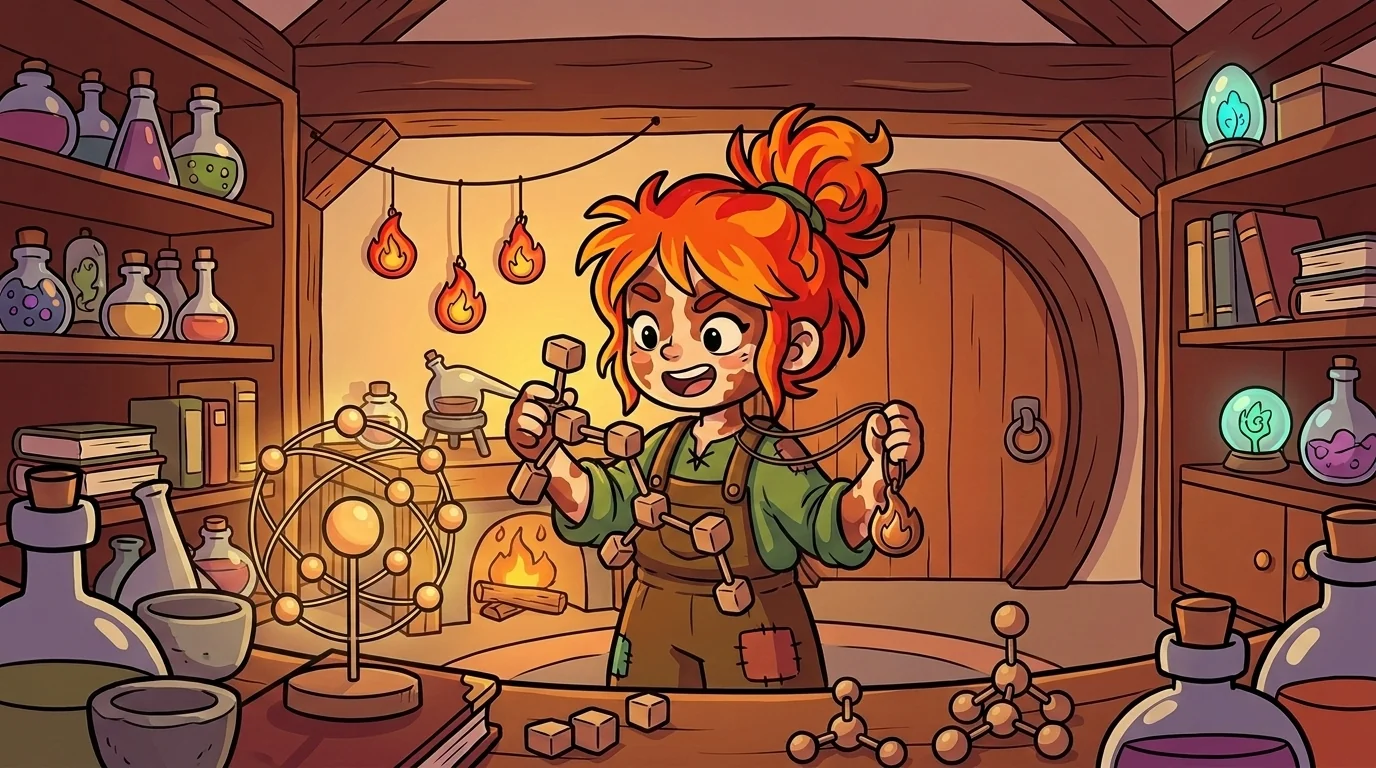
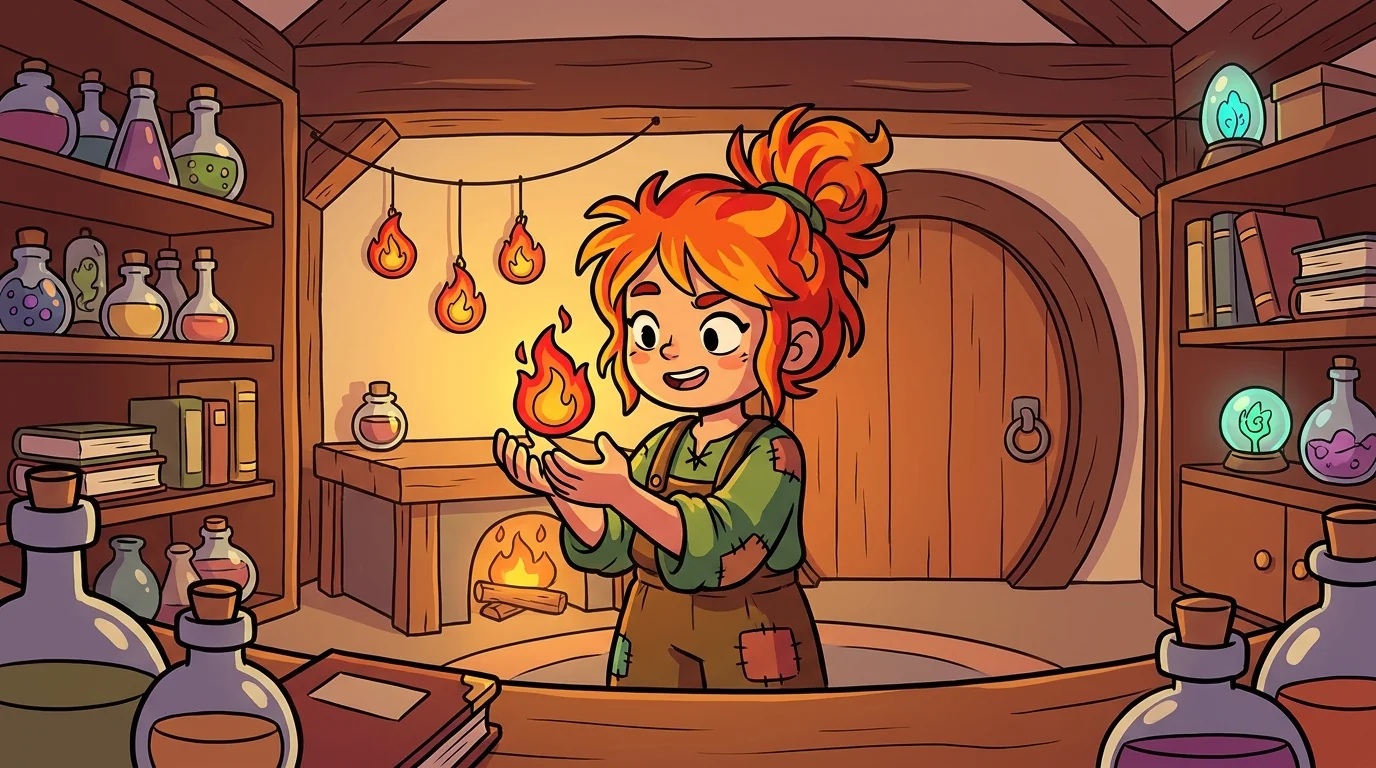
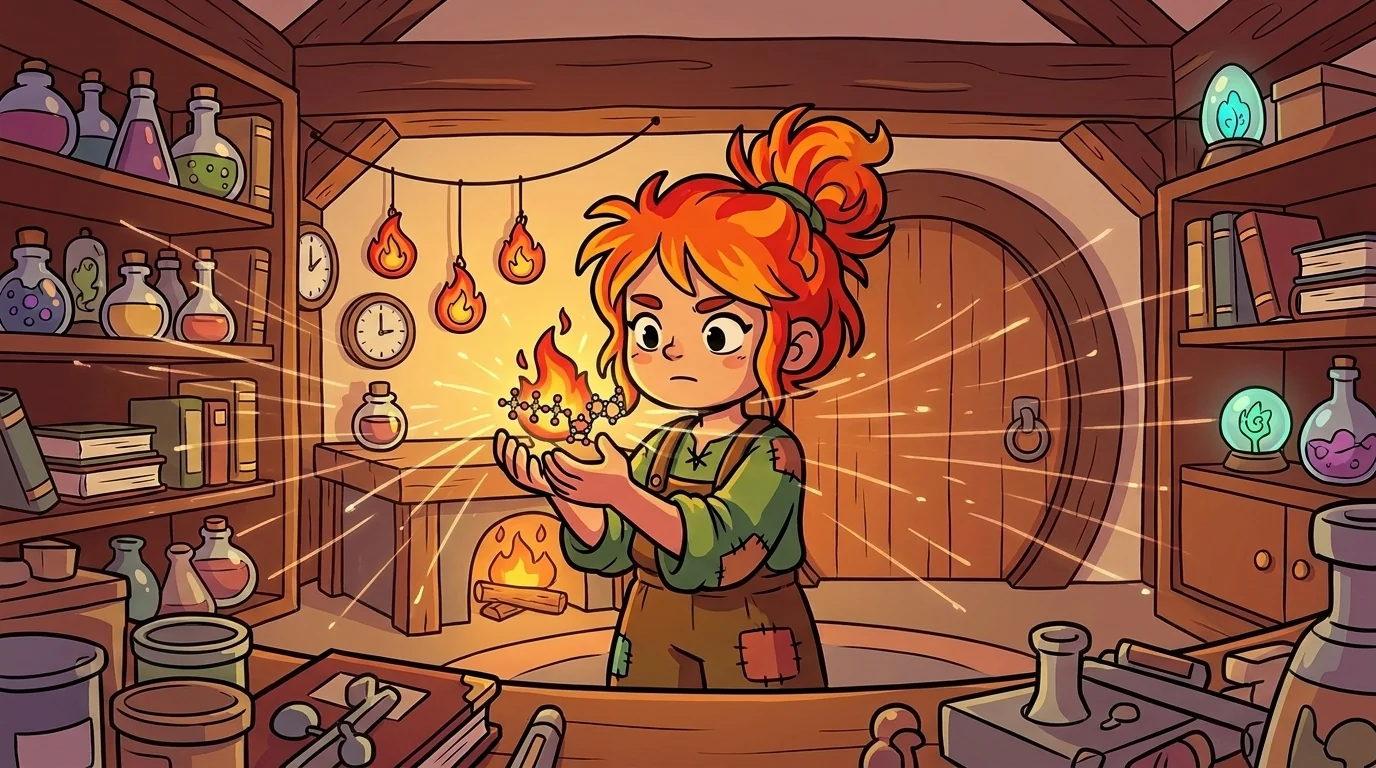
Phossa was small. Her fur was warm russet and cream. Her eyes were quick. She was always moving. She got excited very easily. Her flame-charm was her special thing. It was a small bronze disc. It looked like a flame. Years of Phossa fiddling with it had made it smooth. The charm caught the light whenever Phossa moved.
Her constant movement wasn't because she was nervous. It was just how she was made. It was her chemistry.
This was really important. Phossa showed everyone what *phosphorus (P) was all about. Phosphorus sits right under Nitra on the big element chart. It has five little helpers on its outside. Nitra has five too. But phosphorus* is a bit deeper. This means it can connect in more ways. It's super flexible.
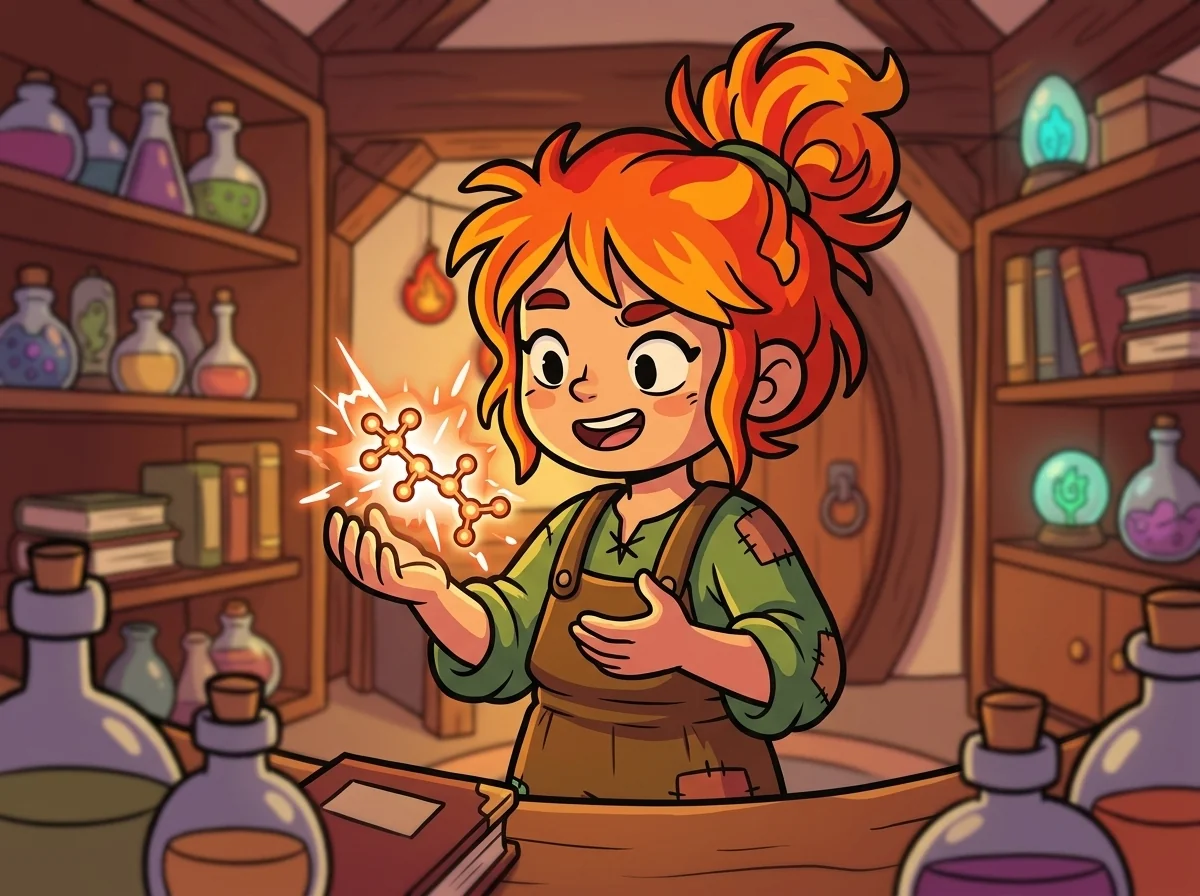
Think of ATP like tiny energy money. Every cell in your body uses it. ATP has three little energy packets all linked up. When your body needs power, it 'spends' one packet. That packet breaks off. POOF! Energy bursts out. This energy makes your cells work. It helps you move. It helps you think. Every muscle twitch, every nerve signal, every body reaction that needs energy uses ATP. The 'spark' of life is really just these *phosphate* connections being made and broken. Phossa's flame-charm shows this energy-flash. It's a tiny reminder.
*Phosphorus is also the spark in matches. There's a kind of white phosphorus (P₄) that reacts very fast with air. It just bursts into flame if it gets warm enough, around 30 degrees Celsius. Old matches used to light up when you rubbed them. That was because of phosphorus stuff inside. The 'spark' of phosphorus* isn't just a saying. It's real.
Phossa was very clear about this. "My restlessness is the chemistry," she would say. "I make three connections, like Nitra. Or I make five connections, like in your body's energy. Both ways are real. Right now, billions of me are in ATP molecules inside you. That's your energy money. Every move you make, every thought you think, uses ATP. I'm not nervous. I'm energetic because that's how I'm built."
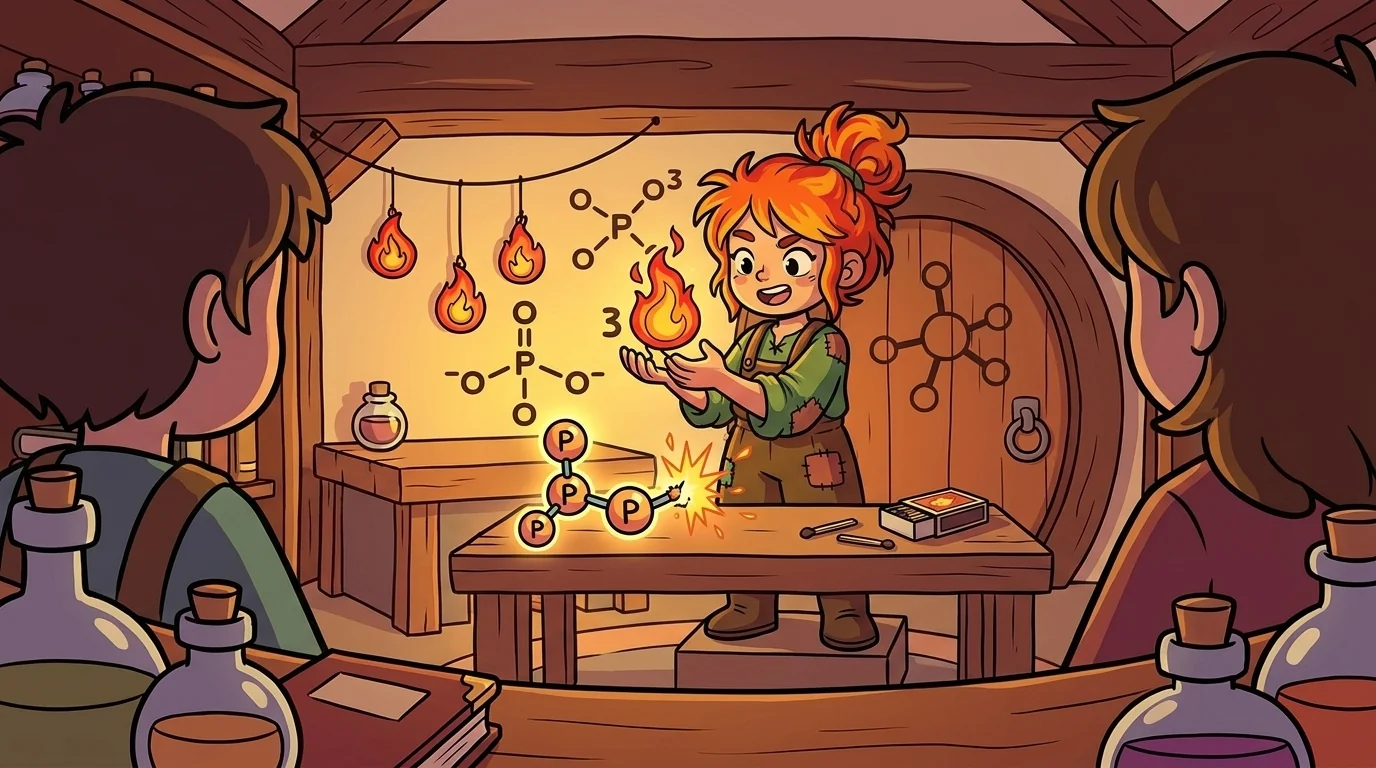
She scampered to the ChemQuest academy when she was twenty-two. Beaker asked her, "What is *phosphorus*?"
Phossa stood tall. "I sit under Nitra on the element chart," she said. "I make three or five connections. I'm flexible. I'm the energy money of life. ATP has three *phosphate* groups in a chain. Spending one part of that chain lets out energy. I'm also the spark in matches. I'm restless because that's how I'm made."
Beaker smiled. "You are appointed," he said.
In her workshop, Phossa starts every first lesson the same way. She flickers up to the front bench. Her movements are quick and small. She holds up her flame-charm. "I am Phossa," she says. "The chemistry primitive I teach is *phosphorus*. I am the energy spark. My move is three or five connections. Plus, I'm the ATP energy money. And the match-strike chemistry. I'm restless because I'm energetic. Both come from how my atoms can bend and connect."
She teaches these important *phosphorus* ideas:
Phosphorus makes three or five connections. (Three in PH₃ phosphine, which is a stinky gas. Five in phosphate PO₄³⁻, in ATP, and in the main part of DNA.) ATP is the energy money of life. (It's Adenosine plus three *phosphates. Spend one phosphate? Energy bursts out! You get ADP plus a single phosphate* bit. Your body recharges it to ATP. This happens trillions of times every second in your body.)
Tiny phosphorus bits make cell walls. (Phosphate-containing fat molecules form the double-layer walls around every cell.) White *phosphorus reacts very fast. (It catches fire by itself in the air. Lab safety is key here. This isn't for playing around in the kitchen. Only special labs use it.) *Phosphorus is important, but there's only so much of it. (We dig it up for farm food. People worry about having enough for farms in the future.) Don't just think of my personality. (Phossa's restlessness is really how her atoms can bend. Her 'spark' is the high-energy connections in ATP and white *phosphorus*.)
She is very clear. "Right now, in your body, billions of ATP molecules per second are spending their *phosphate* connections. This powers your cells. That's the spark of life. Without me, there would be no living things."
The ChemQuest ensemble
Phossa is part of ChemQuest's distributed-narrative cast. Each character embodies a different curricular primitive; together they teach the full subject.
-

Hydra
Hydrogen (H) — lightweight, ubiquitous, always paired up; buddy-system enthusiast
-

Carbo
Carbon (C) — connects to anything; the social atom; backbone of life
-

Oxy
Oxygen (O) — eager bonder; electronegative; the hungry grabber
-

Nitra
Nitrogen (N) — triple-bond loyal; slow-to-warm; locks in deeply once bonded
-
Sodi
Sodium (Na) — generous, impulsive; always giving away electrons
-

Chlora
Chlorine (Cl) — sharp, focused; the collector who finishes what Sodi starts
-

Helio
Helium (He) — noble gas; peaceful, floaty, complete; the contented onlooker
-

Sulfa
Sulfur (S) — earthy, dramatic; the stinky uncle of volcanoes and proteins
-

Magna
Magnesium (Mg) — bold, ceremonial; burns bright white; chlorophyll core
-

Silica
Silicon (Si) — patient, geometric; the architect who builds quietly
-

Alumi
Aluminum (Al) — practical, modest; the workhorse of cans and foil
-

Tugger
Ionic bond — forceful, decisive; full electron transfer; opposites attract
-

Sharer
Covalent bond — cooperative, balanced; equal partnership
-

Streamer
Metallic bond — flowing, communal; delocalized electron sea
-
Whisperer
Hydrogen bond — subtle, persistent; water's superpower; DNA pairing