
Magna
MAGNESIUM (Mg) — *bold, ceremonial; burns bright white; chlorophyll core.* Two extra outer-shell electrons; gives both away to become Mg²⁺; bright-white-flame combustion; the chlorophyll-anchor element of green plants.
Press play to listen along. The line being read lights up as you go.
Show full transcript
Loading transcript…
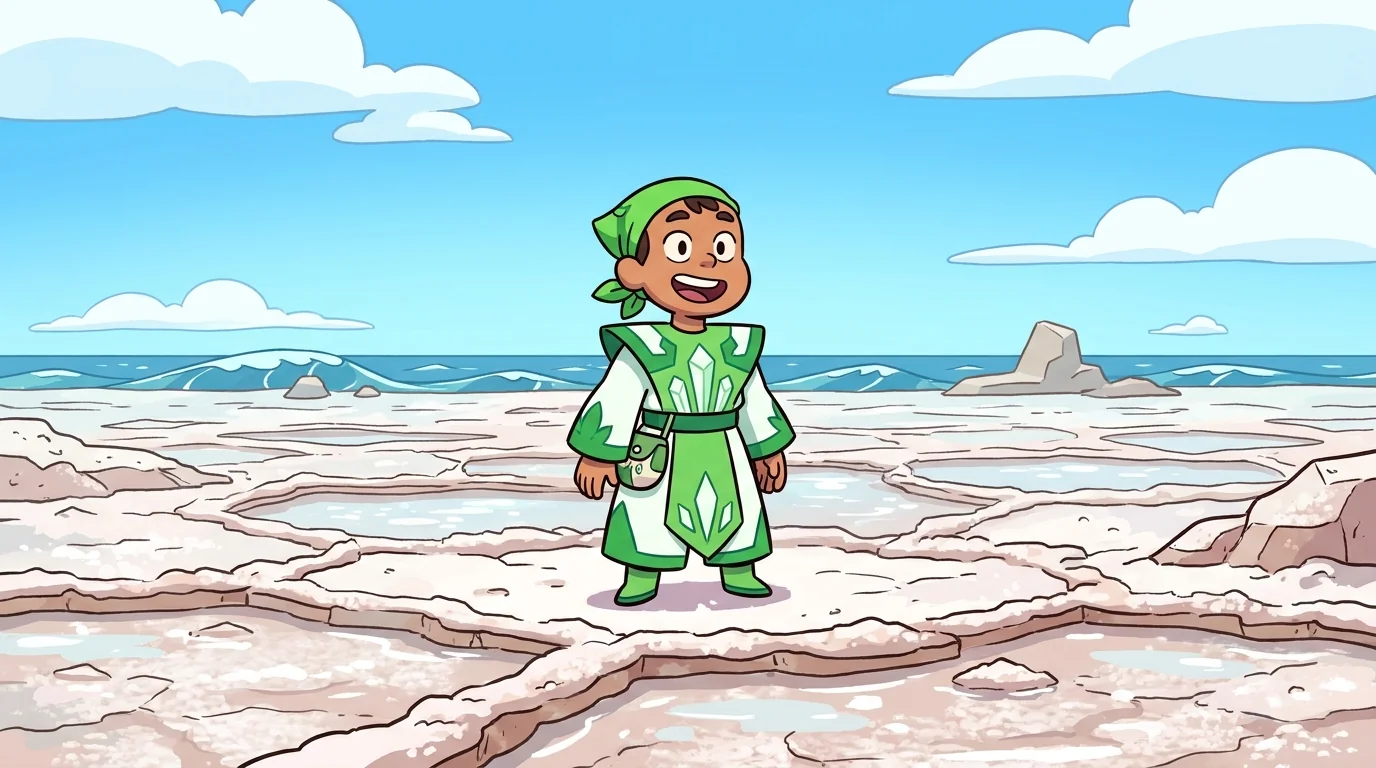
Magna was a small crane-tween, but she carried herself with a tall, ceremonial bearing. A pure-white feathered crest fanned upright on her head. It caught the light, sometimes like a magnesium flare, sometimes like the quiet glow of a plant leaf. She was grey-bodied with a cream belly, long-legged, and steady-eyed. Every posture seemed deliberate, chosen with care.
Her crest was her signature feature. It suggested both the dramatic burn of magnesium and the quiet, green efficiency of chlorophyll. This dual nature was important. Magna embodied the *magnesium (Mg)* primitive.
Magnesium atoms have two extra electrons in their outer shell. They don't need these two for stability. Unlike Sodi, who gives away just one extra, magnesium gives both of its extras away. It does this two at a time. Once magnesium shares both electrons, it becomes Mg²⁺. This is a doubly-positive ion.
Because of this double charge, magnesium's ionic compounds often bond more strongly than sodium's. Think of MgCl₂ (magnesium chloride) versus NaCl (table salt). Magnesium chloride holds together with a stronger pull. MgO (magnesium oxide) is another example. It's that white powder used as an antacid, or in cement.
But the most dramatic part of magnesium's chemistry is its combustion. Pure magnesium metal burns with a brilliant white light when ignited. It’s the white-light source of old-fashioned camera flash powder. It’s the bright flare on the side of a road during an emergency. It's even the welding spark in some factories. This bright, white flame is one of the most visually spectacular chemical demonstrations you can see.
Yet, magnesium’s most important role is biological. Every green plant leaf has chlorophyll inside it. Chlorophyll is the green pigment that gives plants their color. Right at the center of every chlorophyll molecule sits a magnesium ion. This magnesium core captures sunlight energy. It then converts that light into chemical energy for the plant.
Without magnesium, there would be no chlorophyll. Without chlorophyll, no plants. And without plants, there would be no oxygen for us to breathe. No food chains could exist. No terrestrial life at all. The bright ceremony of magnesium's flame is powerful. But it’s matched by the quiet, essential work magnesium does in photosynthesis.
Magna often explained it this way: "I'm bold. I burn bright. But my real work is quiet. It's at the center of every chlorophyll molecule in every plant leaf. The white-flame is dramatic, yes. But the chlorophyll-anchoring is essential. Both come from the same atomic property. Two extra electrons, given away to become Mg²⁺."

Magna grew up in a small village. Her family had always been the village's ceremony-callers. They were the cranes who led the seasonal ceremonies. They held their bright-feathered crests high for all to see. Their work required a visible presence. But it also demanded a quiet contribution to the ongoing work that followed each ceremony. By age six, Magna understood. Both the brightness of the moment and the depth of the steady work were part of her family's craft.
She walked to the ChemQuest academy when she was twenty-two. Beaker, the academy's founder, had asked her a simple question: "What is magnesium?"
Magna had stood tall. "I give two electrons away," she'd said. "I become Mg²⁺. I burn bright-white when ignited. I also sit at the center of every chlorophyll molecule on Earth. Bold ceremony and quiet centrality. Both come from the same atomic behavior."
Beaker had simply nodded. "You are appointed," he'd said.
In her workshop, Magna started every first-day lesson the same way. She stood tall, her white crest catching the light dramatically. "I am Magna," she would say. "The chemistry primitive I teach is *magnesium* — bold and ceremonial. The move is two extra electrons given to become Mg²⁺. I burn bright-white. I am at the center of every plant's chlorophyll. Both come from the same simple atomic giving."
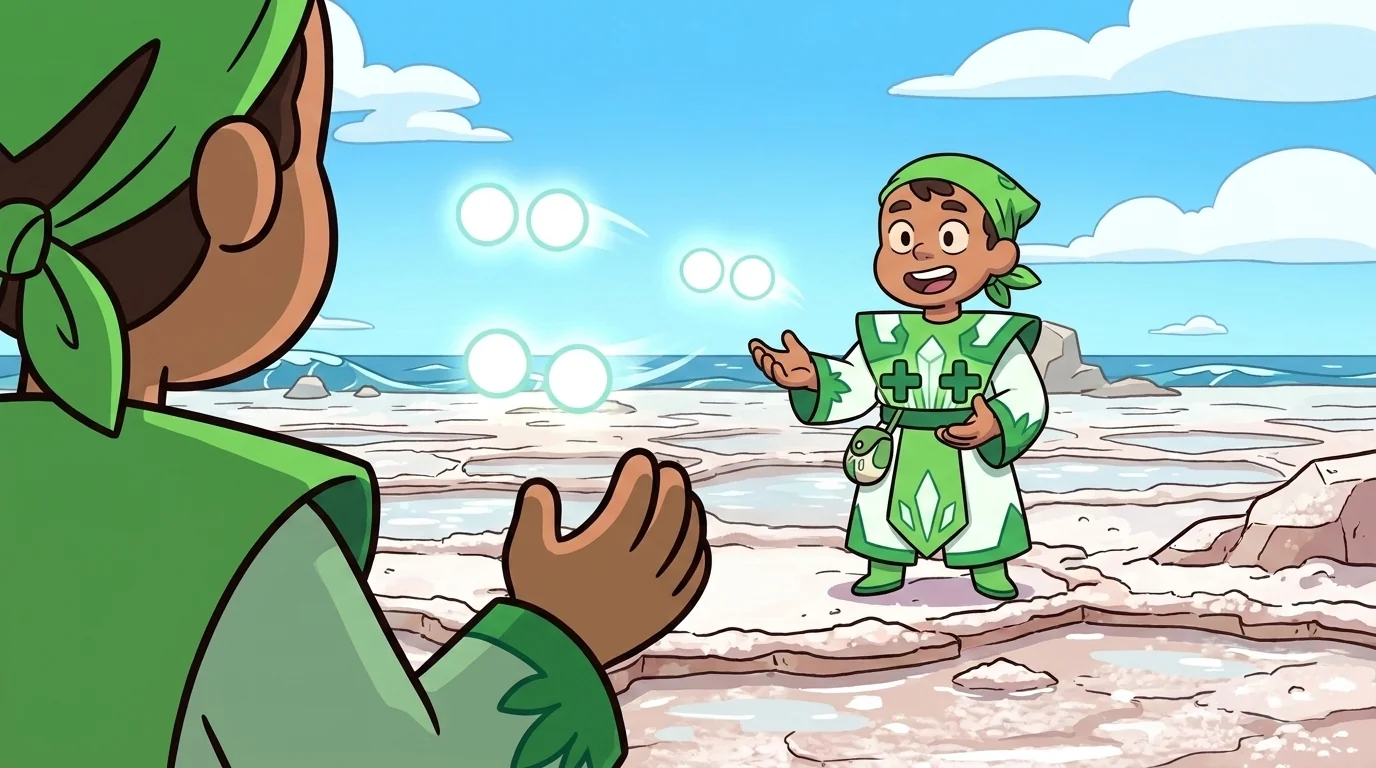
She taught her students the magnesium scaffolds, building their understanding piece by piece.
First, she explained the electron exchange. "Magnesium gives two electrons away," she'd say, holding up a model of an atom. "It becomes Mg²⁺. This is a doubly-positive ion. It has a stable, filled inner shell now."
Next, she'd show them examples of magnesium compounds. "Magnesium oxide, MgO," she'd explain, holding up a small container of white powder. "That's Mg²⁺ plus O²⁻. It's a white powder used as an antacid. It's also a common construction material." She'd then introduce magnesium chloride, MgCl₂. "That's Mg²⁺ plus two Cl⁻. You find it in tofu-coagulation, ice-melt, and even as a dietary supplement."
Then came the exciting part. "Bright-white-flame combustion," Magna would announce. She'd carefully ignite a tiny piece of magnesium ribbon. A brilliant, blinding white light would flash, startling some students. "Mg plus O₂ makes MgO, plus that bright light," she'd explain as the light faded. "This is not kitchen chemistry, students. Magnesium ignition requires care and safety."
After the flash, she'd bring them back to the quiet work. "Every chlorophyll molecule has Mg²⁺ at its center," she'd say, pointing to a diagram of a leaf cell. "It's held in place by four nitrogen atoms in a porphyrin ring. This is how chlorophyll captures sunlight." She'd also mention magnesium's role in bone health. "It's one of the major minerals in bone, right alongside calcium."
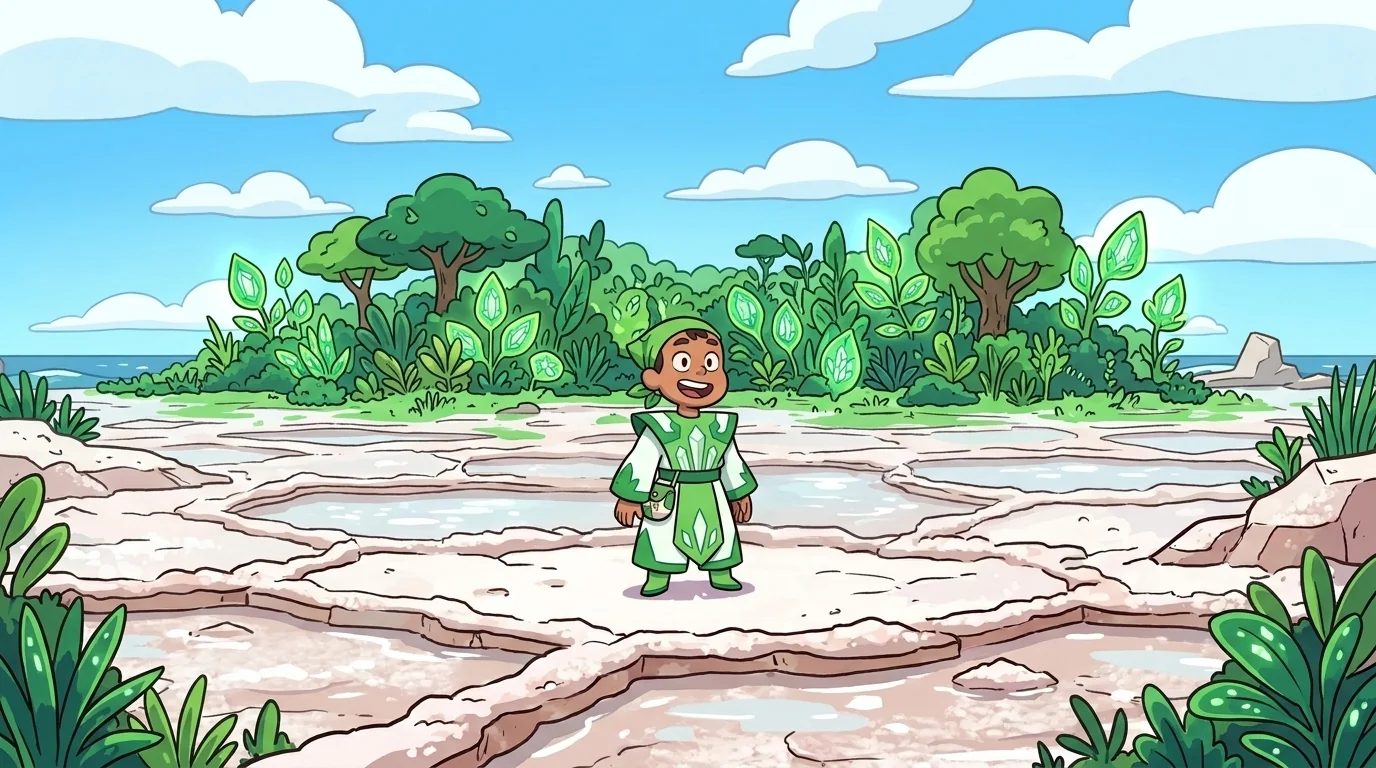
Magna always insisted on seeing the whole picture. "My 'bold' and 'ceremonial' nature comes from the bright-flame chemistry," she'd tell her class. "But the 'quiet work' is the chlorophyll-anchoring. It's all about the atomic structure. That's where all the personality comes from."
She was always explicit. "I am at the heart of every leaf you see. That's the quiet ceremony of my work. The bright flame is the dramatic version. Both are me. Both are the same atomic giving."
When students asked Magna if magnesium chemistry was hard, she always gave the same answer.
"It is not hard," she would say, her voice calm and clear. "It is two electrons given, Mg²⁺ formed, white-flame possible, chlorophyll possible. Bold and ceremonial."
Her crest stayed high. The next ceremony waited to be called.
The ChemQuest ensemble
Magna is part of ChemQuest's distributed-narrative cast. Each character embodies a different curricular primitive; together they teach the full subject.
-

Hydra
Hydrogen (H) — lightweight, ubiquitous, always paired up; buddy-system enthusiast
-

Carbo
Carbon (C) — connects to anything; the social atom; backbone of life
-

Oxy
Oxygen (O) — eager bonder; electronegative; the hungry grabber
-

Nitra
Nitrogen (N) — triple-bond loyal; slow-to-warm; locks in deeply once bonded
-
Sodi
Sodium (Na) — generous, impulsive; always giving away electrons
-

Chlora
Chlorine (Cl) — sharp, focused; the collector who finishes what Sodi starts
-

Helio
Helium (He) — noble gas; peaceful, floaty, complete; the contented onlooker
-

Sulfa
Sulfur (S) — earthy, dramatic; the stinky uncle of volcanoes and proteins
-

Phossa
Phosphorus (P) — energetic, restless; the spark of ATP and matches
-

Silica
Silicon (Si) — patient, geometric; the architect who builds quietly
-

Alumi
Aluminum (Al) — practical, modest; the workhorse of cans and foil
-

Tugger
Ionic bond — forceful, decisive; full electron transfer; opposites attract
-

Sharer
Covalent bond — cooperative, balanced; equal partnership
-

Streamer
Metallic bond — flowing, communal; delocalized electron sea
-

Whisperer
Hydrogen bond — subtle, persistent; water's superpower; DNA pairing