
Stead
SUBSTITUTION — putting a known value in the place of a variable, so an expression full of letters becomes a sum you can work out.
Loading audio…
Press play to listen along. The line being read lights up as you go.
Show full transcript
Loading transcript…

Stead spent fourteen years as an understudy at the grand theatre in the harbour district. An understudy is a person who learns another actor's whole part — every line, every step, every pause — so that if that actor falls ill, the understudy can step into their exact place and the play goes on.
It is a curious life. For most of it, you wait. You know the part perfectly, but the stage is not yours. Then one evening a message comes — the leading player has a fever — and suddenly you are pulling on their costume, standing in their mark on the stage, speaking their words, being, for one night, exactly where they would have been.
Stead was very good at it. The trick, she had learned, was to bring nothing of your own into the place you filled. You did not act your version of the part. You stood in the other player's stead and did precisely what the part required — the exact words, in the exact spot. The audience should not notice a change at all.
"You don't replace them with yourself," she would tell the younger understudies. "You put yourself where they stood, and you do exactly what that place asks. The place has a part to play. You just fill it, faithfully."
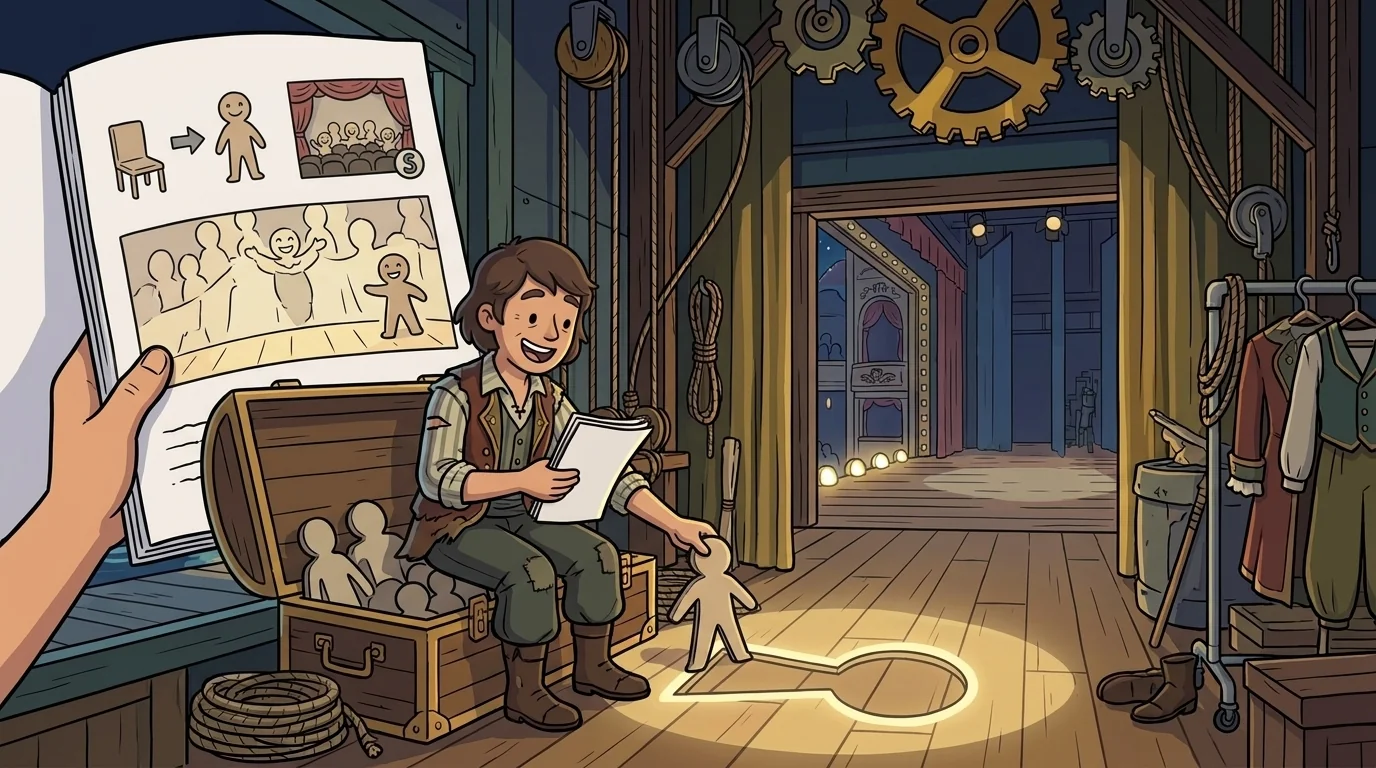
One night, after Stead had gone on for an ailing lead, a stagehand's daughter named Bit asked her how she managed to seem like a completely different person.
"I didn't become someone else," said Stead. "There was an empty place in the play — a spot marked for the lead. I stepped into that spot and did what the spot needed. The play didn't change. Only the person filling the place did."
Bit turned this over. "So the play had a... a hole shaped like a person," she said. "And you fit yourself into it, and it worked out to a whole play again."
"A hole shaped like a person," Stead repeated, delighted. "Yes. Exactly that." That night she wrote inside her script: A PLACE HELD OPEN. Step in, do what the place needs, and the whole thing works out.

After that, Stead saw held-open places everywhere — a seat kept for a guest, a blank in a form waiting for a name, a gap in a wall where one stone had fallen and any stone of the right size would do.
A year later the EquationQuest academy, which was forever trying to explain to children what the mysterious letter x actually was, heard of a theatre understudy who "stepped into a held-open place and made the whole thing work out." The academy master wrote to her. Stead, who had spent enough evenings waiting in the wings, accepted.

The board, Stead found, was a stage full of held-open places, each marked not with a chalk cross but with a letter.
She wrote on the board: 2x + 1.
"Here is a play with a place held open," she said, and tapped the x. "This x is not a number yet. It is a mark on the stage — a spot waiting for someone to step in. The play cannot finish until the place is filled." The children watched. "Now — suppose I tell you that today, x is 5." She wrote x = 5 to one side. "Then I do what an understudy does. I step 5 into the place where x stood."
She wrote it slowly: 2x + 1 becomes 2(5) + 1.
"The letter is gone. The 5 stands in its stead. And now it is only a sum: 2 × 5 = 10, then 10 + 1 = 11." She underlined the 11. "The scary letter became a plain number the moment something stepped into its place."
"So x was never really a mystery," said Bit's cousin, who was in the front row. "It was just a place waiting for a value."
"A place waiting for a value," said Stead. "That is the whole of substitution. You are handed a value, and you step it in."

She still watches the odd play from the wings, when the academy lets her, and still knows a dozen leading parts by heart, just in case.
At the academy she tells the children who are frightened of letters that a letter is not a monster and not a riddle. It is only a place held open on a stage — and the moment you are told what value belongs there, you step the value in, and the mystery becomes an ordinary sum you already know how to do.
"It isn't hard," she says. "It's just filling a place. Put the value where the letter stood, and work out what's left."
When the hall is empty and the board wiped clean, Stead sometimes stands for a moment in the centre of the room, on the spot where she teaches, and feels the quiet, sure gladness of a person who has spent her life stepping faithfully into places and making the whole thing work out. She would not have traded a single one of those evenings, held open in the wings, for anything.
The EquationQuest ensemble
Stead is part of EquationQuest's distributed-narrative cast. Each character embodies a different curricular primitive; together they teach the full subject.
-

Lever
Maintaining balance — do the same thing to both sides
-

Solo
Isolating the variable — moving everything else away from x
-

Undo
Inverse operations — addition ↔ subtraction, multiplication ↔ division
-

Spread
Distribution — multiplying across parentheses
-

Flipper
The sign-flip in inequalities when multiplying/dividing by a negative
-

Corral
Combining like terms — you can only add or subtract terms of the same kind; gather the like ones together
-

Leaven
Exponents — repeated multiplication; the small raised number counts how many times
-

Marshal
Order of operations — the agreed sequence for working an expression (PEMDAS)
-

Prise
Factoring — find the part two or more terms share and pull it out front