Prise
FACTORING — finding the part that two or more terms share and pulling it out to the front: 6x + 9 = 3(2x + 3). The reverse of distributing.
Loading audio…
Press play to listen along. The line being read lights up as you go.
Show full transcript
Loading transcript…

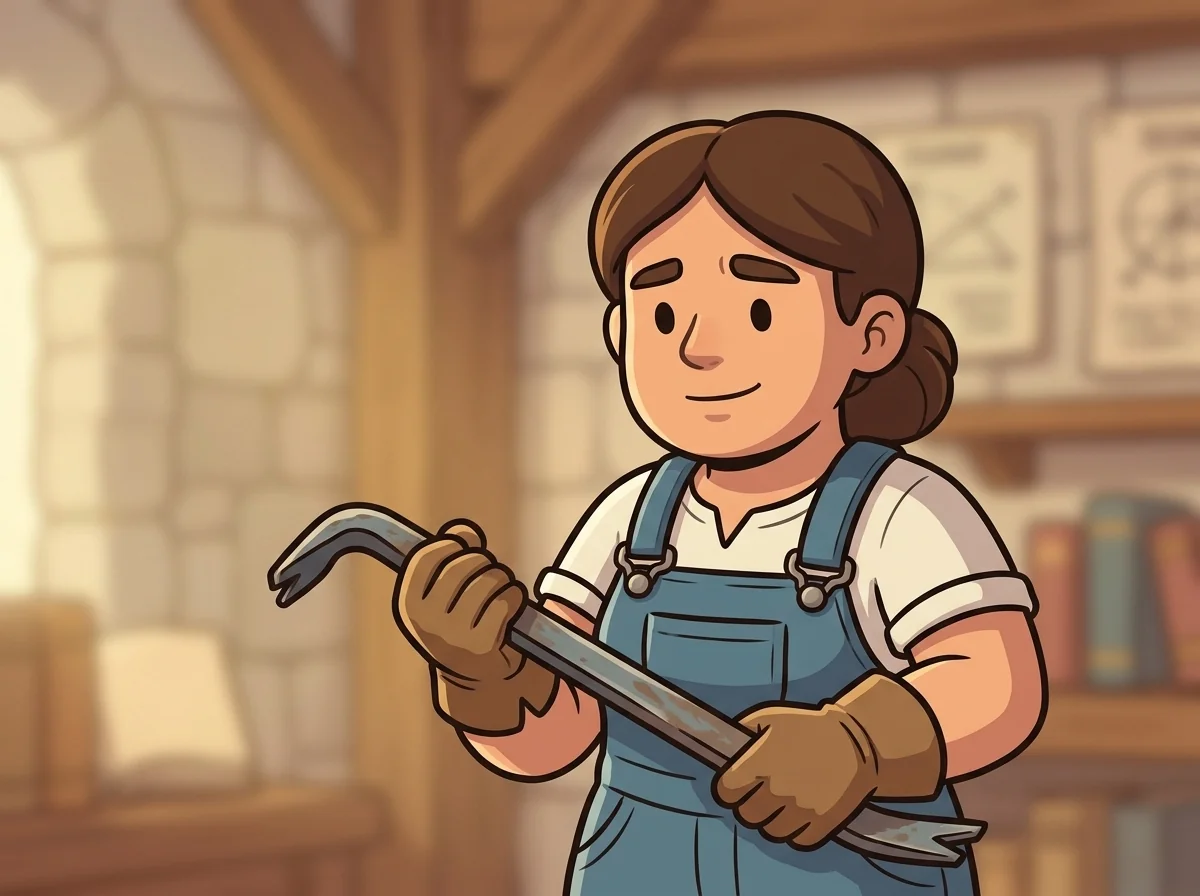
Prise worked, for thirteen years, on the busy docks of a river port, unloading the barges that came down from the upland farms. Every barge arrived stacked with crates, and every crate was strapped, roped, and nailed shut. Prise's tool was a pry-bar — a flat iron lever worn smooth by her hands — and her skill was in the prising.
She was not a strong worker so much as a careful one. She had learned that you did not force a crate; you found the place where it wanted to open, set the bar in the seam, and prised gently until it gave.
But the thing Prise became known for was quicker eyes than most. When six identical crates came off a barge, each strapped with the very same kind of rope, Prise did not cut six ropes one at a time. She saw at a glance that the six shared one thing — the same strap — and she prised all six straps loose together, in one clean pull, and set the shared rope aside to be re-used. The other dockhands hacked at each crate on its own. Prise found what they had in common, and pulled it out once.
"Look at what they share before you touch them," she would say, running her eye down a stack. "The shared part comes out first. Then the rest is easy."

One afternoon a young dockhand named Vell watched Prise clear a heap of mixed cargo and asked how she worked so much faster than anyone else.
"I don't work faster," said Prise. "I look first. See these two loads?" She pointed. "This one's six barrels. That one's nine barrels. But look —" she tapped the pallets — "both of them are stacked on the same size sledge. Three barrels to a sledge. So really it's two sledges here and three sledges there, and every sledge is the same. Pull the sledge out as the shared thing, and the whole pile makes sense."
Vell frowned, then brightened. "So instead of six and nine as two separate messes," he said, "it's three, shared — and then two of them and three of them."
"The shared three, pulled to the front," said Prise. That night she scratched inside her tool-chest lid: FIND WHAT THEY SHARE. Pull it to the front. Six and nine both share three — so it's three of (two and three).
After that, Prise saw shared parts in everything — two recipes that both began with the same broth, three songs built on the same three chords, a row of houses all raised on the same kind of stone. Underneath what looked separate, there was so often one thing held in common, waiting to be pulled to the front.
A year later the EquationQuest academy, which wanted someone who could teach children to tidy an expression back down after it had been spread out, heard of a dockworker who "found what a heap shared and pulled it out in one pull." The academy master wrote to her. Prise, who was ready to trade the river damp for a warm hall, accepted, and brought her worn pry-bar with her.
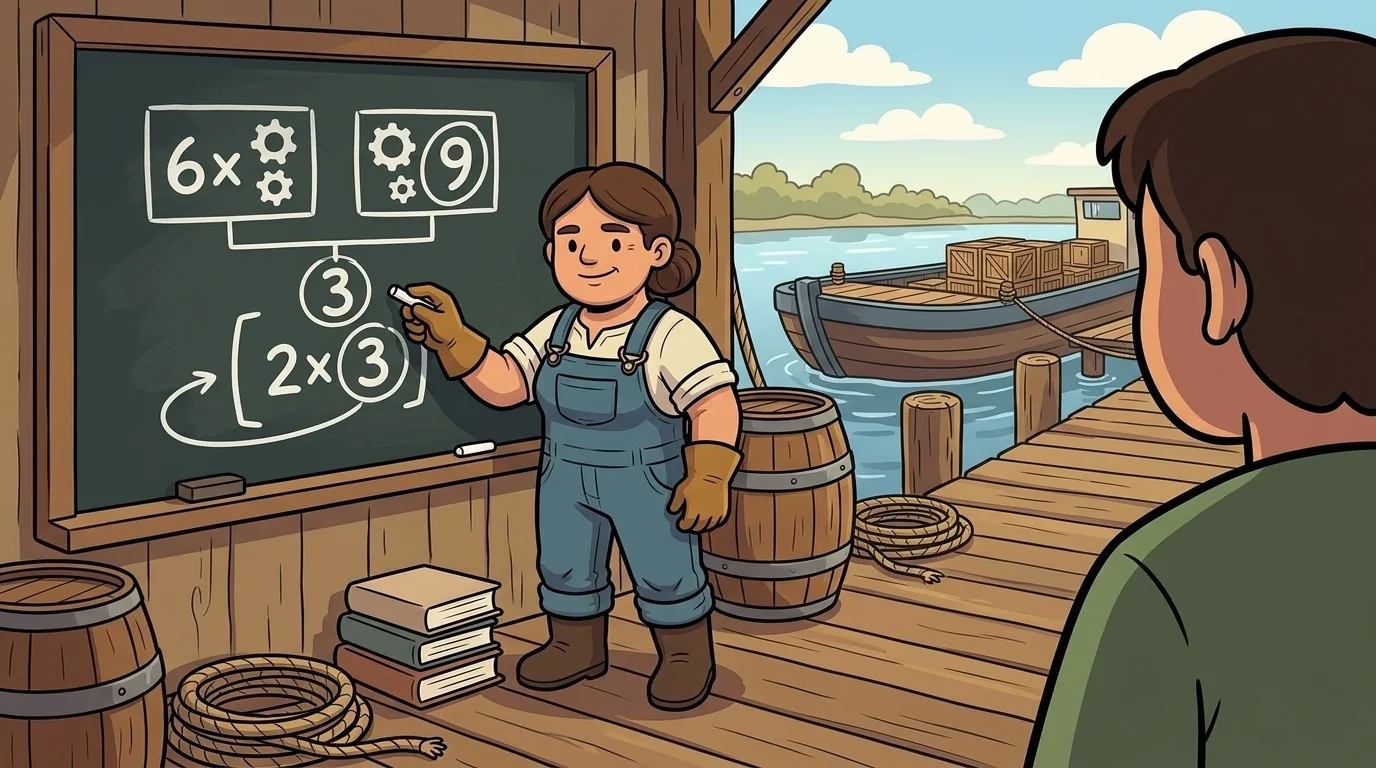
The board, Prise found, was a dock with the crates rubbed out and numbers written in. And numbers, like crates, so often shared a part.
She wrote on the board: 6x + 9.
"Two loads," she said. "6x here, 9 there. They look separate. But look at what they share." She circled the numbers. "6 is 3 × 2. 9 is 3 × 3. Both of them carry a 3. The three is the shared strap." She set her chalk like a pry-bar against the expression. "So I prise the 3 out to the front, and write what's left inside brackets: 6x + 9 becomes 3(2x + 3)."
She checked it aloud, the way she checked a crate had really opened: "3 × 2x = 6x. 3 × 3 = 9. Yes — it's the same load, only tidier. The shared three, pulled to the front, and the rest tucked in the brackets."
"That's just the roller run backwards," said Vell's cousin, who had learned from Spread. "Spread rolls the three across. You prise it back out."
"Exactly backwards," said Prise, pleased. "Spread spreads. I gather. Same seam, opposite pull."
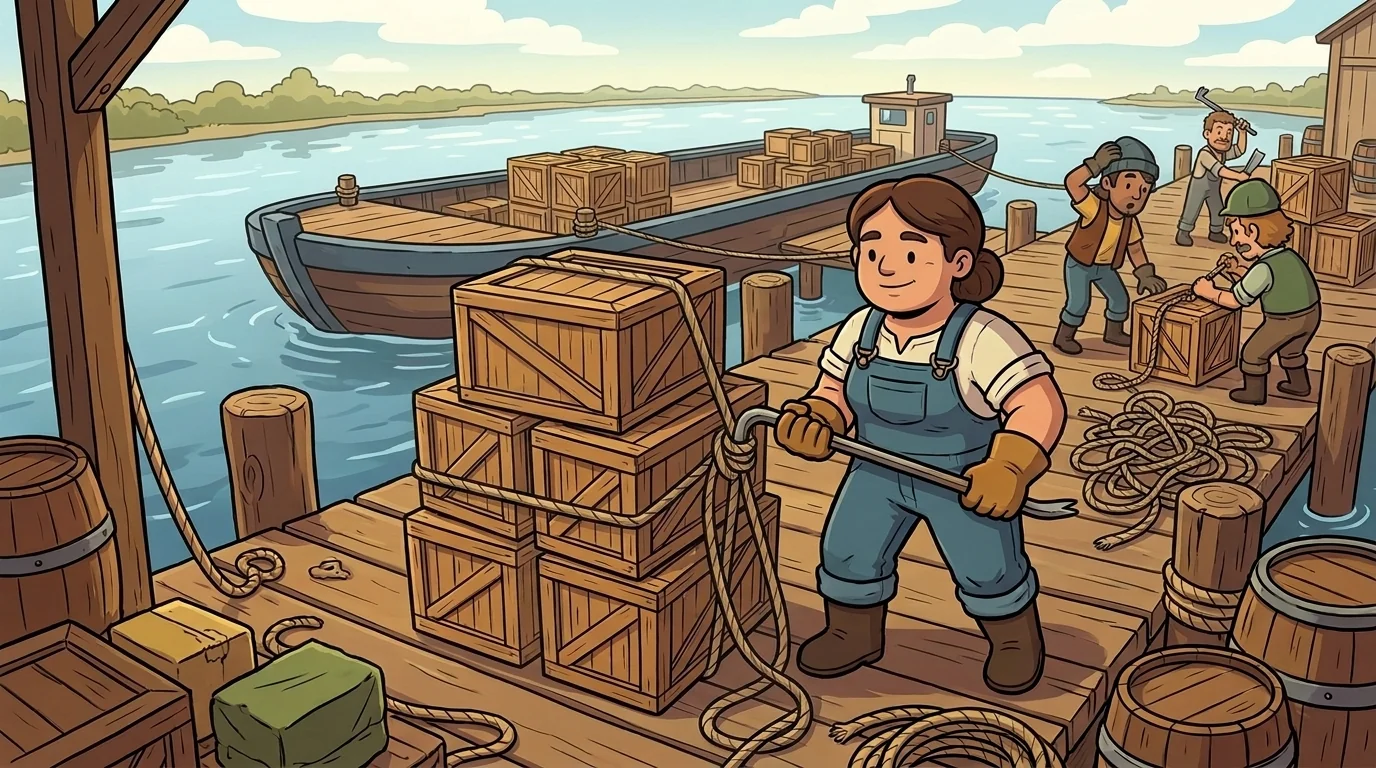
She still visits the docks when the academy can spare her, and the young hands still call her over for a stubborn crate.
At the academy she tells the children that factoring is not a new and frightening thing. It is only what she did on the docks every day — looking at a heap of separate-seeming parts, finding the one thing they quietly share, and prising it out to the front so the rest falls simple.
"It isn't hard," she says. "It's just looking first. Find what they share. Pull it to the front. The rest comes easy."
When the hall empties, Prise runs her thumb along the smooth worn edge of her old pry-bar, and feels the steady, useful gladness of a person who has spent her life finding what things have in common. It is a quiet kind of gladness, and it has never once let her down.
The EquationQuest ensemble
Prise is part of EquationQuest's distributed-narrative cast. Each character embodies a different curricular primitive; together they teach the full subject.
-

Lever
Maintaining balance — do the same thing to both sides
-

Solo
Isolating the variable — moving everything else away from x
-

Undo
Inverse operations — addition ↔ subtraction, multiplication ↔ division
-

Spread
Distribution — multiplying across parentheses
-

Flipper
The sign-flip in inequalities when multiplying/dividing by a negative
-

Corral
Combining like terms — you can only add or subtract terms of the same kind; gather the like ones together
-

Leaven
Exponents — repeated multiplication; the small raised number counts how many times
-

Marshal
Order of operations — the agreed sequence for working an expression (PEMDAS)
-

Stead
Substitution — put a known value in place of a variable, then simplify