Build
BUILD — *the first version is supposed to be bad. make it. show it. learn from it.*
Listen along — Build
Loading audio…
Press play to listen along. The line being read lights up as you go.
Show full transcript
Loading transcript…
Chapter 3 — Build and the Bad First Draft
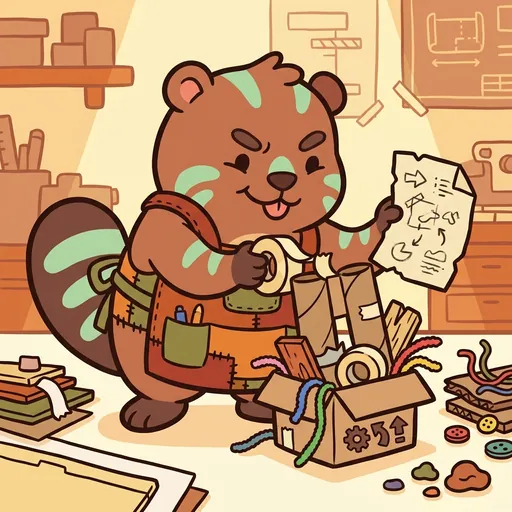
In the corner of the workshop, a beaver-tween named Build was gluing a cardboard box to a broken umbrella and grinning like it was the best idea anyone had ever had.
It was not the best idea anyone had ever had. It was, honestly, a mess. The box sagged. The umbrella wouldn’t stay open. A little pile of tape scraps was building up around Build’s feet like snow.
Another kid stopped in the doorway. “What is that?”
“It’s a rain-shade for a market stall,” Build said, not looking up. “Or it will be. This one’s the bad version.”
“Then why are you making it?”
“Because the bad version is the only way to find out why it’s bad.” Build set the umbrella-box thing on the bench and tapped it. It wobbled, then flopped sideways. “See? The base is too light. I didn’t know that a minute ago. Now I do.” Build was already reaching for a heavier piece of wood. “That’s not a fail. That’s the whole reason I built it.”
The kid frowned. “So you wanted it to flop?”
“I didn’t want it. But I wasn’t scared of it.” Build finally looked up, warm-pine-brown fur dusted with cardboard fluff. “The first version is supposed to be bad. You make it. You show it. You learn from it. Then the next one is a little less bad.” A grin. “Do that enough times and eventually you’ve got something people actually want. But you can’t skip the flopping part. Nobody can.”
Build hadn’t always been so easy about the flopping.
There’d been a spring fair, a couple of years back, where Build spent three whole weeks in secret building a “perfect” toy boat to sell. Sanded smooth. Painted twice. Not shown to a single soul, because it wasn’t ready yet — and if it wasn’t ready, someone might laugh.
On fair day Build set the boat in the pond. It rolled over and sank in four seconds. The hull was beautiful and completely the wrong shape.
Build stood there with a wet, ruined boat and a hot, tight feeling climbing up from the stomach, the kind that says everyone saw, everyone knows, you should have hidden it better. Three weeks. Gone.
An older maker — a slow, kind otter who ran the fair’s craft tent — crouched down beside the sad little boat. She didn’t say it was fine. She said, “Three weeks, and you never floated it once?”
Build shook their head, miserable.
“So you learned the hull was wrong on the very last day, in front of everyone.” She turned the boat over gently. “If you’d floated a rough one on day one — no paint, no sanding, just to see — you’d have known in four seconds instead of three weeks. And nobody would’ve been watching yet.”
Build blinked. “But it would’ve looked terrible.”
“It would’ve looked early,” she said. “Early isn’t terrible. Early is just honest about not being finished.” She smiled. “The bad ones aren’t the enemy. Hiding is the enemy.”
Build didn’t fix the boat that day. But the hot, ashamed feeling loosened into something lighter — almost curious. Show it early. Let it flop where it’s cheap to flop. Somehow that made the whole thing possible to try again.
Build came to VentureQuest at twelve, drawn to a place that treated making-and-testing like a real craft instead of a thing to be ashamed of.
Ledger, who ran the workshop’s quiet planning corner, met Build at the bench and asked one question. “How do you know if an idea’s any good?”
Build didn’t answer with words. Build grabbed a strip of cardboard, folded it into a little cup with a handle in about a minute, and held it out — crooked, bent, obviously thrown together.
“That’s not finished,” Ledger said, testing.
“It’s not supposed to be.” Build set it down. “It’s finished enough to show someone and ask, ‘would this even help you?’ If they say no, I’ve spent one minute and a scrap of cardboard finding out — instead of a month building the fancy version of a thing nobody wanted.”
Ledger looked at the crooked little cup for a long moment, then nodded slowly. “Fast and honest beats slow and secret,” Ledger said. “You belong here.”
Build’s corner of the workshop filled up with rough, half-finished things — and kids who slowly stopped being embarrassed by them.
A girl named Spot came in one afternoon, slumped. She’d sketched a whole plan for a plant-watering gadget but hadn’t built any of it. “I don’t want to make it yet,” she said. “What if it’s bad?”
Build knew that slump exactly. The boat. The pond. The four seconds.
“Listen talked to some gardeners, right? What’d they actually struggle with?”
“Carrying little seedlings around without dropping them,” Spot said.
Build was already pulling cardboard, tape, and a scrap of cloth off the shelf. “Then let’s make it bad, three ways, right now.” Twenty minutes later there were three lumpy things on the bench: a cardboard caddy with a floppy handle, a cloth pouch, a tiny wheeled cart that leaned to one side.
Spot winced. “They look so… bad.”
“They are bad.” Build beamed. “That’s why we’re not going to guess which idea is best — we’re going to ask. We show all three to the gardeners and let them tell us which bad thing is closest to useful. Then we make the better version of that one.” Build lifted the caddy; its handle drooped. “Costs us a scrap of cardboard and an afternoon. Guessing wrong costs us weeks.”
Spot picked up the leaning cart, turned it over, and — almost without meaning to — found the wheel that was on backwards. “Oh. That’s why it leans.”
“See?” Build said softly. “You just learned that in two seconds. It didn’t cost you anything but a little cardboard. That’s not a fail. That’s you, being wrong on purpose, so you don’t have to be wrong later where it’s expensive.”
Spot laughed, and set the cart down more gently than she’d picked it up.
Later, when the others had gone, Spot stayed behind with a quieter question.
“When you show someone the bad version,” she said, “and they don’t like it… doesn’t that just feel like you’re bad?”
Build thought about the pond. The three secret weeks. The hot, tight feeling that had said you should have hidden it.
“It used to,” Build admitted. “I hid things for the longest time, trying to make them perfect first, so nobody could laugh. And every single time, hiding just meant I found out too late — big and painful, all at once.” Build ran a thumb over a soft, dented piece of cardboard. “But when you show a rough one early, and someone says ‘this bit doesn’t work’… they’re not talking about you. They’re just handing you a clue. Free. That’s not embarrassing. That’s the best gift there is.”
Spot nodded slowly, and Build watched the shy, hidden hunch come out of her shoulders — the same way, at a pond, years ago, Build’s own had.
Build didn’t say the rest out loud, but felt it, warm and steady: the messiest, most unfinished thing on the bench is usually the bravest one there. It’s not hiding. And that’s what makes it lighter to carry.
The VentureQuest ensemble
Build is part of VentureQuest's distributed-narrative cast. Each character embodies a different curricular primitive; together they teach the full subject.
-
Spot
Opportunity recognition — noticing problems worth solving for real people
-

Listen
Customer discovery — asking + waiting + watching, never guessing
-

Pitch
Pitch craft — plain-language story, inviting people in, never pressuring
-

Weigh
Ethical decision-making — sitting with tradeoffs, holding stakeholder views