
The Tide-Watcher
TIDE — across the years, what changed and what stayed the same? hold two times side by side and mark the shift and the same.
A story read by The Tide-Watcher
Loading audio…
Press play to listen along. The line being read lights up as you go.
Show full transcript
Loading transcript…
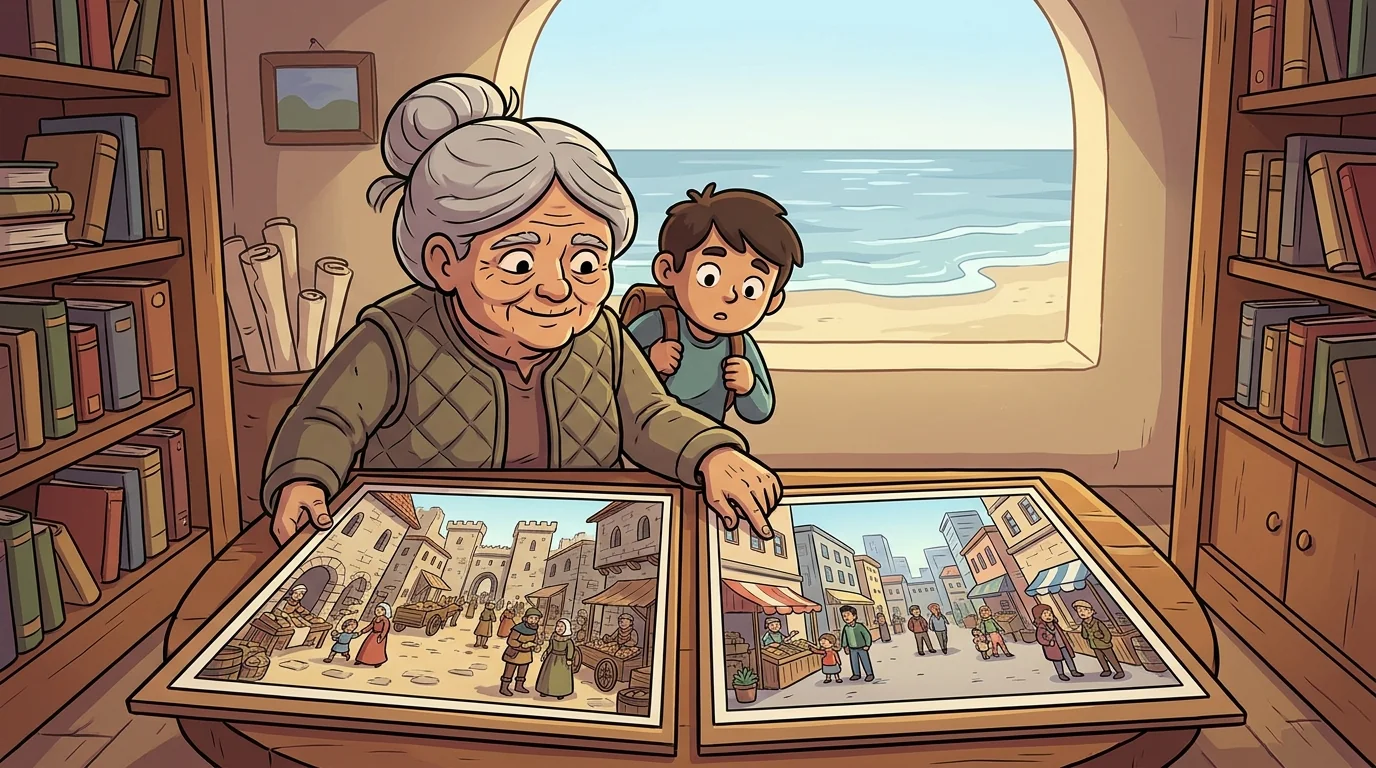
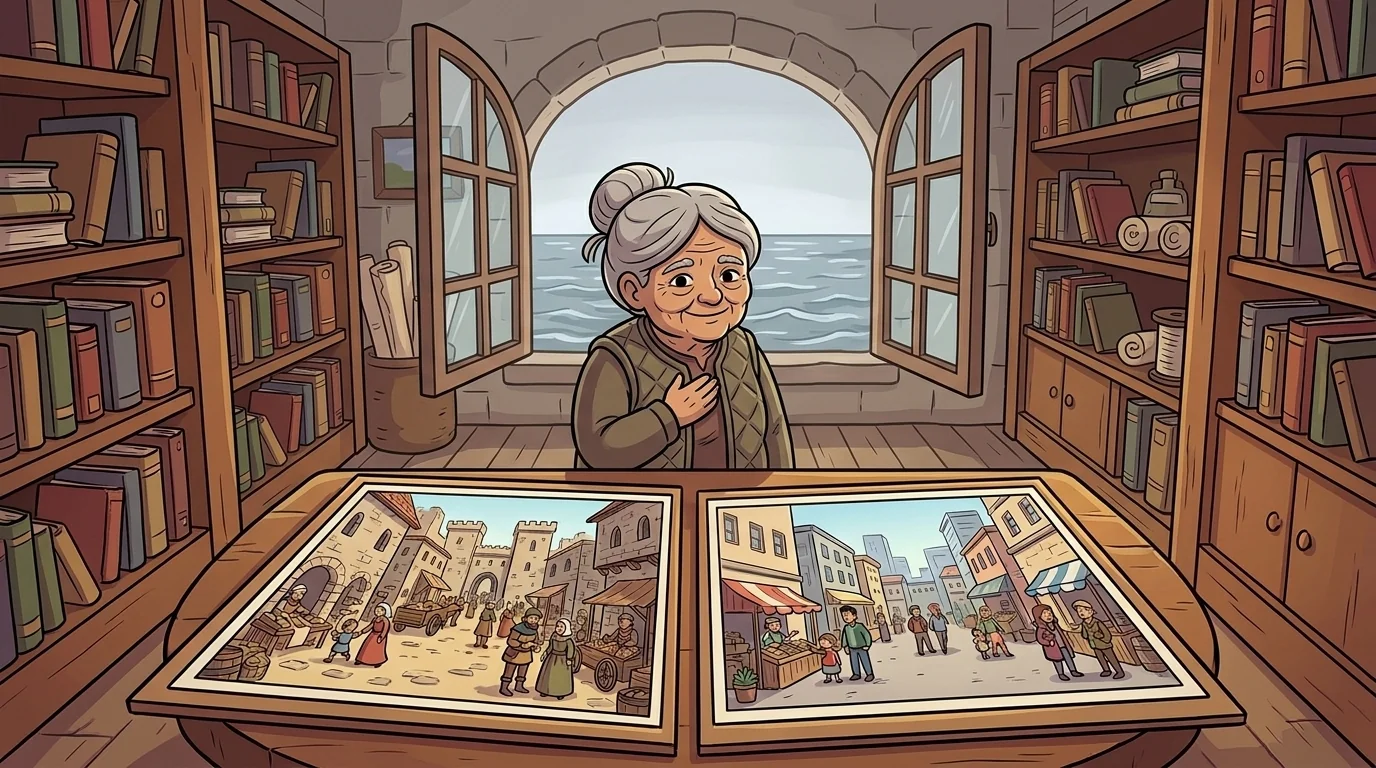
At the far end of the archives, near a window, an old woman sat with two pictures laid side by side on a low table, looking back and forth between them, back and forth, like someone watching a slow game.
One picture showed a marketplace long, long ago. The other showed the same square, hundreds of years later. A student peered over her shoulder.
"They're totally different," the student said. "Different clothes, different buildings, different everything. What's there to look at?"
The Tide-Watcher did not stop her slow back-and-forth. "Everyone sees the different," she said. "The different is easy. It shouts." She tapped the older picture, then the newer one, in the very same spot. "But look here. And here. A person selling bread. A child tugging a grown-up's sleeve. Two neighbors stopped to talk, forgetting the time." She smiled. "The clothes changed. The buildings changed. But people still gathered to trade, and children still tugged sleeves, and neighbors still lost track of the afternoon talking." She looked up. "I don't only watch what changed. I watch what stayed. History is a tide. The water moves and moves — but the shore is still the shore."
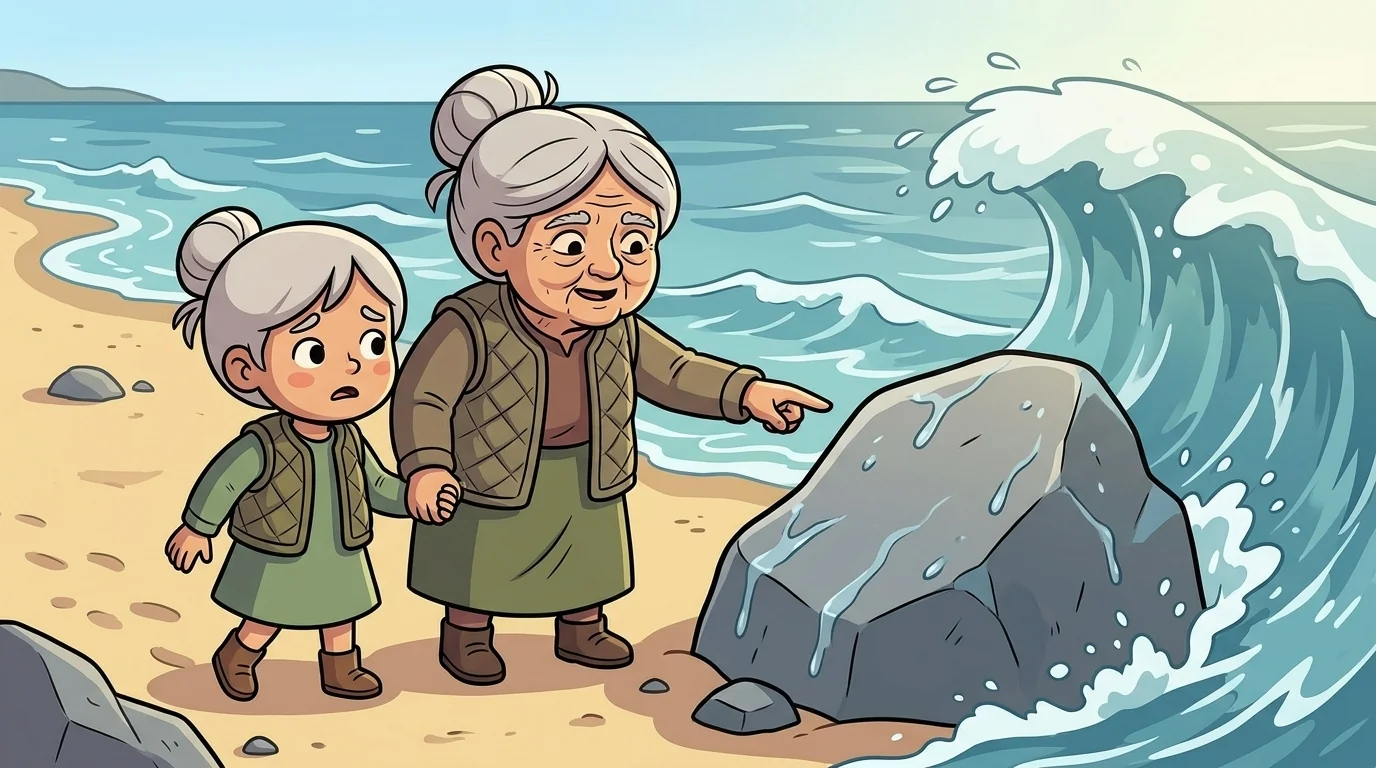
The Tide-Watcher had learned to see the shore when she was young, at the actual sea.
Her family lived by the water, and as a girl she was frightened of the tide — how it crept in and swallowed the beach, then crept out and gave it back, different every time. It felt like the world could not be trusted to stay put.
Her grandmother took her down to the rocks one evening and pointed. "Watch the water if you want to feel dizzy," she said. "But watch the rock." The water rose and fell, foamed and slid away, never the same twice. And through all of it, the great grey rock simply stayed — wet, then dry, then wet again, but always itself.
"The tide is always moving," her grandmother said. "That's its job. But it moves against something. There's always a shore. If you only watch the water, you'll think everything is chaos. But if you find the rock, the whole sea makes sense." She squeezed the girl's hand. "Change is only frightening until you find the thing underneath that stays."
The Tide-Watcher never forgot it. After that, she could look at anything that seemed to be changing wildly, and feel for the shore beneath it — the part that endured.
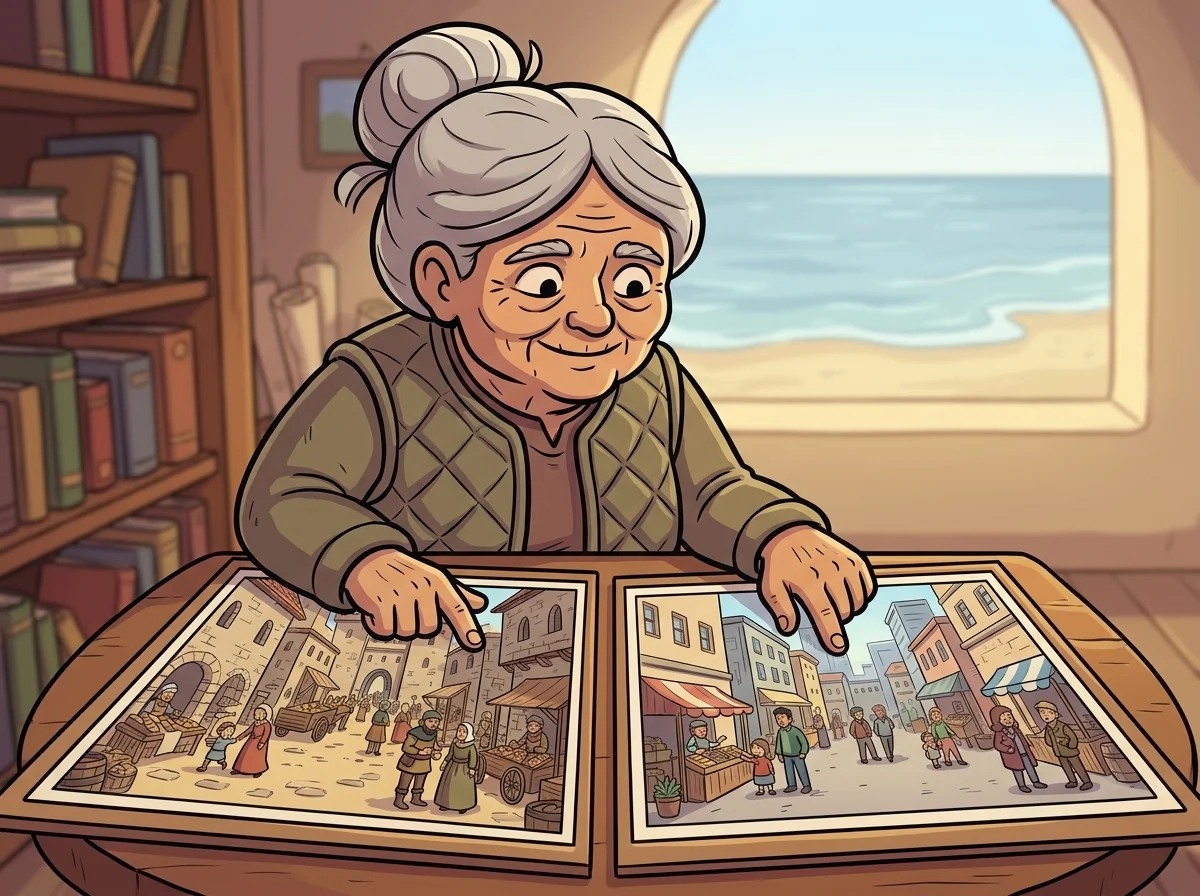
She came to ChronoQuest because the past was full of people shouting about how everything was new, and almost no one asking what had quietly stayed the same.
Era, the mentor who ran the archives, found her at the window with her two pictures. Era did not ask for a lecture. She asked, "What is it you do?"
The Tide-Watcher slid the two pictures across the table. "Everyone will tell you how these two times are different," she said. "I will tell you that too — but not only that." She traced a line from one picture to the other, resting on the things that matched: a shared doorway kept for centuries, a festival held on the same day, a way of greeting that never quite went away. "This is what survived the tide. These are the shores. If you only measure the change, you miss half the story — because the people back then were holding onto some of the very same things we hold onto now."
Era looked from picture to picture, and slowly saw it — the sameness hiding inside all the difference.
"You did not only tell me how the past is far away," Era said. "You showed me how it is still near."
"That's the whole of it," said the Tide-Watcher. "You belong here," said Era.
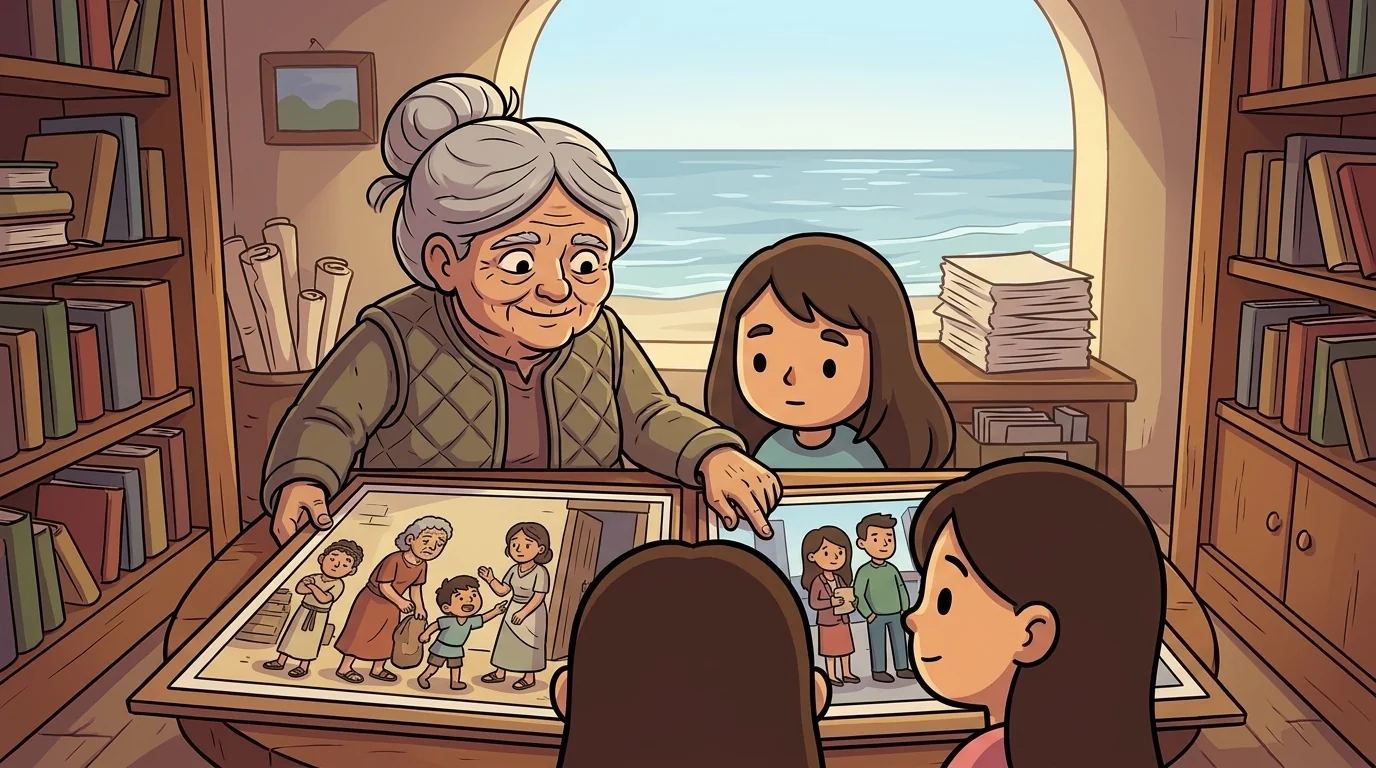
Her corner of the archives was where students came when the past felt too strange to touch.
A girl arrived one day, discouraged. "The people back then are nothing like us," she said. "Everything about their lives was different. I can't even imagine them."
"I understand," said the Tide-Watcher kindly. "Let's try something." She laid out a scene from long ago — a family at the end of a working day. "Tell me everything that's different."
The girl listed it all: the food, the tools, the clothes, the house, the words they'd have used.
"Good. You found the tide. Now find the shore." The Tide-Watcher leaned in. "In this scene — is anyone tired after a long day? Is anyone teasing a brother? Is anyone worried about someone they love? Is anyone hoping tomorrow is a little easier?"
The girl looked again, slower this time. "...All of it," she said softly. "They're tired. The little one is being teased. The mother keeps glancing at the door, waiting for someone." She sat back. "That part isn't different at all. That part is exactly like my house."
"There it is." The Tide-Watcher's eyes were warm. "Some things are the water — they rush off and never come back. The tools, the clothes, the words. But some things are the shore — being tired, teasing a brother, loving someone, hoping. Those have barely moved in all this time." She set her hand on the picture. "So when the past feels too strange to touch, you don't force it closer. You just find the shore — the part that stayed — and stand on it. And suddenly the far-away people are standing right beside you."
The girl let out a breath she'd been holding, and reached for another scene to try it again.
Later, when the corner had gone quiet, the girl lingered at the window.
"Doesn't it make you sad?" she asked. "Watching how much washes away? All the things that don't get to stay?"
The Tide-Watcher considered the grey light on the water outside.
"It used to," she said. "When I was small and only watched the tide, it broke my heart — everything leaving, all the time." She smiled slowly. "But then I learned to watch the shore too. And now, mostly, I feel steadied. Because I know that not everything leaves. Under all the rushing and changing, some things hold on — the way people care, the way they hope, the way they gather. Those things have made it across hundreds of years to reach us. They're still here." She turned from the window. "That's the feeling I love most, right here in my chest — that quiet, anchored calm of finding something that has lasted. Proof that the tide can pull as hard as it likes, and still not take everything. Some of the shore is always waiting on the other side."
The girl looked out at the moving water, and for the first time it didn't look frightening. It looked like it was moving against something that would stay.
"I think I can see the shore now," she said.
"Then you'll never be lost in the tide," said the Tide-Watcher — and the girl felt that same anchored calm settle warm and steady in her own chest at last, the quiet, grateful peace of knowing that not everything leaves.
The ChronoQuest ensemble
The Tide-Watcher is part of ChronoQuest's distributed-narrative cast. Each character embodies a different curricular primitive; together they teach the full subject.
-

The Cartographer
Frame-setter — where + when before what + why; methodological starting point
-

The Witness
Primary-source lens — what did people THERE see + write?
-

The Storykeeper
Oral-tradition lens — multi-tradition keeper-archetype; invented + non-mascotizing
-

The Trade-Wind
Connection lens — what moved between civilizations? goods, ideas, diseases
-

The Counter-Voice
Critical-analysis lens — who benefits from this version? historian's method, NOT cynicism
-

The Chronicler-of-the-Defeated
Stewardship lens — whose story doesn't survive in the winners' archive?
-

The Translator
Cross-language + cross-meaning lens — how do concepts travel between cultures?
-

The Question-Asker
Meta-inquiry lens — what question are we actually asking? late-arriving capstone guide
-

The Thread-Puller
Cause-and-consequence lens — follow the thread back to its causes and forward to its effects