Mass
AIR MASSES + FRONTS — warm vs cold, moist vs dry. Air masses move; when they meet, the boundary is the front; fronts produce weather.
Listen along — Mass
Loading audio…
Press play to listen along. The line being read lights up as you go.
Show full transcript
Loading transcript…
Chapter 2 — Mass and the Front-Line Map
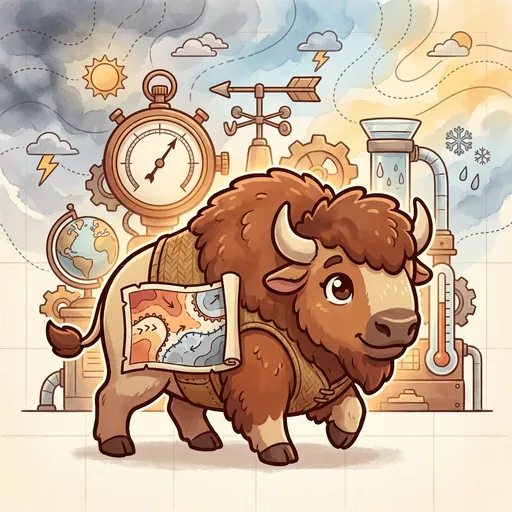
Mass stood at the edge of the school field with her nose in the wind and her folded map still in her pocket, reading the sky the way other bison read a book.
A boy skidded up beside her, out of breath. “The teacher says it’s going to storm. But look —” he pointed at the wide blue afternoon. “There’s nothing up there. She’s guessing.”
“She’s not guessing,” Mass said. “She’s watching the seam.” She wet a hoof and held it up. The breeze on the field was warm, damp, a little heavy — the kind of air that made your shirt stick to your back. “Feel that? Warm and wet. That’s the air sitting on us right now. A big soft blanket of it, all the same, stretching for miles.” She turned to face the far hills, where a thin line of cloud lay low and grey. “But over there — that’s a different blanket. Cold and dry. And it’s walking this way.”
The boy squinted. “Blankets of air?”
“Big chunks of it,” Mass said. “Each chunk shares a mood — a temperature, a wetness. You’re standing inside one right now. When a new one shoves in, the weather changes.” She traced a slow line in the air where the warm and the grey would meet. “That seam, where they push against each other — that’s the front. That’s where everything happens.” She smiled, patient. “The blue up there? That’s just the calm before the two of them meet.”
By evening, the storm rolled in exactly along the line she’d drawn. The boy watched from his window and thought about seams.
Mass had learned to read the seam long before she had a map for it.
She grew up in a village where her family watched the herds — great slow rivers of cattle drifting across the seasonal pastures. As a small calf she’d trot beside her grandfather at the back of the drive, and he’d point at a herd on a far hill and say, “Watch how it moves as one, little Mass. Not a hundred cattle. One big thing.”
One grey morning two herds drifted toward the same valley from opposite ends, and six-year-old Mass felt her stomach knot. She could see it coming — the crowding, the noise, the two masses about to collide — and nobody else seemed worried. She tugged her grandfather’s coat, throat tight. “They’re going to crash into each other. Something bad’s going to happen right there.” She jabbed at the gap between them.
Her grandfather didn’t tell her to calm down. He crouched beside her and looked where she was pointing. “You feel it too,” he said, almost proud. “That heavy, about-to-happen feeling. Right in the middle, where they’ll meet.” He nodded slowly. “That feeling isn’t fear, exactly. It’s noticing. The two herds won’t just blend — they’ll press, and things will happen along the line between them. If you keep your eyes on that line, you’ll know what comes next before anyone.”
The herds met. They milled and split and settled. Nothing bad happened at all — but Mass had been right about where to look. The tight, watchful feeling in her chest had a use now. It wasn’t dread. It was a compass, pointing her at the seam.
She walked to the WeatherForge academy when she was older, because a place that studied the sky ought to understand the kind of thing that moved in great slow blankets and met along lines.
Gale, who ran the academy, met her at the gate and asked one question. “What are air masses and fronts?”
Mass didn’t reach for the map. She reached for the memory. “Air comes in big chunks,” she said. “Each chunk has a mood — warm or cold, wet or dry. They drift slow, like herds. And when two of them meet, they don’t just mix.” She held her two hooves apart, then pushed them toward each other until they touched. “They press. And along the line where they touch, the warm one climbs up over the cold one, and all that lifted-up wetness turns into clouds and rain.” She held the touching line steady. “That line is the front. That’s where the weather is.”
Gale looked at her hooves a long moment. “You are appointed,” he said.
Mass’s classroom was full of maps, and one autumn a girl came in scowling at hers.
“I don’t get it,” the girl said. “The whole thing’s just colored blobs and squiggly lines. How’s anyone supposed to know it’ll rain?”
Mass unfolded her own map on the workbench and set the girl’s beside it. “Put your finger where you live.”
The girl did. It landed in a wash of pale orange.
“That’s the air sitting on you today,” Mass said. “Warm-ish. Now — see this blue coming in from the side, with the little triangles on the edge?”
“Yeah.”
“That’s a cold chunk, marching toward your finger. The triangles are teeth — they point where it’s headed. That toothed line is the seam. The front.” She slid the blue blob until its teeth nudged the girl’s fingertip. “When those teeth reach you, the cold shoves under the warm, the warm shoots up fast, and —” she snapped her fingers ”— sharp storm, then clear skies behind it.”
The girl leaned in. “And the red one? With the little bumps?”
“Warm chunk catching up to cold. Gentler. It slides up slow instead of shoving, so you get long, steady rain — hours of grey drizzle, not one big crack of thunder.” Mass tapped both lines. “That’s the whole trick. Find your chunk. Find the seam coming at it. The kind of seam tells you the kind of weather.” She sat back. “It’s not blobs and squiggles anymore, is it?”
The girl was already tracing a front-line with her finger, mouthing sharp, then clear. “It’s a story,” she said. “You just have to read the seam.”
“You just have to watch where they meet,” Mass agreed.
Later, when the room had emptied, the girl came back with a smaller question, her voice quieter.
“What if you’re wrong?” she said. “What if you say the storm comes at three and it comes at five?”
Mass thought about the valley, and two herds, and her grandfather crouched beside her.
“Then I was a couple hours off,” she said gently. “The chunks are big and slow, but they’re alive — they wander, they slow down, they change their minds a little. So I don’t promise you certain. I promise you watchful. I tell you which seam is coming and roughly when, and then I keep my eyes on the line.” She folded the map, corner over corner, the way you fold something you trust. “The best part isn’t being right to the minute. It’s that feeling — the one you get when you can sense the two of them about to meet, and you know exactly where to look. That heavy, held, here-it-comes feeling in your chest.”
The girl nodded slowly, and Mass watched the scowl melt into something steadier — the same quiet, watching feeling she’d carried out of a grey valley long ago, warm and certain under her ribs.
The WeatherForge ensemble
Mass is part of WeatherForge's distributed-narrative cast. Each character embodies a different curricular primitive; together they teach the full subject.