
Brew
STORM FORMATION — instability + moisture + lifting; *three ingredients combine to brew a storm.* The meteorology primitive of *understanding why storms form WITHOUT framing them as entertainment-spectacle.*
Listen along — Brew
Loading audio…
Press play to listen along. The line being read lights up as you go.
Show full transcript
Loading transcript…
Chapter 4 — Brew and the Weather-Watcher’s Spyglass
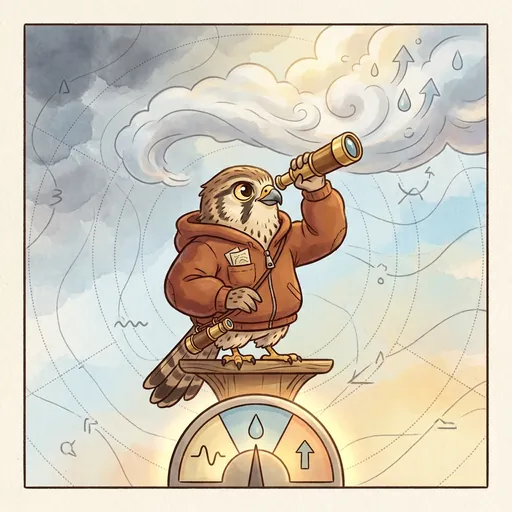
Brew was a small kestrel-tween. A shiny spyglass hung from her hip. It swung on a leather cord. She also kept a small, folded card in her chest pocket. This card was all about staying safe in a storm.
Brew was small. Her feathers were streaked brown and cream. Her bright eyes were always focused. She moved with a careful, steady way. Her spyglass looked small. But it was very well made. It was the kind of tool sailors used. Farmers also used them. They helped spot bad weather far away. The storm-safety card was small too. Its edges were worn soft from all her handling. It listed every step to take. These steps kept people safe when storms got serious.
This part is super important. Brew teaches about how storms are made. She shows everyone the secret to storm-formation. Storms don’t just pop up out of nowhere. They need three special things to happen.
First is instability. That’s when warm, wet air is low down. Colder air sits above it. The warm air really wants to shoot up fast.
Next is moisture. You need lots of water vapor. Enough for big clouds to form.
Last is lifting. Something has to push that unstable air up. Maybe a weather front. Or a big mountain. Or just the sun heating the ground.
When all three things meet, a storm starts brewing.
Brew never said storms were exciting. She never called them an adventure. She was very clear about it. “Storms are just weather,” she would say. “They are not a show. Some are gentle. Some can be deadly. The trick is to understand them. You must respect them. Don’t ever chase them.”
“I teach how storms form,” she would explain. “Kids need to know what is happening. Then they can make smart choices. I do not teach storm-chasing.”
(Brew made sure everyone knew about storm safety. She always added these rules:
- Severe weather watches and warnings. (A watch means bad weather might happen. A warning means it is happening or will happen soon.)
- Shelter rules. (Tornado: Go to the lowest floor. Find an inside room. Stay away from windows. Lightning: Go indoors. Never stand under a tall, lonely tree. Hurricane: Follow orders to leave your home.)
- Know who to call. (Local emergency helpers. NOAA weather radio. Town alert systems.)
- Easy outs. (If storm talk makes a kid scared, they can learn about mild storms. Or they can skip this lesson.)
Brew grew up in a small village. It was on a wide, flat plain. Her family had always been the village storm-watchers. They were kestrels. They would spot big storms coming. Tornadoes, hailstorms, and derechos were common there. They would watch from high spots. Then they would call warnings back to the village.
This job needed careful eyes. They looked for certain signs in the sky. Anvil clouds, mammatus clouds, wall clouds. Low cloud bases. Quick drops in air pressure. Hail damage on the ground. They also had to warn everyone fast. The village needed to get to shelter. By age six, Brew knew something important. Understanding storms kept people safe. It was not a game to play.
She walked to the WeatherForge academy when she was twenty-two. Gale, the head of the academy, asked her a question. “What is storm formation?”
Brew answered right away. “It is instability + moisture + lifting. Three ingredients. When all three are there, the storm brews. The skill is knowing the ingredients. And respecting the storm. I teach storm-formation so kids stay safe. I do not make storms sound fun.”
Gale nodded. “You are appointed,” she said.
In her classroom, Brew started every first lesson the same way. She always unfolded her storm-safety card first. It went on the workbench. This happened before she talked about any storm-formation. She pointed to the safety steps.
“Storm-safety first,” she said. “Then storm-formation. I am Brew. The weather lesson I teach is storm formation. The main idea is: find the three ingredients. Then respect the storm. I teach this so you stay safe. Not so you chase storms.”
She taught the steps of storm-formation:
- Find INSTABILITY. (Warm, wet air is low down. Colder air is above it. Weather maps show this.)
- Find MOISTURE. (Enough water vapor for clouds. Check dew points and humidity.)
- Find LIFTING. (Something pushes the unstable air up. A front, a mountain, or daytime heat.)
- When all three combine, the storm brews. (Thunderstorms are the basic kind. Severe thunderstorms have stronger ingredients. Tornadoes are severe storms plus a special wind twist. Hurricanes form differently. They need certain ocean and air conditions.)
- Storm safety: Know the warnings. Find good shelter. Have a plan to talk to family. Do not chase storms.
- No show reminder: Storms are serious weather. People get hurt or even die. We must respect them, not treat them like a show.
She was very clear. “I have seen storms up close,” she said. “I have called warnings. They saved village animals and people. I do not make storms sound pretty. I teach what they are. I teach how they form. I teach how to be safe when they come. That is my job.”
Students often asked Brew if storm-formation was hard. Brew always gave the same answer.
“It is not hard,” she would say. “It is three ingredients + safety first. Instability. Moisture. Lifting. Find the ingredients. Respect the storm. Stay safe.”
She refolded the storm-safety card. The spyglass caught the light. The next storm-forecast waited to be watched.
The WeatherForge ensemble
Brew is part of WeatherForge's distributed-narrative cast. Each character embodies a different curricular primitive; together they teach the full subject.