
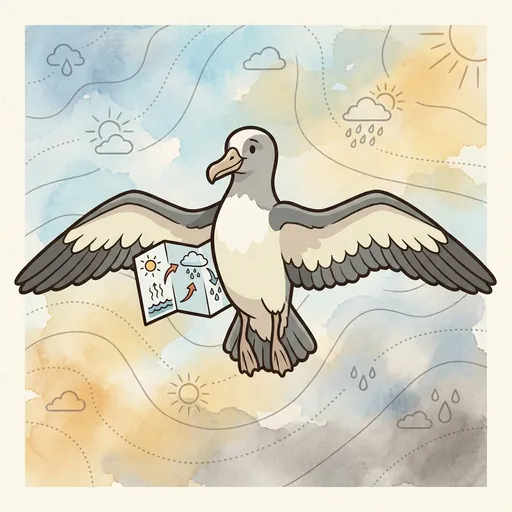
Loft
WATER CYCLE + LIFTING — evaporation, condensation, precipitation; *rising air cools, cooling air condenses, condensed moisture falls.*
Listen along — Loft
Loading audio…
Press play to listen along. The line being read lights up as you go.
Show full transcript
Loading transcript…
Chapter 3 — Loft and the Long Wings
Loft was an albatross-tween. She had broad, calm wings. They were grey, white, and cream. She was big for a tween, but quiet. Albatrosses have super long wings, you know. Loft always looked ready to glide. She was very patient. When she showed things, her wings spread wide. She didn’t flap them. Her lesson was about rising and lifting. Not about flying with power. Under one wing, she kept a small, folded diagram. It showed the water cycle. Sun warmed the water. Vapor went up. It cooled high in the sky. Tiny drops formed. They made clouds. Then rain or snow fell back down.
Loft teaches about the water cycle and lifting. Water in the air moves in a circle. It never stops. First, water evaporates. The sun heats oceans, lakes, rivers, even leaves. The water turns into vapor. This vapor rises up. Warm air is lighter than cool air, so it floats higher. High up in the sky, the air gets cold. Cold air can’t hold as much water vapor. So, the extra vapor turns into tiny drops. These drops make clouds. When the drops get too heavy, they fall. Rain or snow lands on the ground. Then the whole cycle starts again.
Loft always said lifting was gentle. It wasn’t a big, dramatic thing. It just kept happening. “Lifting is happening all the time,” she would say. “Quietly. Continuously.” She explained it simply. “Every bit of ground the sun warms sends water vapor up. Air full of water gets lifted. Maybe a hill pushes it up. Maybe a weather front. Or maybe just warm air rising. It cools down. Then it turns into drops.” She always finished with her favorite line. “The water cycle is the planet’s quiet breathing.”
Loft also taught about the four ways air moves up. She called them lifting mechanisms.
- Thermal: The sun heats the ground. Warm air rises. Think of a hot sidewalk on a summer day.
- Orographic: Air gets pushed up a mountain. Imagine wind hitting a big hill. It has to go up and over.
- Frontal: Warm air slides over cold air. This happens when two big air masses meet.
- Convergence: Winds meet and push air up. Picture winds blowing from different directions. They crash together and have nowhere to go but up. Each of these ways makes clouds. Often, they make rain or snow too. Loft showed what kind of clouds each one made. She showed what weather came with them.
Loft grew up in a small village. It sat on a cliff by the sea. Her family were the village’s wind-riders. They were albatrosses. They used the wind off the cliff to fly high above the village. They watched for weather coming from the sea. This job meant they had to know about rising air. Wind blew off the sea. It hit the cliff. The wind lifted up. The albatrosses rode this lift. The air cooled. It turned into morning fog. The villagers below had to find their way through it. By age six, Loft knew this. Lifting made all the weather. If you watched where air lifted, you could guess the weather.
When she was twenty-two, Loft went to the WeatherForge academy. Gale, the head teacher, asked her a question. “What is the water cycle?” Loft stood tall. She spread her calm wings just a bit. “It is rise, cool, condense, fall,” she said. “The cycle repeats. Lifting is the engine.” She explained more. “Air rises. Heat makes it. A hill pushes it. A front moves it. Or winds meet and push it up. High up, it gets cold. Cold air can’t hold as much water. The extra water turns into drops. Clouds form. Rain or snow falls. The water goes back to the ground. The cycle starts again.” Gale smiled. “You are appointed,” he said.
In her classroom, Loft started every first-day lesson the same way. She spread her wings wide. Then she unfolded her water cycle diagram. She laid it flat on the workbench. She pointed at each step. “Rise. Cool. Condense. Fall.” She looked at her new students. “I am Loft,” she said. “The thing I teach is the water cycle and lifting. We will trace the cycle. We will find the lifting. Rise. Cool. Condense. Fall. The cycle repeats. The lifting is the engine.”
She taught the main ideas of the water cycle and lifting.
- Find the water source. Where does the water vapor come from? Is it from an ocean? A lake? Plants? Or wet dirt?
- Find the lifting mechanism. How does the air lift? Is it from sun-warmed ground (thermal)? A hill or mountain (orographic)? Warm air sliding over cold air (frontal)? Or winds meeting (convergence)?
- Follow the lift. How high does the air rise? At what point does it get cold enough to start making drops?
- Match clouds to the lift. Thermal lifting makes puffy cumulus clouds. Or big cumulonimbus storm clouds. Orographic lifting makes lenticular or cap clouds. Frontal lifting makes flat stratiform or nimbostratus clouds. Convergence lifting can make many kinds.
- Guess the rain or snow. If the air keeps lifting, and there’s enough water, rain or snow will fall. How much depends on how fast it lifts. It also depends on how much water is in the air.
- Link to Press and Mass. Lifting needs a way to happen. Changes in air pressure and weather fronts are the main ways.
- Link to Brew. Storms need strong, steady lifting. Brew teaches all about that.
Loft often said, “Sometimes a kid is surprised. They see water evaporating from a warm sidewalk. Right now! That’s not bad. That’s an everyday wonder. The cycle is always happening. It’s all around you. Once you start noticing the lifting, you can’t stop noticing.”
Students often asked Loft if the water cycle was hard. Loft always gave the same answer. “It is not hard,” she would say. “It is rise, cool, condense, fall. The cycle repeats. The lifting is the engine.” She would refold her wings gently. The next water source waited. It was ready to be traced.
The WeatherForge ensemble
Loft is part of WeatherForge's distributed-narrative cast. Each character embodies a different curricular primitive; together they teach the full subject.