
Loft
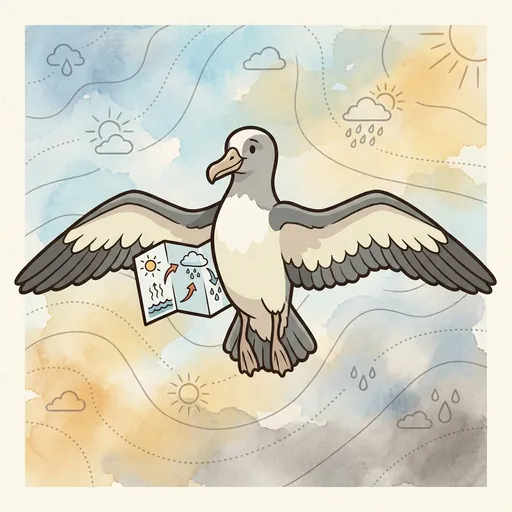
WATER CYCLE + LIFTING — evaporation, condensation, precipitation; *rising air cools, cooling air condenses, condensed moisture falls.*
Listen along — Loft
Loading audio…
Press play to listen along. The line being read lights up as you go.
Show full transcript
Loading transcript…
Chapter 3 — Loft and the Long Wings
Loft stood at the front of the WeatherForge classroom, her broad, calm wings spread just slightly, catching the light from the high windows. She was a small albatross-tween with broad calm wings and a small folded water-cycle diagram tucked under her wing. Her wingspan was impressive, even for an albatross, making her quietly large for a tween. Her feathers were grey-and-white-and-cream, a soft blend that seemed to absorb sound. Loft held a glide-postured stillness, radiating a deep, unhurried patience.
Her wings spread to the sides when she demonstrated a concept. They didn’t flap, not ever, because her lessons were about rising and lifting, not about powered flight. Tucked carefully under her left wing, she carried a small folded water-cycle diagram. It was her constant companion, a crisp, well-worn map of how the world breathed.
Loft unfolded the diagram onto the workbench. Her movements were precise, economical. She smoothed the paper with a gentle claw, revealing a series of arrows and simple drawings: sun heating water → vapor rising → cooling at altitude → condensing into droplets → forming clouds → precipitating back to surface. This diagram was the heart of her teaching. Loft embodied the water-cycle + lifting primitive.
“The water cycle is happening all around us,” Loft explained, her voice soft but clear. She tapped the first drawing. “Water in the atmosphere does a continuous cycle. It evaporates from oceans, lakes, rivers, even wet leaves. The sun warms the water, turning it into an invisible vapor.” Her claw moved along the arrow. “This vapor, this warm, light air, rises. It’s less dense than the cool air around it, so it floats up, up, up.”
She paused, letting the image settle. “At altitude, high above us, the air cools. Think about how cold it gets on a mountaintop, even in summer. Cool air can’t hold as much water vapor as warm air. So, the excess water vapor starts to condense.” Her claw tapped the cloud drawing. “It turns into tiny liquid droplets. Millions of them. That’s what a cloud is.”
Loft traced the final arrow. “When those droplets grow heavy enough, they precipitate.” She looked up at the ceiling, as if watching rain fall. “They fall back to the surface as rain or snow. And then, the cycle repeats.” She smiled, a small, knowing upturn of her beak. “Lifting is happening all the time. Quietly. Continuously. Every patch of sun-warmed ground sends water-vapor upward. Every patch of moisture-laden air, when lifted by a hill or a front or a thermal, cools and condenses. The water cycle is the planet’s quiet breathing.”
She then introduced the four lifting mechanisms that move air upward, the engines of this quiet breathing. “First,” she said, holding up a claw, “there’s thermal lifting. That’s when the sun heats the ground, and the warm air above it rises. Think of a hot road shimmering in summer.”
“Then there’s orographic lifting,” she continued, making a gentle slope with her wing. “Air forced up a mountain slope. The mountain pushes the air higher, and it cools.”
“Third, frontal lifting,” she said, one wing sweeping over the other. “A warm air mass riding over a cold air mass, like a gentle wave.”
“And finally, convergence,” she finished, bringing her claws together. “Winds piling air upward at a low-pressure center, pushing it all together and up.” Each mechanism, she explained, produces clouds and often precipitation. Loft connected each mechanism to the kind of cloud and weather it typically produces. Thermals made puffy cumulus clouds, while frontal lifting often brought wide, flat stratiform clouds.
Loft had learned these lessons early. She grew up in a small village perched on a coastal cliff, a place where the wind was a constant, living thing. Her family had been the village’s wind-rider observers for generations. They were the albatrosses who used the cliff-updraft to soar above the village, watching the weather roll in from the vast, grey sea. The work had required understanding rising air in her bones. The wind off the sea, hitting the cliff face, was lifted upward. Loft and her family rode that lift, feeling the invisible currents. The lifted air condensed into the morning fog that the villagers below had to navigate, a thick, swirling blanket that hid the world. Loft had learned by age six that lifting was the engine of weather — and that observing where lifting was happening predicted where weather would form.
Years later, when she walked to the WeatherForge academy, Gale had asked her a single, direct question: “What is the water cycle?”
Loft had stood tall, her wings tucked, and answered without hesitation. “It is rise, cool, condense, fall. The cycle repeats. Lifting is the engine. Air rises, either by heat, a hill, a front, or convergence. At altitude it cools. Cool air holds less moisture. The excess condenses. Clouds form. Precipitation falls. The water returns to the surface. The cycle starts again.”
Gale had nodded. “You are appointed.”
Now, in her own classroom, Loft began every first-day lesson the same way. She spread her wings to the sides, a silent, graceful gesture. She unfolded the water-cycle diagram on the workbench. She pointed at each stage with a deliberate claw: rise. cool. condense. fall.
“I am Loft,” she said, her gaze sweeping over her new students. “The meteorology primitive I teach is water cycle and lifting. The move is trace the cycle + identify the lifting mechanism. Rise. Cool. Condense. Fall. The cycle repeats. The lifting is the engine.”
She then laid out the water-cycle + lifting scaffolds, the steps her students would follow. “First,” she explained, “you identify the moisture source. Where is the water vapor coming from? The ocean? A lake? The plants in the forest? The wet soil after a rain?”
“Next, identify the lifting mechanism. Is it thermal, from a sun-warmed surface? Orographic, air pushed up a hill or mountain? Frontal, a warm mass riding over a cold one? Or convergence, winds meeting at a low-pressure center?”
“Then, you trace the lift. How high does the air rise? At what altitude does it cool to the dew point and start condensing?” Loft tapped the cloud on her diagram.
“After that, you match cloud-type to lifting. Thermal lifting often creates those big, puffy cumulus clouds, sometimes even cumulonimbus, the storm clouds. Orographic lifting can give us lenticular clouds, like flying saucers, or cap clouds on mountain peaks. Frontal lifting brings stratiform clouds, those wide, flat sheets, or nimbostratus, the steady rainmakers. Convergence can produce a variety.”
“Finally, you predict precipitation. If the lifting is sustained, and there’s enough moisture, precipitation follows. Whether it’s light or heavy depends on how fast the air is lifted and how much moisture it holds.”
She added two more important connections. “This all connects to Press + Mass. Lift requires a mechanism, after all. Pressure gradients and front boundaries are major mechanisms for moving air. And it connects to Brew. Storm formation, the really intense stuff, requires intense, sustained lifting. Brew teaches you that part.”
Loft looked out at her students. “I sometimes have a kid surprised that water is evaporating from a sun-warmed sidewalk RIGHT NOW. That’s not failure. That’s an everyday wonder. The cycle is always happening, all around you. Once you start noticing the lifting, you can’t stop noticing.”
When students asked Loft whether the water cycle was hard, Loft always said the same thing, a quiet certainty in her voice.
“It is not hard. It is rise, cool, condense, fall. The cycle repeats. The lifting is the engine.”
She refolded her wings gently, a soft rustle of feathers. The next moisture source waited to be traced.
The WeatherForge ensemble
Loft is part of WeatherForge's distributed-narrative cast. Each character embodies a different curricular primitive; together they teach the full subject.