
Mass
AIR MASSES + FRONTS — warm vs cold, moist vs dry. The meteorology primitive of *air masses move; when they meet, the boundary is the front; fronts produce weather.*
Listen along — Mass
Loading audio…
Press play to listen along. The line being read lights up as you go.
Show full transcript
Loading transcript…
Chapter 2 — Mass and the Front-Line Map
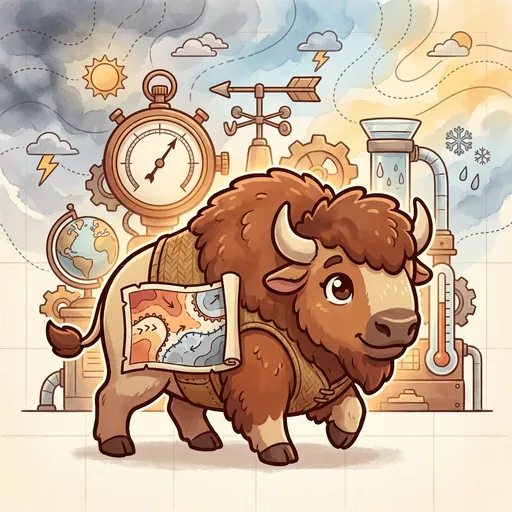
Mass was a small bison-tween. Her thick, two-toned brown-and-cream coat made her look like a chunky cartoon character, never threatening. She walked with a steady, patient rhythm, her stocky frame moving with purpose. At her hip, a small, carefully folded weather-map stayed tucked into a pocket.
This map was her constant companion. It showed the world in colored regions, each representing a different air mass. Toothed or rounded lines, like tiny mountain ranges or gentle hills, marked the fronts where these masses met. Mass understood these lines better than anyone. She knew that air never moved as one uniform thing. Instead, it traveled in vast, invisible chunks, each with its own temperature and moisture. A warm, moist tropical mass, for instance, behaved very differently from a cold, dry polar mass.
When two of these large air masses met, they didn’t just blend together like paint. A distinct boundary formed between them, a meeting-line called a front. This front was where most of the world’s weather happened. Warmer air, being lighter, always rode up over the colder air. As that warm air climbed, it cooled. The moisture in it condensed into clouds, often bringing rain or snow.
Mass never made air masses sound exotic or complicated. “Air masses are just big chunks of air,” she would explain, her voice calm and clear. “They all share a temperature and humidity. They’re everywhere, all the time. Right now, you’re sitting inside one.” She would tap her map. “When a different air mass moves in, the weather changes. The front is the boundary. The front is where the action is.”
She taught her students the four basic types of air masses. There was continental polar, which was cold and dry, forming over land. Then maritime polar, also cold but moist, born over oceans. Continental tropical brought warm, dry conditions, while maritime tropical meant warm and moist.
Mass also taught about the basic front types. A cold front happened when a cold mass replaced a warm one. These were sharp, often bringing stormy weather before clearing. A warm front was the opposite: a warm mass replacing a cold one. These were more gradual, often leading to steady, prolonged rain. Sometimes, neither mass won, creating a stationary front with long-lasting, unchanging weather. The most complex was an occluded front, where a cold front caught up to a warm front, creating a tangled mix of conditions.
Mass had grown up in a small village. Her family had been the village’s cattle-driver-watchers for generations. Their job was to track the grazing bison herds as they moved across seasonal pastures. This work taught Mass to pay close attention to large, slow-moving things. Herds, much like air masses, moved in coherent groups, following predictable patterns. By the time she was six, Mass already understood that anticipating what would happen next depended on understanding these big, slow movers.
She walked to the WeatherForge academy when she was twenty-two. Gale, the academy’s founder, had asked her a simple question: “What are air masses and fronts?”
Mass had answered without hesitation. “Air masses are big chunks of air with shared temperature and moisture. They move slowly. When two meet, the boundary is the front. The front is where weather happens. Cold mass meets warm mass: warm rises over cold; rising warm condenses moisture; clouds and rain.”
Gale had simply nodded. “You are appointed.”
In her classroom, Mass began every first-day lesson the same way. She would carefully unfold her weather-map on the workbench. Her finger would trace the colored regions. “Here is a warm air mass,” she would say, “and here is a cold one.” Then she would follow the front-line between them. “I am Mass. The meteorology primitive I teach is air masses and fronts. The move is identify the masses and locate the fronts. The front is where weather happens.”
She taught her students a clear set of steps, a scaffold for understanding.
First, identify the air mass over your location. Is it warm or cold? Moist or dry? Did it form over land, making it continental, or over the ocean, making it maritime?
Next, look for incoming air masses. Weather maps show these masses moving. The next one to reach you will bring the next change.
Then, find the fronts. A cold front appears as a blue line with triangles. A warm front is a red line with semicircles. Stationary fronts mix both symbols. An occluded front is purple, showing both.
After that, predict the weather sequence. An approaching front means a weather change is coming. When the front passes, that’s when the active weather hits. Once it’s past, settled weather usually follows.
It was important to match the front-type to the weather pattern. A cold front often brought sharp, sometimes stormy weather, then clearing skies. A warm front meant gradual, steady rain. Stationary fronts caused prolonged, unchanging conditions. Occluded fronts were always complex.
She taught them to track the front-line on the map. How fast was it moving? Was it hours away, or days?
Finally, she emphasized the need to coordinate with Press. Pressure gradients drove air-mass movement, and fronts often lined up with areas of low pressure.
Mass was always clear about one thing. “I sometimes get a front-passage wrong by a few hours,” she would admit. “That’s normal forecasting uncertainty. Air masses are big and slow, but not perfectly predictable. We aim for confidence, not certainty. Read teaches that discipline.”
When students asked Mass if thinking about air masses was hard, she always gave the same answer.
“It is not hard. It is identify + locate + predict. Air masses are big chunks of air. They move. When they meet, the boundary is the front. The front is where weather happens.”
She would then refold the weather-map, carefully smoothing the creases. The next front-line, a silent promise of change, waited to be tracked.
The WeatherForge ensemble
Mass is part of WeatherForge's distributed-narrative cast. Each character embodies a different curricular primitive; together they teach the full subject.