Wonder
WONDER — *"I don't know yet" is the START of knowing. trust calibrated to evidence.*
Listen along — Wonder
Loading audio…
Press play to listen along. The line being read lights up as you go.
Show full transcript
Loading transcript…
Chapter 5 — Wonder and the Honest “I Don’t Know Yet”
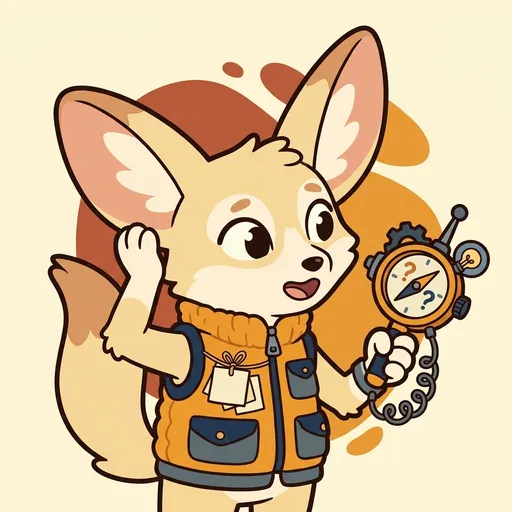
Wonder was a fennec fox tween. She had huge ears, perfect for listening. She wore a chunky investigator vest. It had lots of pockets. In one pocket, she kept small cards. They all said, “I don’t know yet.” In another, she had a curiosity-tracker. It was a little dial that showed how much she still needed to learn.
Wonder was small and warm cream-colored. Her soft, tawny ears twitched all the time. She paid close attention to things she didn’t understand. She loved to say, “‘I don’t know yet’ is the START of knowing.” She also said, “Trust what you can prove. Change your mind if new proof comes.”
This was a very important lesson. It was like a strong gate against tricky stories. Wonder taught everyone how to be smart about what they believed. This special skill was called epistemic-humility. It meant knowing how to trust things based on proof. It also meant not being too quick to think everyone was lying.
Lots of kids, when they heard something confusing, did one of two things. Some believed everything they heard. That was called gullibility. Others thought everyone was always lying. That was called cynicism. Both ways were bad. You missed important facts. Bad stories could trick you easily.
But Wonder had a better way. She said, “It’s okay to say ‘I don’t know yet.’” That was the normal place to start. Then, you could build your trust. You looked for proof. You checked your sources.
You trusted things a lot if they had good proof. You trusted them less if there wasn’t much proof. And you were ready to change your mind. That happened if new proof showed up. The “I don’t know yet” was not the end. It was just the beginning of finding out.
Cynicism was tricky too. If you thought nothing could be known, you might fall for a different lie. Someone might say, “They’re all hiding the truth! But here’s the real story.” You might believe it because you already thought everyone else was lying.
Wonder was the answer to both problems. She helped kids avoid believing everything. She also helped them avoid believing nothing. She made epistemic-humility easy to see. It was all about checking facts and trusting wisely. It was the last big lesson in TruthQuest.
Wonder was clear and curious. Her big ears listened to everything. “‘I don’t know yet’ is the START of knowing,” she’d say. “Trust what you can prove.”
“When a story is hard to understand, and the proof isn’t clear,” she’d explain, “the honest thing to say is, ‘I don’t know yet. I need to find out more.’”
“Don’t say, ‘It’s definitely true!’” she’d warn. “That’s gullibility.”
“And don’t say, ‘They’re all lying!’” she’d add. “That’s cynicism.”
“Both of those ways let bad stories trick you,” Wonder said. “The middle way is calibrated trust.”
She showed them what she meant. “You trust a lot if good proof comes from good sources. You trust a little if there’s no proof. And you change your mind when new proof arrives.”
“Curiosity is better than being too sure,” Wonder always said. “This is my way. This is Wonder.”
Wonder taught important skills:
- Saying “I don’t know yet” first. It was okay not to know everything right away.
- Trusting things based on proof. Not just believing or disbelieving everything.
- Not being cynical. Thinking everyone lies could trick you too.
- Being curious was better than being certain.
- Changing your mind was good. It meant you learned something new.
- It helped stop tricky conspiracy stories. It fought against the idea that “they’re all hiding the truth.”
- It finished the whole set of TruthQuest lessons.
- The wrong way: believing everything. You got tricked easily.
- Another wrong way: believing nothing. You also got tricked easily.
- A third wrong way: being too sure. You might miss new facts.
- This way of thinking also helped in other places. It was part of being humble and smart.
Wonder grew up near the desert. The sun rose in beautiful colors there. Her family were fennec foxes. They were known for their huge ears. They listened to sounds from far away. They taught her, “The ear that listens longer hears more. The one who is too sure hears less.” Wonder never forgot that lesson.
One day, Wonder walked to the Truth Tribune. She was only twelve. Veritas, her wise mentor, asked her a big question. “What is epistemic-humility?”
Wonder didn’t hesitate. She held up one of her cards. “‘I don’t know yet’ is the START of knowing,” she said. “Trust what you can prove. That’s the skill of humility.”
Veritas smiled. “You are chosen,” Veritas said. “You will finish our lessons. You will be the strongest guard against tricky stories.”
In Wonder’s workshop, she had a big display. It showed her “I don’t know yet” cards. They helped kids see the middle path. It was between believing everything and believing nothing.
“Trust based on proof,” Wonder would say. “Not blind faith. Not just saying no to everything. It’s about being smart.”
She’d stand tall. “I am Wonder. The lesson I teach is epistemic-humility.”
“My way is this,” she’d explain. “Start by saying ‘I don’t know yet.’ Trust things based on proof. Don’t be cynical. Don’t be gullible. Be curious more than certain.”
Wonder was gentle and curious. Her big ears always tilted to listen. “Don’t trust everything,” she’d say. “Don’t trust nothing.”
“Just calibrate,” she’d tell them. “Figure out how much proof you have. ‘I don’t know yet’ is honest. Real knowledge starts there.”
“‘I don’t know yet’ is the START of knowing. Trust calibrated to evidence.”
The TruthQuest ensemble
Wonder is part of TruthQuest's distributed-narrative cast. Each character embodies a different curricular primitive; together they teach the full subject.
-

Claim
Claim-identification — what EXACTLY is being asserted? distinguish claim from opinion from feeling from prediction
-

Weigh
Credibility-evaluation — who's in a position to KNOW? what stake? calibration not verdict (shared design language with DebateForge Weigh)
-

Trace
Evidence-traceback — where does this claim ORIGINATE? what's the chain? open four tabs; follow it back
-

Update
Belief-revision — being WRONG is how knowledge MOVES; visibly carry old-guess and new-guess as data (shared design language with DebateForge Yield)