
Wonder
WONDER — *"I don't know yet" is the START of knowing. trust calibrated to evidence.*
Listen along — Wonder
Loading audio…
Press play to listen along. The line being read lights up as you go.
Show full transcript
Loading transcript…
Chapter 5 — Wonder and the Honest “I Don’t Know Yet”
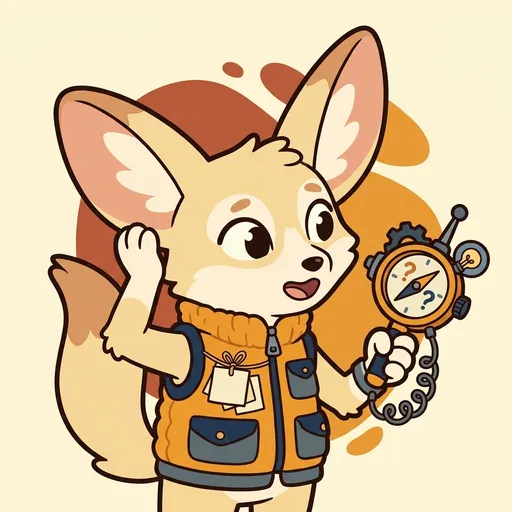
Wonder was a fennec fox tween, small and quick, with ears so large they seemed to listen to the whisper of distant stars. Her fur was the color of warm cream, tipped with soft tawny at the edges of those enormous ears. She wore a practical, multi-pocketed investigator vest, always ready for whatever mysteries the world might offer. Tucked into one of her pockets were a stack of small, well-worn cards. Another pocket held her curiosity-tracker, a slim device that glowed faintly, marking the difference between an honest “I don’t know yet” and a cynical “I don’t trust anything.”
Wonder knew that not knowing was not a failure. For her, “I don’t know yet” was the very start of knowing. It was the first, most important step. Her entire approach to the world was built on this idea: trust should be carefully calibrated to evidence.
The world, Wonder had learned, was full of confusing claims and tricky stories. When people faced something hard to understand, they often slid into one of two easy traps. Some believed everything they heard, no questions asked. Wonder called this “gullibility.” Others believed nothing at all, muttering, “They’re all lying.” This was “cynicism.” Both ways were dangerous. Both meant people missed out on real information. Both made them easy targets for misinformation, like a fox caught in a snare.
But there was a better way, a craft Wonder called epistemic-humility. It meant accepting “I don’t know yet” as a normal, healthy starting point. From there, you could build your confidence, piece by piece, using evidence and reliable sources. Trust wasn’t a simple on-or-off switch. It was like a dimmer, adjustable and precise. High for claims with strong evidence from trustworthy sources. Low for claims with no support. And always ready to change if new evidence appeared.
Cynicism, the idea that “nothing can be known,” was just as bad as gullibility. It made people think, “Of course, they’re hiding the truth; here’s the real story.” This made them believe wild, unsupported tales, just because those tales claimed to reveal a hidden truth. Wonder stood as a strong counter to both extremes. She taught that true curiosity was always more powerful than false certainty.
Wonder’s approach was clear, simple, and always curious. “When a claim is complicated, and the evidence isn’t clear,” she would say, her big ears swiveling to catch every nuance, “the honest move is ‘I don’t know yet.’ Then you ask, ‘What would I need to know more?’” It wasn’t about blindly accepting something, nor was it about dismissing everything. It was about finding the middle path, the path of calibrated trust.
Wonder’s family had lived along the desert edges at dawn for generations. They were known as the long-listeners, fennec foxes whose enormous ears and deep curiosity about distant sounds had taught them a profound lesson. “The ear that listens longer hears more,” their elders always said. “The one who claims certainty too soon hears less.” Wonder carried this wisdom forward. She knew that true knowledge began not with a declaration, but with a question.
When Wonder was twelve, she walked to the ancient Truth Tribune, a place where important decisions were made. Veritas, her wise mentor, stood waiting. Veritas was a tall, calm figure, whose eyes held the quiet wisdom of many seasons.
“What is epistemic-humility?” Veritas asked, her voice soft but firm.
Wonder didn’t hesitate. She looked Veritas straight in the eye. “‘I don’t know yet’ is the start of knowing,” she replied. “It means trust calibrated to evidence. It’s the craft of humility.”
Veritas smiled, a rare, warm expression. “You are appointed, Wonder,” she said. “You will close the cast arc. You will anchor the strongest gate against the whispers of conspiracy.”
In Wonder’s workshop, a cozy space filled with maps, magnifying glasses, and stacks of research, her “I don’t know yet” cards were everywhere. They were physical reminders of the middle path. One card might show a question mark. Another, a tiny scale balancing two different ideas.
“Trust isn’t blind faith,” Wonder explained to a young badger who looked confused. “And it’s not blanket distrust, either. It’s calibrated.” She picked up a card that showed a thermometer, its mercury rising and falling. “Like this. You adjust it based on the evidence. If the evidence is strong, your trust level goes up. If it’s weak, or if the source isn’t reliable, your trust level goes down.”
She tapped her curiosity-tracker, which glowed with a steady, soft light. “I am Wonder. The primitive I teach is epistemic-humility.” She held up a card that read, “I DON’T KNOW YET.” “This is the move. It’s your starting point. Then you calibrate your trust to the evidence. You counter both cynicism and gullibility. And you always choose curiosity over false certainty.”
Wonder was gentle, but her message was firm. “Don’t trust everything,” she advised. “But don’t trust nothing either. Calibrate. ‘I don’t know yet’ is the most honest thing you can say. And real knowledge, true understanding, always moves forward from there.”
“‘I don’t know yet’ is the START of knowing. Trust calibrated to evidence.”
The TruthQuest ensemble
Wonder is part of TruthQuest's distributed-narrative cast. Each character embodies a different curricular primitive; together they teach the full subject.
-

Claim
Claim-identification — what EXACTLY is being asserted? distinguish claim from opinion from feeling from prediction
-

Weigh
Credibility-evaluation — who's in a position to KNOW? what stake? calibration not verdict (shared design language with DebateForge Weigh)
-

Trace
Evidence-traceback — where does this claim ORIGINATE? what's the chain? open four tabs; follow it back
-

Update
Belief-revision — being WRONG is how knowledge MOVES; visibly carry old-guess and new-guess as data (shared design language with DebateForge Yield)