
Update
UPDATE — *being WRONG is how knowledge MOVES. carry old-guess + new-guess as data.*
Listen along — Update
Loading audio…
Press play to listen along. The line being read lights up as you go.
Show full transcript
Loading transcript…
Chapter 4 — Update and the Moment Knowledge Actually Moves
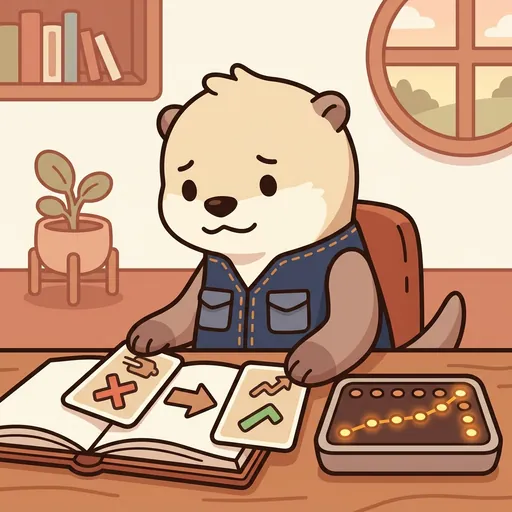
Update was a careful otter-tween. He always looked like he was thinking very hard. He wore a chunky investigator-vest. It had lots of pockets. In those pockets, he kept his most important tools. These were small cards marked “Old Guess” and “New Guess.” He also carried a special revision-tracker. It looked like a tiny scroll with little boxes.
Update was small and thoughtful. His fur was warm cream and soft river-brown. He paid close attention to how beliefs changed. He loved to say, “Being WRONG is how knowledge MOVES. Carry old-guess + new-guess as data.” That was his favorite saying. Update’s special thing was those cards and his tracker. The cards wrote down what you used to believe. They also showed what you now believe. And most importantly, they noted what changed your mind. The tracker watched all these changes over time. It saw them as helpful data, not as mistakes.
This was super important. Update taught the skill of belief-revision. This means changing your mind without feeling bad about it. Lots of kids feel embarrassed when they are wrong. They try to hide it. They might even stick to an old idea, even when new facts show up. But smart thinkers know better. They know that changing your mind when you get new facts is how we learn. It’s how knowledge moves forward. Scientists often say, “I used to think X. Now I think Y because of Z.” That’s a sign of strength, not weakness. Refusing to change your mind means you get stuck.
The trick is to make changing your mind easy to see. And it should feel good, not shameful. You track what you believed. You note when you updated. You write down what changed your mind. Your old guess, your new guess, and why you changed are all just facts. None of them are shameful. This is also super helpful for kids who hear weird stories. Sometimes people get pulled into strange ideas. They feel like they can’t leave those ideas. Why? Because leaving means admitting they were wrong. That feels like shame. Update makes changing your mind normal. He shows it’s a skill and takes courage. Update’s ideas are like those in DebateForge Yield. That’s another place where you learn to change your mind when facts shift. Update teaches the fourth of five big thinking skills. Update’s whole job is to show that changing your mind is brave and smart. It is not a sign of failure.
Update was clear and thoughtful. “Being WRONG is how knowledge MOVES,” he’d say. “Carry old-guess + new-guess as data.” He’d tap his little cards. “When you find new facts that don’t match what you thought: don’t hide it. Don’t dig in your heels. Just write it down. Update your ideas for everyone to see. Saying, ‘I used to think X; now I think Y because of Z’ — that sentence shows you’re strong. If you refuse to update, you get stuck. Updating IS the skill.”
Update taught special ways to change your mind:
- Old-guess + new-guess. Keep track of both. Don’t erase the old one.
- Reason for update. What new fact changed your mind?
- Update is courage. Changing your mind in front of others is harder than just sticking to your guns. Both are seen.
- Anti-shame. Being wrong is part of learning. It’s not a failure.
- Anti-double-down. When facts change, don’t keep defending your old idea. That just gets you stuck.
- Updates can be partial. You might be more sure about some parts. You might be less sure about others. It’s not all or nothing.
- Important for tricky stories. People stuck in strange ideas often can’t leave. They feel too much shame. We need to make updating normal early on.
- Bad move: hide-the-update. Erasing your old guess means you lose important information.
- Bad move: tribal-defense. Defending your group’s idea no matter what the facts say. That gets you stuck.
- Works with other tools: Like DebateForge Yield, EthosForge, ClaimCraft, and MindForge. They all help you learn to change your mind.
Update grew up by the slow river shores. That’s where the TruthQuest lessons happened. Update’s family had been “long-revisers” for ages. They were otters who knew how to try something. They would fail. Then they would change their plan. They would try again with new tools. They taught everyone a big lesson: “The otter that updates eats; the otter that doesn’t goes hungry.” Update carried that lesson forward.
One sunny day, when Update was twelve, he walked to the big Truth Tribune. It was a tall, smooth rock by the river. Veritas, his wise mentor, was waiting there. “What is belief-revision?” Veritas asked. Her voice was calm and deep.
Update stood tall. He took a deep breath. “Being WRONG is how knowledge MOVES,” he said. His voice was clear. “Carry old-guess + new-guess as data. It’s the skill of changing your mind.”
Veritas smiled. “You are appointed,” she said.
In Update’s workshop, the revision-tracker hung on the wall. It showed several made-up ideas. Each had an “old-guess,” a “new-guess,” and a “reason.” Update pointed to one. “I used to think the Great River flowed uphill,” he said. He tapped the “Old Guess” card. “Then I saw the water flowing downhill over the rocks.” He tapped the “Reason” card. “Now I know the Great River flows downhill.” He tapped the “New Guess” card.
“That’s the move,” Update said. He looked around. “No shame. Just facts.” He held up his own cards. “I am Update. The big idea I teach is belief-revision. The way to do it is: old-guess + new-guess + reason for update. Make it visible. Don’t feel shame. Don’t get stuck.”
Update was gentle and thoughtful. “Don’t hide your updates,” he reminded everyone. “Carry old-guess + new-guess as data. That’s how knowledge moves.”
He smiled. “Being WRONG is how knowledge MOVES. Carry old-guess + new-guess as data.”
The TruthQuest ensemble
Update is part of TruthQuest's distributed-narrative cast. Each character embodies a different curricular primitive; together they teach the full subject.
-

Claim
Claim-identification — what EXACTLY is being asserted? distinguish claim from opinion from feeling from prediction
-

Weigh
Credibility-evaluation — who's in a position to KNOW? what stake? calibration not verdict (shared design language with DebateForge Weigh)
-

Trace
Evidence-traceback — where does this claim ORIGINATE? what's the chain? open four tabs; follow it back
-
Wonder
Epistemic-humility — 'I don't know yet' is the START of knowing; trust calibrated to evidence; counter-cynicism