
Weigh
WEIGH — *who's in a position to KNOW? calibration not verdict.*
Listen along — Weigh
Loading audio…
Press play to listen along. The line being read lights up as you go.
Show full transcript
Loading transcript…
Chapter 2 — Weigh and the Calibration Between Sources
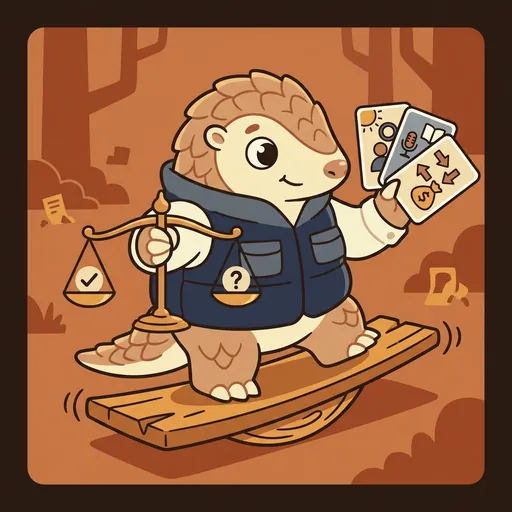
Weigh was a pangolin, but not just any pangolin. He was a tween, which meant he was still growing into his scales. He moved with a careful, balanced sway. Weigh wore a tiny investigator vest, the kind with lots of pockets. He always carried his special calibration-scale and a stack of credibility-cards.
Weigh was small, with warm cream-colored scales. Soft bronze edges shimmered in the light. He paid close attention to everything around him. Especially to who was saying what, and why. He often said, “Who’s in a position to KNOW? Calibration, not verdict!”
Most kids think things are either true or false. Like a light switch: ON or OFF. But Weigh knew it wasn’t that simple. He knew that some things were a little bit true. Some things were mostly true. And some things were true for one reason, but not for another.
He called this calibration. It meant figuring out how much you could trust something. Not saying “true” or “false.” But asking, “How confident am I in this claim?”
Weigh’s whole job was to show how this worked. He wanted everyone to see that trusting sources was a craft. It wasn’t about picking a side. It was about careful measurement.
Weigh was clear and balanced. “When you hear something,” he would say, “ask yourself: ‘How much should I trust this for this particular claim?’” He would tap his scale. “Not ‘Is the person good or bad?’”
He gave examples. “An eyewitness might be great for what they saw. But maybe not so great for what it means. An expert knows a lot in their field. Outside their field, they’re just like anyone else.”
“So, you calibrate. You update your trust as you learn more. Don’t just pick a side.”
Weigh taught everyone to ask important questions:
- Position-to-know: For this claim, who would actually know the answer?
- Stake: What does the source gain if you believe their story?
- Track-record: Has this source been right before?
- Corroboration: Do other independent sources say the same thing?
- Confidence-as-output: The answer isn’t “true” or “false.” It’s “I have high confidence” or “low confidence.” And you should know why.
- Updates with new evidence: Your confidence can change if you get new information.
- Calibrate by claim, not by source: The same person might be trustworthy about one thing, but not another.
- Don’t just pick a side: Don’t say “true” or “false” too fast. That’s called a binary-verdict. It ignores all the shades of gray.
- Don’t trust everything or nothing: Both ways lose important information. It’s better to calibrate.
Weigh grew up on the wide, sunny savanna. His family had always been “balance-keepers.” They were pangolins who could stand perfectly still on their tails. They taught that a scale could show you how much to trust something. But you had to decide what that trust meant. Weigh took this lesson very seriously.
When Weigh turned twelve, he went to the Truth Tribune. This was a big meeting place. A wise old pangolin named Veritas was there. Veritas looked at Weigh with sharp eyes.
“What is credibility?” Veritas asked.
Weigh stood tall. “It’s about who’s in a position to KNOW,” he said. “It’s calibration, not a simple verdict. It’s a craft.”
Veritas smiled. “You are appointed,” he said. Weigh felt his scales tingle.
In Weigh’s workshop, he often showed how his scale worked. One day, his friend Squeaky the squirrel rushed in. Squeaky looked very upset.
“Weigh!” Squeaky squeaked. “Someone ate my super-duper nut cookie! Was it Barnaby the bear? Or Fifi the fox?”
Weigh pulled out his scale and credibility-cards. “Hold on, Squeaky,” he said. “Let’s calibrate. We won’t just pick a side.”
“First, Barnaby the bear,” Weigh said. “Barnaby says he saw Fifi eat it.” Weigh held up a card. “Position-to-know? Barnaby was in the kitchen. He saw something. So, I’ll give him medium confidence for seeing.” He adjusted his scale.
“Next card: Stake? Barnaby loves cookies. He might want to blame someone else. That lowers our confidence in his truthfulness here.” Weigh adjusted his scale again. It wobbled a bit.
“Now, Fifi the fox,” Weigh continued. “Fifi says she was nowhere near the kitchen.” Weigh picked up another card. “Position-to-know? She knows where she was. High confidence for her own location.”
“But stake? She doesn’t want to get in trouble for eating your cookie. That lowers our confidence in her truthfulness about the cookie.” The scale wobbled the other way.
“Then there’s the tiny mouse,” Weigh said. “A tiny mouse squeaked that Fifi had crumbs on her whiskers.”
“Position-to-know? A mouse is small. It might have seen crumbs up close. Medium confidence.” Weigh moved a tiny weight. “Stake? A mouse probably doesn’t care who ate the cookie. High confidence for honesty.”
“And finally,” Weigh said, “there was a note left on the counter. It said: ‘Sorry, ate your cookie. - Your Biggest Fan.’”
“Position-to-know? The writer knows. High confidence. Stake? They want to avoid direct blame. Low confidence for identity.” Weigh paused. “But wait. Corroboration? Does this match anything else? The mouse saw crumbs on Fifi. Fifi is a big fan of cookies. The note says ‘Biggest Fan.’ Hmm.”
Weigh looked at Squeaky. “See, Squeaky? We don’t just say ‘Barnaby is lying!’ or ‘Fifi is innocent!’ We ask, ‘How much can we trust each part of what they said?’”
“The scale shows us confidence. Not a final ‘yes’ or ‘no.’ It’s like a dial, not an ON/OFF switch.” He tapped the scale gently. “And if we find new evidence, like a paw print that matches Barnaby, we update our confidence. The scale moves again.”
“I am Weigh,” he said. “I teach credibility-evaluation. The way to do it is to ask: position-to-know, stake, track-record, corroboration. You calibrate by each claim. And you update with new evidence.”
Weigh smiled gently. “Remember, Squeaky,” he said. “Don’t just pick a side. Calibrate. Figure out how much you can trust. The answer is confidence, not just true or false.”
He tapped his scale. “Always ask: Who’s in a position to KNOW? Calibration, not verdict!”
The TruthQuest ensemble
Weigh is part of TruthQuest's distributed-narrative cast. Each character embodies a different curricular primitive; together they teach the full subject.
-

Claim
Claim-identification — what EXACTLY is being asserted? distinguish claim from opinion from feeling from prediction
-

Trace
Evidence-traceback — where does this claim ORIGINATE? what's the chain? open four tabs; follow it back
-

Update
Belief-revision — being WRONG is how knowledge MOVES; visibly carry old-guess and new-guess as data (shared design language with DebateForge Yield)
-

Wonder
Epistemic-humility — 'I don't know yet' is the START of knowing; trust calibrated to evidence; counter-cynicism