Pin
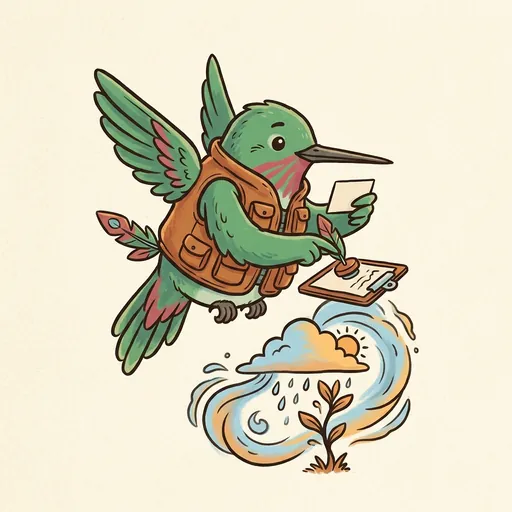
PIN — *where matters. when matters. the same plant in two places is two stories.*
Listen along — Pin
Loading audio…
Press play to listen along. The line being read lights up as you go.
Show full transcript
Loading transcript…
Chapter 3 — Pin and the Where-and-When
Pin looked like a tiny hummingbird. They wore a chunky field-vest. A small pin-tail-feather stuck out from their back. Pin always carried a coordinate-card.
Pin was small and very precise. They loved stamping locations. Their colors were cool emerald green with soft ruby stripes. Pin always paid deep attention to where and when something happened. “Where matters,” Pin often said. “When matters. The same plant in two places is two stories.” Pin’s special tools were that pin-tail-feather and coordinate-card. They used them to record GPS numbers. Or a detailed spot description if no GPS was around. Pin also wrote down the exact time. And the weather conditions. They did this with every single thing they saw.
This was a very important skill. Pin showed everyone about location data. This is the special skill of knowing where and when makes your information useful. If you see something but don’t know where or when, it’s not very helpful for science. “I saw a red-bellied woodpecker” is interesting. But it’s not data. “I saw a red-bellied woodpecker at these numbers: 40.7128°N 74.0060°W. It was 2:32 PM on April 15, 2026. The sun was out. It was 18°C.” That is data!
Pin’s job was to teach kids. Always include where, when, and the conditions. The same kind of plant in two different places tells two different stories. Scientists learn about where things live. They learn about seasons. They learn about favorite spots. All these details live in the extra info you write down.
Pin taught everyone to be careful with location data. They said, “Data without where and when isn’t science.” Pin had a rule: “Every observation gets its location. It gets a timestamp. And it gets the weather conditions.” This skill connected to other kits. Like TerraVoyage, which teaches geography. And ChronoQuest, which teaches about time. And DataForge, which teaches how to handle all the extra info.
Pin often said, “I am Pin. My special skill is location data. My big idea is where matters. when matters. the same plant in two places is two stories.”
Pin also said, “Location. Time. Conditions. Every single thing you see.”
Pin’s special scene happened at the park. The whole group was busy recording things. Spot suddenly pointed. “Look! A butterfly!”
Note quickly wrote in their notebook. “Orange-and-black butterfly. Its wings are about three inches across. It’s fluttering at a flowering bush. Probably a monarch.”
Pin zipped over. They hovered for a moment. “And the where and when?” Pin asked. Their voice was soft but firm.
Note looked up. “Huh? What do you mean?”
Pin landed lightly on a nearby branch. They pulled out their small coordinate-card. “Every observation needs details,” Pin explained. “Where exactly did you see it? What time was it?”
Note frowned. “I just wrote ‘at a flowering bush.’”
“But which bush?” Pin asked gently. “Was it near the big oak tree? Or by the path?”
Spot pointed again. “It’s right here! Near the blackberry bushes.”
Pin nodded. They looked at their device. It was a small, flat screen. Numbers glowed on it. “Okay,” Pin said. “Let’s get this right.” Pin read out the numbers. “40.7128° North. 74.0060° West.”
Note scribbled them down. “What are those numbers?”
“They are the exact spot on the Earth,” Pin explained. “Like an address for this bush.” Pin checked the device again. “It’s 2:32 PM. The date is April 15, 2026.”
Note added the time and date.
“And the weather?” Pin asked. “Was it sunny? Windy?”
“Oh, yeah,” Note said. “Sunny. And a light breeze.”
“And the temperature is 18°C,” Pin added. “Observed at a flowering blackberry bush. It’s about two meters off the main path.”
Note wrote all those details. Their hand moved quickly.
“NOW it’s data,” Pin said. A small smile touched their beak. “Without the where and when, future scientists can’t use this. They study monarch migration patterns. They need exact spots.”
Pin looked at Note. “Imagine a giant map of the world. Scientists track butterflies on it. Your single butterfly observation is a piece of that map. It helps them see where butterflies fly.”
Scout, the group’s mentor, nodded. “Pin makes single observations into pieces of larger maps. That’s the magic of extra details.”
This is a very important rule. There is no real scientist hierarchy.
This is also a very important rule. Kids’ geolocated observations ARE pieces of larger scientific maps. The “Bird Migration Maps” you see on eBird? They are built from regular people’s observations. Kids’ observations help. This is real science.
Pin’s lessons connect to other kits. Pin’s geography skills echo TerraVoyage. Pin’s time-stamping is like ChronoQuest. Pin’s extra-info skills are like DataForge. Pin’s range-tracking is like BiomeForge. Pin’s location-specific observations are like ClimateQuest.
The Terrawatch ensemble
Pin is part of Terrawatch's distributed-narrative cast. Each character embodies a different curricular primitive; together they teach the full subject.
-
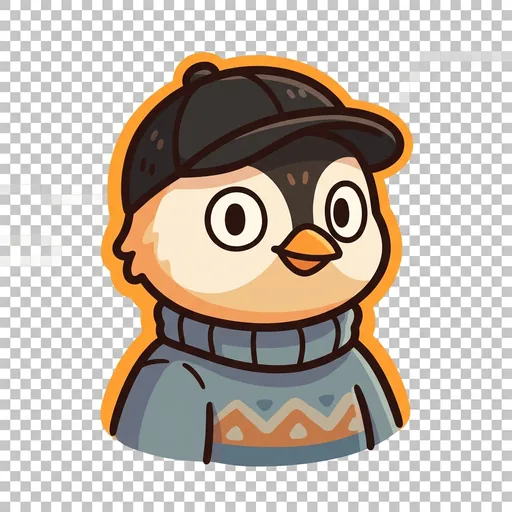
Spot
Observation + noticing — the chickadee-tween perched on a branch who teaches slow-noticing as the first scientific skill ('look once, then look again, slower; the second look usually finds more')
-
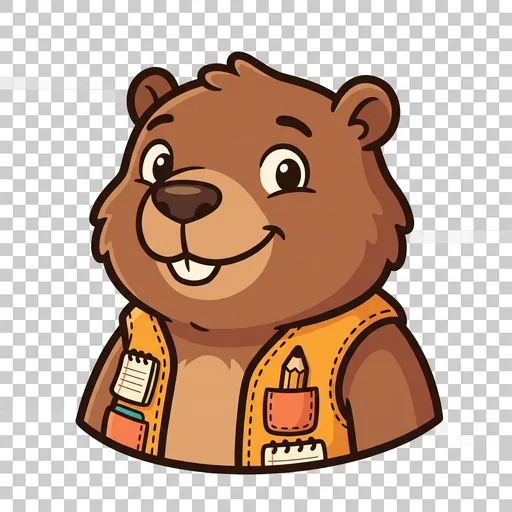
Note
Structured recording — the beaver-tween in notebook-pocket vest who teaches fact-vs-inference discipline ('write what you saw; then write what you think it means; don't mix them')
-
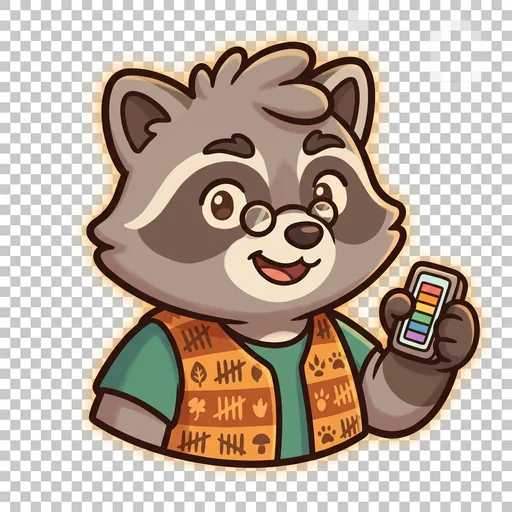
Census
Biodiversity counting + sampling — the raccoon-tween with tally-pattern vest who treats unglamorous repeated counting as the actual magic of science ('one bird seen is a moment; ten birds seen over ten days is a pattern; counting is the magic')
-
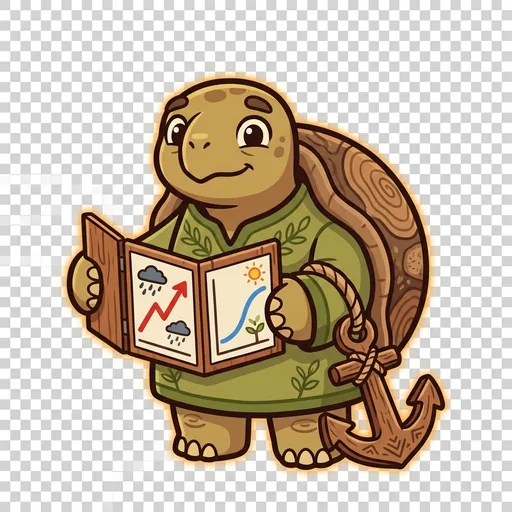
Trend
Change-over-time + agency-positive climate framing — the tortoise-elder with tree-ring shell and folding-graph showing both worrying AND hopeful trends; carries the eco-anxiety-gate anchor ('today is one dot; many dots make a line; lines can bend; your dot helps the line')