
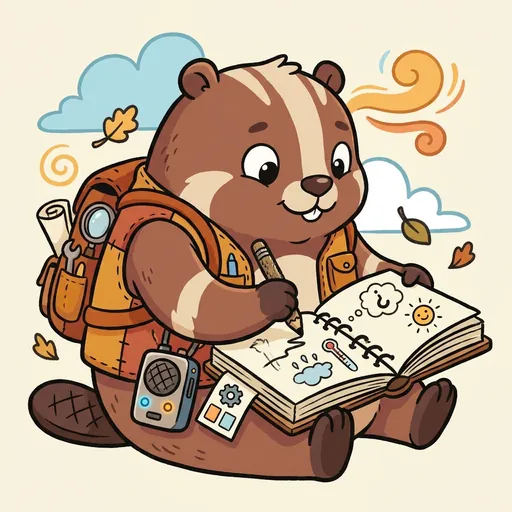
Note
NOTE — write what you saw. then write what you think it means. don't mix them.
Listen along — Note
Loading audio…
Press play to listen along. The line being read lights up as you go.
Show full transcript
Loading transcript…
Chapter 2 — Note and the Two Columns
In the middle of the busy park, while everyone else was pointing and shouting guesses, a beaver-tween named Note sat down on a log, opened her notebook, and drew a single line straight down the page.
Two columns. She always started that way.
A brown bird landed on a low branch a few feet off, tilted its head, and went still. Around Note the others were already deciding things about it. “It’s hungry!” one said. “No, it’s hurt — look how it’s sitting.” “It’s watching us.”
Note said nothing. In the left column she wrote, in small even letters: Brown bird, about sparrow-sized. Low branch. Head tilted. No markings on chest. Gone after thirty seconds. Then she slid her pencil to the right column and wrote something different: Maybe a young chickadee or a wren. The head-tilt might mean it’s listening for insects.
The bird flicked away into the leaves.
“Well?” said Spot, leaning over her shoulder. “What was it?”
“I don’t know for sure,” Note said, and tapped the left column. “But this part I do know. This part I saw with my own eyes. That’s the part I keep safe.” She tapped the right column. “This part is just me, thinking out loud. I keep it right next to the truth — but never inside it.”
Spot squinted at the two neat columns. “Why not just write down what it was?”
“Because what it was,” Note said, closing the notebook gently, “is a guess. And guesses have a way of eating the facts if you let them sit in the same sentence.”
Note had learned that from getting it wrong.
When she was small, she’d found a set of tracks in the mud by the creek — deep, clawed, close together — and she’d been certain. Bear. She’d run home shouting it. A bear, right by the water, this morning. She wrote it in her very first notebook, one triumphant word: BEAR.
Her aunt, an old beaver who kept forty years of river journals, had walked back out with her to look. She crouched by the mud a long time. Then she said, not unkindly, “Tell me what you see. Not what you decided. Just what’s here.”
Note had stared. “It’s… big. And there’s claws. And they’re close together.”
“Good. That’s real. Now — did you see a bear?”
”…No.”
“Then you don’t have a bear. You have big clawed tracks, close together, by the creek.” Her aunt smiled. “Maybe a bear. Maybe a big dog. Maybe a raccoon that stepped funny. Your guess might even be right. But when you wrote just BEAR, you threw away everything you actually knew — and left yourself with something you only hoped.”
Note’s face had gone hot. It felt like being caught, and worse, like she’d broken something without meaning to. But her aunt only handed her a fresh page.
“Draw a line down the middle,” she said.
So Note did. Tracks on the left. Bear? on the right. And the hot, caught feeling loosened all at once, because now nothing was lost — the seeing sat on one side, the wondering on the other, and both got to stay.
She walked to Terrawatch when she was twelve, because a place that gathered what people noticed about the whole living world ought to care how carefully it got written down.
Scout, the mentor who met her at the gate, didn’t ask her to name a single bird. He set a leaf on the table between them. “Tell me about this.”
Note looked at it. Then she took out her notebook and drew the line.
Left column: Leaf. Five points. Edges have small teeth. One brown spot near the stem. Slightly curled. Right column: Might be maple. The brown spot could be a bit of rot, or maybe an insect fed there.
She turned the page around so Scout could read both sides.
He was quiet for a moment. “You wrote the seeing apart from the thinking,” he said.
“Yes. So that if my thinking is wrong” — she pointed at might be maple — “the seeing still works. Someone can use the seeing. They can throw out my guess and keep the truth.”
Scout picked up the leaf and turned it over, and there on the underside was a maple’s pale veins. He set it down. “You belong here,” he said.
Note’s corner of Terrawatch filled up, over the seasons, with careful pages.
A boy came to her one grey afternoon, frustrated, holding a photo of a puddle full of frog eggs. “I wrote down everything,” he said, “and my friend says it’s wrong, and now I don’t know what’s real anymore.” He shoved the page at her. It said, in one crowded line: Found a bunch of stressed frog eggs, dying because the pond is too warm.
Note read it twice. “How many eggs?”
“I— a lot. I don’t know exactly.”
“Did you measure the water?”
“No, but it felt warm.”
“Did you watch an egg die?”
He stopped. ”…No.”
She slid a clean sheet toward him and drew the line down it herself. “Left side. Only what you saw. Nothing else.”
Slowly he wrote: Clump of frog eggs in a shallow puddle. Some clear, some cloudy. Water shallow. Sunny spot.
“Now the right side,” Note said. “Every guess you had. All of them. This is where they’re allowed.”
He wrote faster now: Cloudy ones might be dying. Puddle might get too warm in sun. Might dry up.
He looked at the two columns and let out a long breath. “My friend was right that I don’t know they’re dying,” he said. “But I still saw the cloudy ones. That part’s true.”
“That part’s true,” Note agreed. “And a real scientist reading your page can use the cloudy ones — that’s a clue worth having. Your guesses give them somewhere to start looking. You didn’t get it wrong. You just had everything piled into one sentence, so nobody could tell the treasure from the wish.” She tapped the page. “Two columns. Now they can.”
The boy grinned for the first time all afternoon.
Later, when the corner was empty, the boy came back with one quieter question.
“When you’re not sure what something means,” he said, “and you might be totally wrong about the guess part… doesn’t it bother you? Writing down a thing you can’t finish?”
Note thought about the mud by the creek, and the one hot word she’d once been so proud of.
“It used to,” she said. “It felt like admitting I didn’t have the answer. Like the page wasn’t done.” She ran a thumb down the center line of her open notebook. “But then I stopped needing it to be done. The left column is a promise — this really happened, I really saw it. The right column is just me, keeping you company while I wonder. And it turns out the calmest feeling in the world is looking at a page and knowing exactly which part you can lean on.”
She closed the notebook softly.
“You don’t have to be sure to be honest,” she said. “You just have to keep the seeing and the wondering in their own homes. Do that, and even your wrong guesses are safe — and the true things stay true forever.”
The boy nodded, slow and easy, and Note watched the worry go out of his shoulders like water finding level — the same quiet settling she still felt, every single time, the moment she drew that first steady line down a clean white page.
The Terrawatch ensemble
Note is part of Terrawatch's distributed-narrative cast. Each character embodies a different curricular primitive; together they teach the full subject.
-
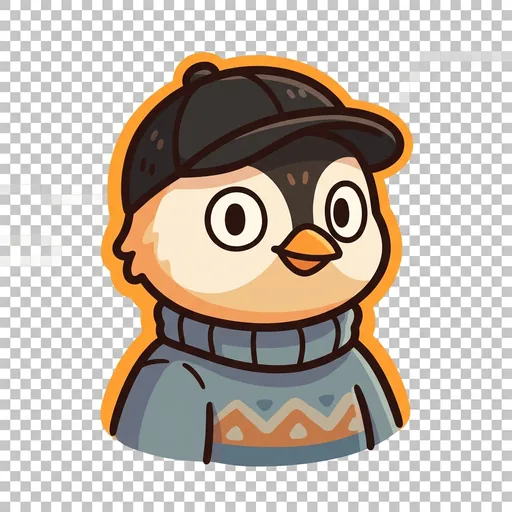
Spot
Observation + noticing — the chickadee-tween perched on a branch who teaches slow-noticing as the first scientific skill ('look once, then look again, slower; the second look usually finds more')
-
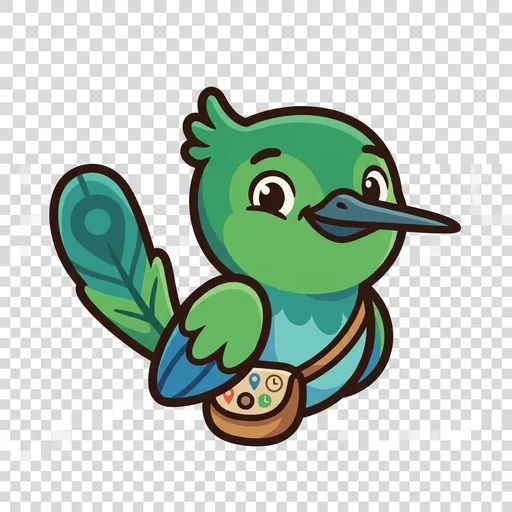
Pin
Geolocation + spatial-data discipline — the hummingbird-tween with pin-tail-feather who teaches that location-stamps + time-stamps make observations useful to other scientists ('where matters; when matters; the same plant in two places is two stories')
-

Census
Biodiversity counting + sampling — the raccoon-tween with tally-pattern vest who treats unglamorous repeated counting as the actual magic of science ('one bird seen is a moment; ten birds seen over ten days is a pattern; counting is the magic')
-
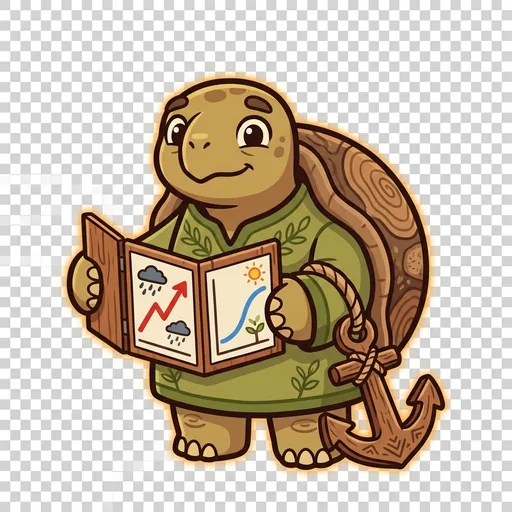
Trend
Change-over-time + agency-positive climate framing — the tortoise-elder with tree-ring shell and folding-graph showing both worrying AND hopeful trends; carries the eco-anxiety-gate anchor ('today is one dot; many dots make a line; lines can bend; your dot helps the line')