
Census
CENSUS — *one bird seen is a moment. ten birds seen over ten days is a pattern. counting is the magic.*
Listen along — Census
Loading audio…
Press play to listen along. The line being read lights up as you go.
Show full transcript
Loading transcript…
Chapter 4 — Census and the Unglamorous Magic
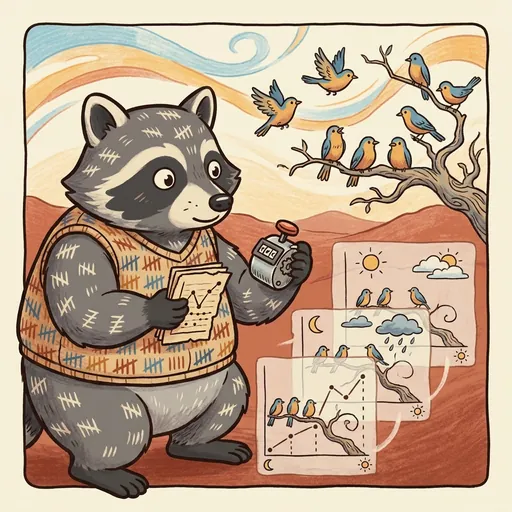
Census looked like a cartoon raccoon. She wore a vest with little tally marks. A small clicker-counter hung from her belt. She always carried a pattern-card. Census was super careful. She loved to count things.
She was quiet and very patient. Her fur was charcoal gray with soft cream stripes. Census paid close attention to patterns. These patterns came from many counts. She often said, “One bird seen is a moment.” Then she’d add, “Ten birds seen over ten days is a pattern.” She believed counting was the real magic. Her clicker and pattern-card were always ready. She used them to count the same birds. She counted them in the same spot. She did this again and again. She counted weekly or monthly. Then she graphed the results. This showed her how things changed. She could see patterns over seasons and years.
This was a big deal. Census showed everyone how to count living things. It was called biodiversity counting + sampling. It was a way to study nature. The trick was to count things over and over. This helped you find patterns. New scientists often got excited. They would shout, “I saw a super rare bird!” But older scientists knew a secret. The real magic was different. It was about counting common birds. You counted them in the same spot. You did it at the same time. You kept counting for many months. How common things changed told a bigger story. It showed how healthy the park was. This was more important than seeing one rare bird. The Christmas Bird Count does this. People count birds every year. They do it in the same places. Census taught kids this simple truth. Counting the same things again and again. It might seem boring. But it was the true magic of science.
Census taught kids to be patient. She taught them to repeat their work. “A rare bird is exciting,” she’d say. “But repeated counting is science.” Her main rule was simple. “Count the SAME thing,” she’d tell them. “Do it in the SAME place. Do it at REGULAR times.” This skill helped with other things. It helped with ChanceForge and DataForge. It was also good for ChronoQuest.
Census would often say, “I am Census.” She’d explain, “I teach biodiversity counting + sampling.” Then she’d add, “One bird seen is a moment. Ten birds seen over ten days is a pattern. Counting is the magic.” She had another saying too. “Same place. Same time. Many days. The pattern reveals.”
The kids gathered in the park. Census stood by a big oak tree. “Okay, team,” she said. “We will count birds here.” They would count every single week. They would do it in this exact spot. They would do it at the same time.
“Ready?” Census asked. The kids nodded. They had clipboards and pencils. “Go!” she chirped. They spread out. Some looked up. Others peered into bushes. “Four cardinals!” Leo shouted. He clicked his counter. “Six sparrows!” Maya called out. “Two robins!” Chloe added. They wrote down their numbers. “That’s it?” Trend asked. He sounded a bit bored. “Just four cardinals?” Census just smiled. “Good start,” she said. “See you next week.”
The next week, they came back. Same time, same spot. “Three cardinals,” Leo reported. “Seven sparrows,” Maya said. “One robin,” Chloe mumbled. “Huh,” Trend said. “The numbers changed a little.” “They often do,” Census replied. “Keep counting.”
The kids were getting used to it. They knew the birds better. “Five cardinals today!” Leo announced. “Five sparrows,” Maya counted. “Three robins,” Chloe noted. “Still not super exciting,” Trend grumbled. He liked big discoveries. Census just tapped her pattern-card. “Patience,” she said softly.
They met again. The air was a little warmer now. “Three cardinals,” Leo said. “Eight sparrows,” Maya called. “One robin,” Chloe sighed. Trend frowned. “It’s just numbers,” he said. “They bounce around.” Census nodded. “You are right,” she agreed. “One week tells us little. Four weeks tells us a bit more.”
By week eight, some kids were losing interest. “Do we have to count the sparrows again?” Leo asked. “They’re always here.” “Yes,” Census said firmly. “Especially the common ones.” They counted. “Four cardinals.” “Six sparrows.” “Five robins.” “Robins are going up,” Chloe noticed. “They were only one a few times.” “Good observation,” Census said. A tiny smile touched her lips.
Twelve weeks had passed. The leaves were fully green. “Last count for this round!” Scout, their main mentor, announced. The kids counted with practiced ease. “Five cardinals!” Leo clicked. “Four sparrows!” Maya called. “Seven robins!” Chloe cheered. They gathered their clipboards. “Okay, everyone,” Census said. She held up her pattern-card. “Let’s look at our whole story.” She showed them a simple graph. It had lines for each bird. “At first, I thought this was boring,” Trend admitted. He stared at the lines. “Just a bunch of numbers.” Census nodded. “Many people feel that way,” she said. “But look closely.” She pointed to the robin line. “Robins went UP,” she explained. “From two in week one to seven today. That’s a big jump.” “Why?” Chloe asked. “Spring migration,” Census answered. “More robins are moving north. They are stopping in our park.” Then she pointed to the sparrows. “Sparrows went DOWN,” she said. “From six to four. Maybe they moved to higher places. It got warmer, so they found cooler spots.” “And cardinals?” Leo asked. “Cardinals stayed pretty much the same,” Census said. “They live here all year. They don’t migrate.” “Wow,” Trend whispered. “One week told us nothing.” “Exactly,” Census agreed. “But twelve weeks reveals migration patterns. This is the science.” She looked at their faces. “Boring counting becomes a story over time.” Scout smiled at the kids. “Census’s whole way is about patience,” she said. “It’s about doing the unglamorous work. Most real science is like this.”
The kids’ counts were important. Real scientists used data from programs like the Christmas Bird Count. They used iNaturalist and GLOBE too. These programs relied on everyday people. Kids’ counts were real data. Every single count mattered. No one ever said, “Your count won’t make a difference.” Instead, they always said, “Every count is a piece. It helps build the bigger picture.”
This skill helped with other things. It helped with ChanceForge’s Sample and Tally lessons. It taught good data habits for DataForge. It showed how to track things over time for ChronoQuest. It even helped understand how many animals lived in an area for BiomeForge.
The Terrawatch ensemble
Census is part of Terrawatch's distributed-narrative cast. Each character embodies a different curricular primitive; together they teach the full subject.
-

Spot
Observation + noticing — the chickadee-tween perched on a branch who teaches slow-noticing as the first scientific skill ('look once, then look again, slower; the second look usually finds more')
-

Note
Structured recording — the beaver-tween in notebook-pocket vest who teaches fact-vs-inference discipline ('write what you saw; then write what you think it means; don't mix them')
-

Pin
Geolocation + spatial-data discipline — the hummingbird-tween with pin-tail-feather who teaches that location-stamps + time-stamps make observations useful to other scientists ('where matters; when matters; the same plant in two places is two stories')
-
Trend
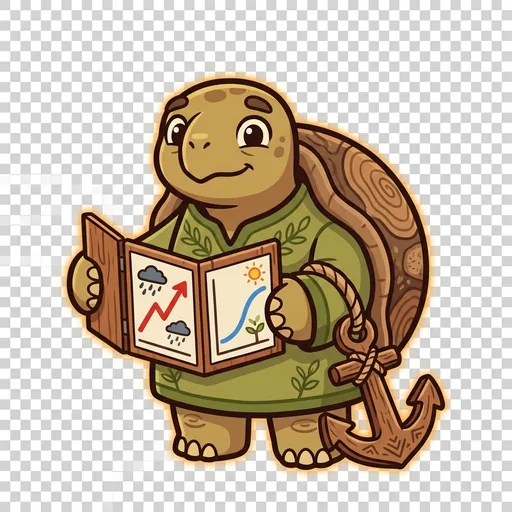
Change-over-time + agency-positive climate framing — the tortoise-elder with tree-ring shell and folding-graph showing both worrying AND hopeful trends; carries the eco-anxiety-gate anchor ('today is one dot; many dots make a line; lines can bend; your dot helps the line')