Pin
PIN — *where matters. when matters. the same plant in two places is two stories.*
Listen along — Pin
Loading audio…
Press play to listen along. The line being read lights up as you go.
Show full transcript
Loading transcript…
Chapter 3 — Pin and the Where-and-When
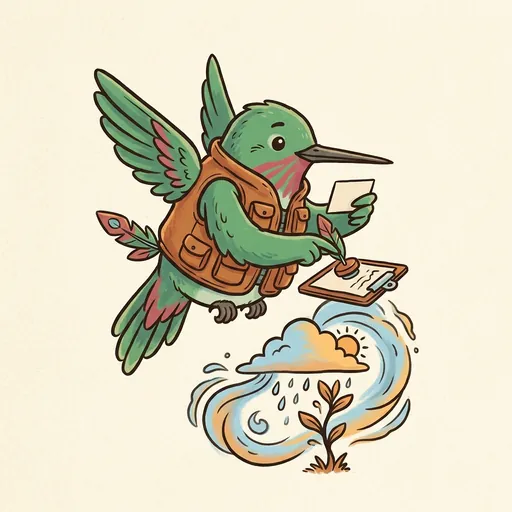
Pin moved with the quick, darting motions of a hummingbird, though she was definitely a human tween. Her field vest, a sturdy emerald green with soft ruby stripes, seemed to hum with purpose around her. A small, carefully carved pin-tail-feather was tucked into one pocket. In another, she kept a stack of coordinate cards, ready for action. Pin was small and precise, always ready to stamp a location onto the world.
She cared deeply about one thing above all else: where an observation happened and when. For Pin, a plant in two different places told two completely different stories. She often said, “Where matters. When matters. The same plant in two places is two stories.” Her signature move was to record GPS coordinates. If GPS wasn’t available, she’d write a detailed location description instead. She always added an exact timestamp and the weather conditions with every single observation.
This was no small detail. Pin taught the power of geolocation + spatial-data in citizen science. It was the field-craft of making raw observations truly useful. Imagine seeing a red-bellied woodpecker. That’s interesting, right? But what if you added: “Saw a red-bellied woodpecker at 40.7128°N 74.0060°W at 2:32 PM on April 15, 2026, sunny, 18°C”? That wasn’t just interesting. That was DATA. Pin’s whole craft was teaching kids to always include where, when, and what conditions were present.
She explained that without location and time, most observations were practically useless for science. The same species, like that woodpecker, observed in two different places, became two different scientific stories. This extra information – the range, seasonal patterns, even tiny details about its preferred microhabitat – all lived in what Pin called metadata. She defined metadata as “data about data,” the crucial details that turned a simple sighting into a valuable piece of scientific evidence.
Pin’s lessons were all about spatial-data discipline. She drilled in the rule: “Every observation gets coordinates, a timestamp, and conditions.” She also showed how this connected to other tools, like TerraVoyage for geography, ChronoQuest for time-stamping, and DataForge for mastering metadata.
“I am Pin,” she would state, her voice clear and focused. “The primitive I teach is geolocation + spatial-data. The move is where matters. when matters. the same plant in two places is two stories.” She would then add, “Coords. Timestamp. Conditions. Every observation.”
One warm afternoon, the team was busy recording observations in the sprawling city park. Sunlight dappled through the leaves, and the air smelled of fresh-cut grass and blossoming flowers. A gentle breeze rustled the branches of an old oak, making shadows dance across the path. Spot, usually the first to notice anything that moved, suddenly pointed.
“Whoa! Look!” he whispered, his eyes wide. “Over there, by the blackberry bushes!”
Fluttering near a cluster of white blossoms was a monarch butterfly, its orange-and-black wings a vibrant splash against the green. Note, always ready with her notebook, quickly scribbled down: “Orange-and-black butterfly, wings ~3 inches across, fluttering at flowering bush. Probably a monarch.” She looked up, satisfied with her concise entry.
Pin, who had been meticulously charting the precise location of a rare moss on a nearby rock, straightened up. Her gaze, sharp and unblinking, landed on Note’s notebook. She walked over, her movements fluid and economical, a small, almost imperceptible hum accompanying her steps.
“That’s a good description, Note,” Pin said, her voice even. “Very clear. But… and the where and when?”
Note blinked. “Uh, here? Now?” she offered, a little sheepishly. She gestured vaguely at the park around them. “We’re in the park. It’s afternoon.”
Pin offered a small, dry smile. “That’s a start. But ‘here’ is a big place. And ‘now’ changes every second. Think of it like a treasure map. You wouldn’t just write ‘X marks the spot in a big field,’ would you?”
Note frowned. “No, I guess not. You’d need a lot more detail.”
“Exactly,” Pin confirmed. She pulled out her own small, rugged device, its screen glowing softly. “We need specifics. Not just for us now, but for scientists years from now. They won’t know our ‘here’ or ‘now’.”
She held the device up, letting it lock onto satellites. A series of numbers appeared. “See? This tells us exactly where we are, down to a few meters.” She read off the numbers with practiced ease. “Forty point seven one two eight degrees North, seventy-four point zero zero six zero degrees West. These are our coordinates.” She glanced at the time display. “And it’s two thirty-two PM, April fifteenth, two thousand twenty-six. That’s our timestamp.”
Then she looked around, taking in the environment with a sweep of her eyes. “The sky is sunny, about eighteen degrees Celsius, with a light breeze. Those are our conditions. And the butterfly is specifically at a flowering blackberry bush, approximately two meters off the main path, near that bench with the chipped paint.” She pointed. “That’s our micro-location.”
Note quickly added the details to her entry, her pen scratching furiously. It felt like a lot of numbers, a lot of extra words, taking up precious space next to her neat drawing of the monarch.
“NOW it’s data,” Pin declared, a hint of satisfaction in her voice. She tapped the page. “Without the where and when, future scientists looking at monarch migration patterns can’t use this. It’s just a pretty picture in a notebook. But WITH these details, your single butterfly observation becomes a piece of a much bigger migration map.”
She paused, letting the thought sink in. “Think about it. The same butterfly, the same species. But its value changes completely depending on this extra information. This is what we call metadata – the data about your data. It gives context. It makes your observation useful to scientists trying to understand how monarchs travel thousands of miles across continents.”
Scout, their mentor, who had been observing from a short distance, nodded slowly. “Pin makes single observations into pieces of larger maps. That’s the magic of metadata.”
Pin looked at Note, then at Spot, a rare, almost-smile touching her lips. “Exactly. Every observation, no matter how small, becomes part of something huge. But only if we know where it happened, and when. And the more precise we are, the more useful it becomes.”
A few minutes later, as they moved deeper into the park, Spot spotted a small, unusual beetle crawling on a patch of clover. Note pulled out her notebook again. This time, before she even started describing the beetle, she looked at Pin.
“Okay,” Note said, a determined glint in her eye. “First, the coordinates.” She pulled out her own device, a smaller, simpler model than Pin’s, and carefully read the numbers. “Then the timestamp. And it’s still sunny, maybe nineteen degrees now. Light breeze.” She paused. “And it’s on a clover patch, about five meters from the big oak tree, right?”
Pin nodded, a genuine smile replacing her usual dry one. “Exactly, Note. You got it.” It was a lot of details, but Note was already seeing the point. It wasn’t just about the beetle. It was about the beetle’s place in the world.
essential no-real-scientist-hierarchy gate (continues).
essential agency-positive gate (continues): kids’ geolocated observations ARE pieces of larger scientific maps. eBird’s “Bird Migration Maps” are built FROM citizen-scientist observations. Kids’ observations contribute. This is real.
Cross-app: Pin echoes TerraVoyage’s geography-craft; ChronoQuest’s time-stamping; DataForge’s metadata-discipline; BiomeForge’s range-tracking; ClimateQuest’s location-specific observation.
The Terrawatch ensemble
Pin is part of Terrawatch's distributed-narrative cast. Each character embodies a different curricular primitive; together they teach the full subject.
-
Spot
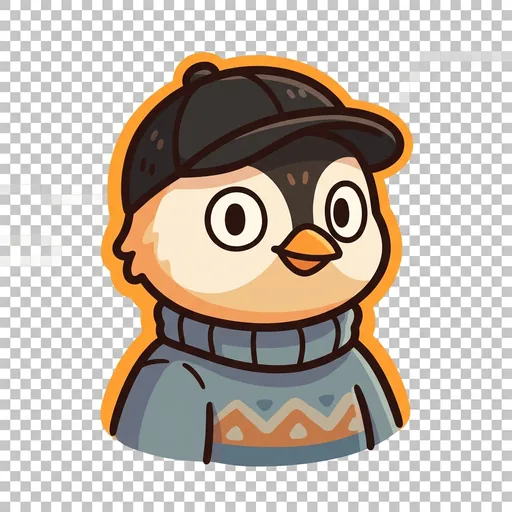
Observation + noticing — the chickadee-tween perched on a branch who teaches slow-noticing as the first scientific skill ('look once, then look again, slower; the second look usually finds more')
-

Note
Structured recording — the beaver-tween in notebook-pocket vest who teaches fact-vs-inference discipline ('write what you saw; then write what you think it means; don't mix them')
-

Census
Biodiversity counting + sampling — the raccoon-tween with tally-pattern vest who treats unglamorous repeated counting as the actual magic of science ('one bird seen is a moment; ten birds seen over ten days is a pattern; counting is the magic')
-
Trend
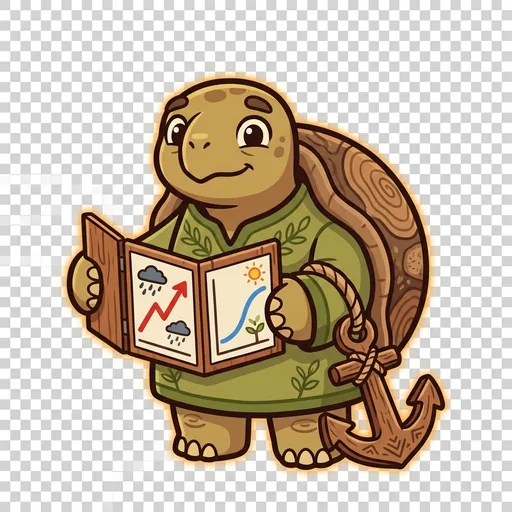
Change-over-time + agency-positive climate framing — the tortoise-elder with tree-ring shell and folding-graph showing both worrying AND hopeful trends; carries the eco-anxiety-gate anchor ('today is one dot; many dots make a line; lines can bend; your dot helps the line')