
Sniff
PATTERN-SPOTTING IN SCAMS + PHISHING — the digital-citizenship skill of recognizing the three universal scam-tells (urgency / too-good-to-be-true / request-for-personal-info) and treating scam-spotting as *a puzzle to win*, not as *a disaster to prevent.*
Listen along — Sniff
Loading audio…
Press play to listen along. The line being read lights up as you go.
Show full transcript
Loading transcript…
Chapter 2 — Sniff and the Three Tells
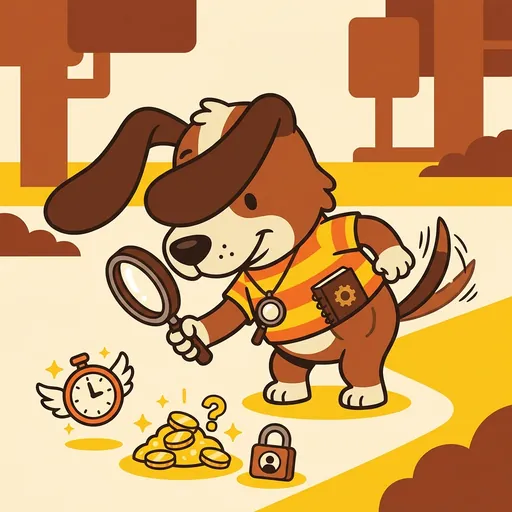
Sniff was a hound-tween. He had a super sensitive nose. A magnifying glass was tucked into his collar.
He was short. His fur was brown and cream. His ears were long and floppy. They swung forward when he smelled something important. His tail wagged like crazy when he found a puzzle. That was almost always.
Sniff carried a small notebook. It said TELLS on the front. He also wore a small magnifying glass. It hung on a cord around his neck.
He always leaned forward a little. His nose twitched, twitch, twitch. He was sniffing for something.
He was sniffing for tells.
What’s a tell? It’s a small clue. It shows you when a trick is happening. Every trick has tells. Sniff’s whole job was to teach kids how to find them.
This part was super important. Sniff never made scam-spotting scary. He never said, “If you don’t spot this trick, something terrible will happen!” That kind of talk was fear-talk. Fear-talk makes kids freeze up. Freezing up is the opposite of what you need to do. You can’t think clearly when you’re panicking.
Instead, Sniff made scam-spotting a game. It was a puzzle to win. He looked at every fake email. Every pop-up that promised a prize. Every text message that seemed too good to be true. He saw them as puzzles. The trickster left clues. Sniff’s job was to help kids find them. The kid was the detective. The trickster was just a puzzle-maker. They left clues by accident. When a kid spotted a tell, the kid won.
Sniff grew up in a small village. His family had a special job there. They were the village letter-sniffers. They were hounds who could smell letters. They knew if a letter was real. Was it from the person it said it was from? Or was it fake? Was someone pretending to be that person?
Letter-sniffing was a big deal. Everyone in his village respected it. His family had done it for many, many years. Sniff learned early. By age six, he knew. Fake letters always smelled a little bit off. The ink was wrong. The paper was wrong. The handwriting felt wrong. Fake letters had tells. Real letters did not.
He walked to the SafetyForge academy when he was twenty-two. Aegis asked him a question. “What is finding patterns in tricks?”
Sniff thought for a moment. He stared at the floor. Then he spoke. “It’s knowing the three big scam-tells,” he said. “They are urgency, too-good-to-be-true, and asking for private stuff.” He looked up. “Every trick has at least one. Most tricks have all three. Every trick has a tell. Sniff for the tell.”
Aegis smiled. “You are hired,” she said.
In his classroom, Sniff started every first lesson the same way. He pulled out his magnifying glass. He sniffed the air very loudly. Sniff, sniff, sniff.
“I am Sniff,” he said. “I teach you how to spot tricks and fake messages. Every trick has a tell. There are three big ones. Let me show you.”
He taught them about the three big tells:
- Tell #1 — Urgency. “Act now! Only 5 minutes left! Your account will be closed!” Sniff shook his head. Real companies do not rush kids. They don’t make them panic. Urgency is a tell.
- Tell #2 — Too-good-to-be-true. “You won a free iPad! Click here to claim it!” Sniff wagged his tail slowly. Real prizes don’t just show up. Not from strangers. Too-good-to-be-true is a tell.
- Tell #3 — Request-for-personal-info. “Confirm your password to keep your account safe!” Sniff tapped his nose. Real companies never ask for your password. Not in a link from an email. Asking for private stuff is a tell.
He made it very clear. “You don’t need to learn a million different scams,” he said. “Just remember the three tells.” He paused. “Most scams have all three. Find one tell, and you’ve probably found a scam. Find two tells, and you’ve definitely found a scam!”
He pulled out his small notebook. He flipped it open. “Want to see real examples?” he asked. “Let me show you the tells in this one.” He pointed. “And this one. And this one.” He treated each example like a puzzle. It was never a scary story. Kids left his class feeling smart. They felt ready. Not scared.
When students asked Sniff if spotting tricks was hard, he always said the same thing.
“It is not hard,” he said. “It is sniffing for the three tells. Urgency. Too-good-to-be-true. Asking for private stuff. Every trick has a tell. Sniff for the tell.”
He sniffed the air again. His tail wagged. The puzzle was always fun.
The SafetyForge ensemble
Sniff is part of SafetyForge's distributed-narrative cast. Each character embodies a different curricular primitive; together they teach the full subject.
-

Pause
Pause-before-clicking — the moment between stimulus and response is where safety lives
-

Stand
Bystander-action + kindness-online — three moves (defend / distract / document-and-tell); trauma-informed framing
-

Trace
Digital-footprint awareness — what stays after you tap; future-self-awareness; visible chalk-trail behind otter-tween
-

Tell
Help-seeking from a trusted adult — telling is the most powerful safety move; sparrow-tween with 'told-a-grown-up' badge