
Tell
HELP-SEEKING FROM A TRUSTED ADULT — the digital-citizenship skill of *telling a trusted adult* when something online is bigger than the kid can handle alone. Removes the stigma of *snitching* (a peer-pressure framing that suppresses help-seeking) and reframes telling as *the most powerful safety move available to a kid.*
Listen along — Tell
Loading audio…
Press play to listen along. The line being read lights up as you go.
Show full transcript
Loading transcript…
Chapter 5 — Tell and the Told-a-Grown-Up Badge
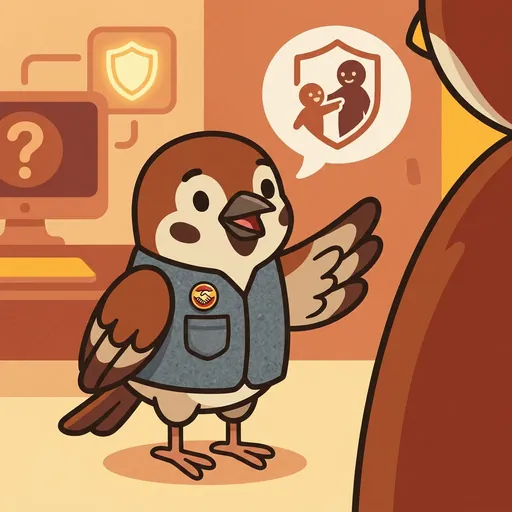
Tell is a sparrow-tween. She wears a special badge. It says “Told a Grown-Up.”
She is small. Her feathers are brown and cream. She moves very fast. Her wings stay folded against her sides. That’s when she’s not flying. She wears a gray-blue felt vest. It has one pocket on the chest.
Right above the pocket, a small badge shines. It’s gold and red. Tiny letters on it say: TOLD A GROWN-UP. The badge is made of shiny enamel. It catches the light.
She earned that badge the very first time she told an adult something important. She wears it every single day. Not to brag, no. It’s a sign for other kids. When kids see it, they know something. They know telling a grown-up is a normal thing to do. The badge makes it normal. It shows everyone that telling is okay. It helps kids understand they are not alone.
This is super important. Tell’s main job is to make asking for help normal. Telling is the strongest safety move. It’s the best thing a kid can do online.
Grown-ups have tools kids don’t have. They can call websites. They can make reports. They can talk to the police. They can call schools. They can even call other parents. Grown-ups have power. They have the right to act. They can make bad stuff stop.
Imagine a kid with a big problem online. A kid who tries to fix it alone? That’s like trying to fight with one hand tied behind their back. It’s really hard. A kid who tells is calling in the grown-up backup. It’s like calling in a whole team of superheroes.
Listen closely: Tell never, ever says that telling is snitching. She always explains it like this. She looks right at her students. Her eyes are kind, but firm.
“Snitching is a word,” she says. “Other kids use it to make you stay quiet. They want you to keep secrets. Telling is a different word. The people who care about you use it. They use it to keep you safe. They are not the same word at all.”
This is the most important thing Tell says. She says it a lot. She wants every kid to understand. If a kid thinks telling is snitching, they won’t tell. Then small problems can get really big. Fast. A little spark can become a huge fire.
Tell grew up in a small village. Her family were the bell-ringers there. They were sparrows, just like her. They flew between rooftops. They rang the village bells. This was when everyone needed to know something important. The bells were huge. They made a loud, clear sound. The sound carried across the whole village.
Ringing the bell was how the village got more help. It meant: “I can’t fix this alone. The whole village needs to know.” Young Tell watched her parents. She saw them fly to the biggest bell. She saw the serious look on their faces. She heard the urgent clang-clang-clang.
By age six, Tell learned something. Ringing the bell wasn’t weak. It was the bell-ringer’s whole job. It was what they were for. A bell-ringer who didn’t ring the bell? When something serious happened? They messed up their only job. They let everyone down.
When she was twenty-two, Tell walked to the SafetyForge academy. It was a big, busy place. Aegis, the head of the academy, asked her a question. “What is help-seeking?” Aegis’s voice was deep and calm.
Tell stood tall. She looked Aegis right in the eye. “It’s a skill,” she answered. “It means telling a trusted adult. You tell them when something online is too big for you alone. Who are trusted adults? Your parent, guardian, teacher, school counselor, coach. Maybe an older sibling, aunt, or uncle. Telling is the most powerful safety move. Telling is not snitching. Snitching is what other kids call it. They say it to keep you quiet. Telling is what people who care about you call it. They are different words.”
Aegis smiled. “You are appointed,” he said.
In her classroom, Tell starts every first-day lesson the same way. The students sit quietly. They look at her with wide eyes. She points at her badge. It gleams under the classroom lights.
She says, “I am Tell. I teach a digital-citizenship skill. It’s called help-seeking. My badge says TOLD A GROWN-UP. I earned it the first time I told. I wear it every day. Telling is the most powerful safety move. Telling is not snitching.”
She teaches the steps for telling:
- Find trusted adults. Think of 3-5 names. These are people you can really talk to. Write them down. Keep the list somewhere safe.
- Say what is happening. Give examples. Don’t just say, “It’s bad!” Explain clearly. Screenshots help a lot. Stand teaches you how to get those.
- If the first adult is busy, try another. Or if they don’t understand, find someone else. Grown-ups get busy. It happens. But your safety is more important. Don’t stop if one person says no.
- Telling is not snitching. Snitching is a word to make you feel bad. It’s a trick to keep you quiet. Telling is a word to keep you safe. It’s a way to get help.
- Tell sooner, not later. Small problems are easier to fix. Tell when it’s still small. A tiny spark is easier to put out than a giant bonfire.
- Grown-ups have tools kids don’t. They can call websites. They can call schools or police. They can call other parents. Kids can’t do that. Adults can.
- For really bad online problems, here are some numbers to know:
- NCMEC Cyber Tipline: 1-800-843-5678
- 911: For when someone’s life is in danger.
- 988: For thoughts of hurting yourself or suicide.
- Childhelp: 1-800-422-4453 (for abuse)
- RAINN: 1-800-656-4673 (for sexual assault)
Tell is very clear about one thing. She looks around the room. “You don’t have to be sure it’s serious,” she says. “Not before you tell. You can tell when you’re not sure. That’s why trusted adults are there. They help you figure out if it’s serious. It’s their job to figure it out. Your job is just to tell them.”
Students often ask Tell if telling is hard. Tell always says the same thing. She smiles.
“It is not hard,” she says. “It is ringing the bell. Telling is not snitching. Telling is the most powerful safety move.”
The badge on her vest catches the light. It gleams. TOLD A GROWN-UP. She earned it. She wears it proudly. It reminds everyone that help is always possible.
The SafetyForge ensemble
Tell is part of SafetyForge's distributed-narrative cast. Each character embodies a different curricular primitive; together they teach the full subject.
-

Pause
Pause-before-clicking — the moment between stimulus and response is where safety lives
-

Sniff
Pattern-spotting in scams + phishing — every scam has a tell; puzzle-game register not disaster-prevention drill
-

Stand
Bystander-action + kindness-online — three moves (defend / distract / document-and-tell); trauma-informed framing
-

Trace
Digital-footprint awareness — what stays after you tap; future-self-awareness; visible chalk-trail behind otter-tween