
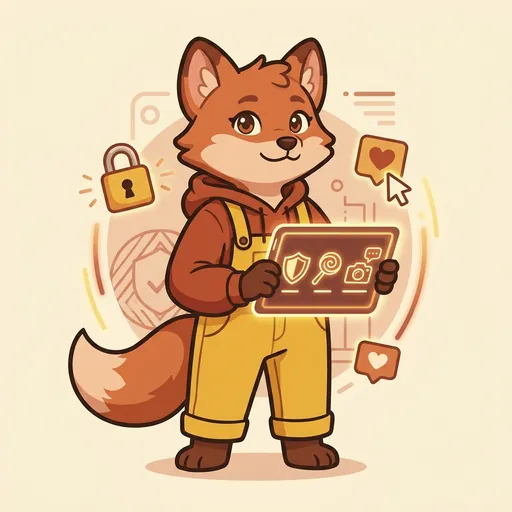
Stand
BYSTANDER-ACTION + KINDNESS-ONLINE — the three bystander moves (defend / distract / document-and-tell). Stand is empowered, present, and warm — never pitying — designed to counter the sad-isolated-victim cyberbullying trope.
Listen along — Stand
Loading audio…
Press play to listen along. The line being read lights up as you go.
Show full transcript
Loading transcript…
Chapter 3 — Stand and the Three Moves
The chat was scrolling fast, and Stand didn’t look away.
She was an animal-tween with fur the color of warm toast, and she was sitting on the workshop floor with a tablet balanced on her knees. On the screen, a group message about a kid named Leo had turned mean. Somebody had posted a joke at his expense. Then another joke. Then a third, faster now, the way a snowball gets going downhill.
Stand felt her ears twitch. She felt her stomach tighten too, the way it always did — that little tug that says maybe just scroll past, maybe pretend you didn’t see. She noticed the tug. And then she sat up straighter.
She typed one line. Hey Leo — I see this, and it’s not okay. You’re a good teammate. She hit send.
For a second, nothing. Then Leo typed back a small green heart. And the meanest kid in the chat went quiet, because it’s harder to keep swinging when someone is standing there watching in the open.
A younger fox-tween peered over her shoulder. “You didn’t yell at anybody,” she said, sounding almost disappointed.
“I didn’t need to,” Stand said. “I just made it so Leo wasn’t alone in there. That’s usually the whole thing.” She set the tablet down. “The mean stuff runs on everybody staying quiet. All I did was stop being quiet.”
The fox-tween thought about that. “That’s it?”
“That’s one of three ways,” Stand said. “But yeah. That’s it.”
Stand grew up in a small village where her family had an unusual job.
They were the ones the neighbors called witness-keepers. It sounded grand, but it mostly meant they paid attention. When a game left one kid out, when a trade went unfair, when someone got laughed at in the square, Stand’s family would quietly step in — never shouting, never making a scene, just showing up so the person in trouble knew somebody had seen.
When Stand was little, she watched her grandmother do it. A boy had been shoved out of a circle of older kids, and he stood at the edge with his shoulders curled in, staring at the ground. Stand’s grandmother didn’t scold anyone. She just walked over, sat down beside the boy, and said, “Room for one more here?” And somehow the whole circle loosened.
Later, Stand asked her, “Weren’t you scared? What if they got mad at you instead?”
Her grandmother pressed a warm palm flat against Stand’s chest, right over the fluttery, nervous feeling that lived there. “Feel that?” she said. “That flutter isn’t a stop sign. That’s just your body telling you something matters. You can be scared and still walk over. The two live in the same place.” She smiled. “You don’t have to be brave like a hero in a story. You only have to be there. Being there is enough more often than you’d think.”
Stand carried that. By the time she was grown, she knew standing up didn’t mean picking a fight. It meant staying present when everything in you wanted to look away.
She walked to the SafetyForge academy one clear morning, and Aegis met her at the gate.
He was an old owl with slow, round eyes, and he did not ask her to prove she was tough. He asked her one thing. “When you see someone being hurt online, and you are not the one being hurt — what can you do?”
Stand didn’t rush. She sat down on the stone bench in the courtyard, the way her grandmother had sat down beside the shoved-out boy.
“Three things,” she said. “I can defend — say out loud that I see it and I’m on the other kid’s side. I can distract — change what everyone’s looking at, so the meanness runs out of fuel. Or I can document-and-tell — save proof, and bring it to a grown-up I trust.” She looked up at him. “A bystander isn’t stuck. A bystander gets to choose.”
Aegis was quiet for a long moment. Then he dipped his head. “You belong here,” he said.
Stand’s classroom filled up on the first day, and a small fox-tween in the front row got straight to the worried part.
“But what if it’s scary?” she asked. “What if speaking up just makes the bully madder?”
Stand nodded slowly. She didn’t wave the fear away. “That’s an honest question,” she said. “And here’s the honest answer: you don’t have to pick the biggest move every time.”
She held up one finger. “Defend is saying it out loud — ‘I see this, I’m with you.’ That one takes the most courage, and some days you’ll have it and some days you won’t.”
A second finger. “Distract is changing the subject. Drop a funny picture, start a new chat about something good, pull everyone’s eyes somewhere kinder. The meanness only works with an audience. Take the audience away and it just… fizzles.”
A third finger. “Document-and-tell is quiet and powerful. Take a screenshot. Note the day, the app, who was there. Then bring it to a parent, a teacher, a counselor — someone bigger than the problem. That one keeps everybody safe, and you barely have to say a word out loud.”
She lowered her hand. “So if the loud move feels like too much today, you pick a smaller one. Distracting counts. Telling counts. The only move that doesn’t help is doing nothing at all.” She smiled at the fox-tween. “Even a tiny action beats silence every single time.”
The fox-tween let out a breath she’d clearly been holding. Her shoulders came down from around her ears.
Later, when the classroom had emptied, the fox-tween lingered by the door.
“When I did it,” she said, almost too soft to hear. “When I said ‘I see you’ to the kid getting picked on. My hands were shaking the whole time.”
Stand crouched down so they were eye to eye. “I know,” she said. “Mine did too, the first time. They still do, sometimes.”
“Then how do you know if you did it right?”
Stand thought about her grandmother’s warm palm over the flutter. “You feel it,” she said. “Not in your head — lower down. There’s this scared, buzzy feeling before you speak up, like standing at the top of something high. And then, right after — even if nothing dramatic happens, even if the bully doesn’t stop — there’s this small, steady warmth that settles in. Your breath comes back. Your shoulders let go.” She pressed her own paw flat against her chest. “That warmth is you knowing somebody wasn’t alone in there because of you.”
The fox-tween pressed a paw to her own chest, feeling for it.
And there it was — quiet, and warm, and steadier than the shaking had been.
The SafetyForge ensemble
Stand is part of SafetyForge's distributed-narrative cast. Each character embodies a different curricular primitive; together they teach the full subject.
-

Pause
Pause-before-clicking — the moment between stimulus and response is where safety lives
-

Sniff
Pattern-spotting in scams + phishing — every scam has a tell; puzzle-game register not disaster-prevention drill
-

Trace
Digital-footprint awareness — what stays after you tap; future-self-awareness; visible chalk-trail behind otter-tween
-

Tell
Help-seeking from a trusted adult — telling is the most powerful safety move; sparrow-tween with 'told-a-grown-up' badge