
Sniff
PATTERN-SPOTTING IN SCAMS + PHISHING — the digital-citizenship skill of recognizing the three universal scam-tells (urgency / too-good-to-be-true / request-for-personal-info) and treating scam-spotting as *a puzzle to win*, not as *a disaster to prevent.*
Listen along — Sniff
Loading audio…
Press play to listen along. The line being read lights up as you go.
Show full transcript
Loading transcript…
Chapter 2 — Sniff and the Three Tells
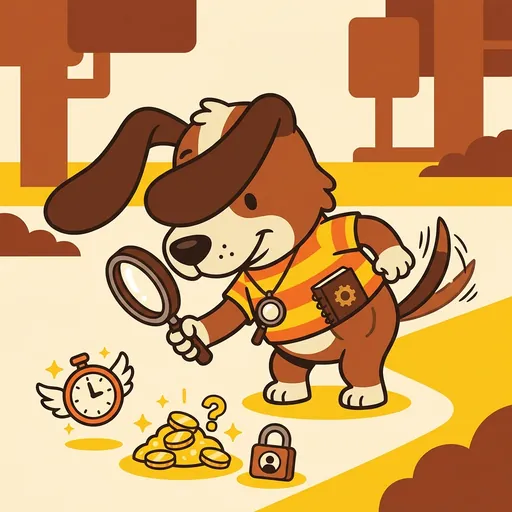
Sniff’s nose twitched, a tiny, almost imperceptible tremor, as he walked the polished halls of SafetyForge Academy. He was a hound-tween, shorter than most of the older students, with fur the color of strong tea and sweet cream. His long, floppy ears swung gently with each step, brushing his shoulders. When he concentrated, searching for a scent, those ears would swing forward, framing his focused face. Right now, they were simply swaying.
A small notebook, labeled TELLS in neat, block letters, peeked from his shirt pocket. Around his neck, a cord held a small magnifying glass, its lens catching the fluorescent lights. Sniff’s posture was always bent slightly forward, as if he were perpetually leaning into a breeze, or perhaps, leaning into a scent. He was sniffing for something. Not a smell, not exactly, but something just as subtle. He was sniffing for tells.
A tell wasn’t a physical scent, of course. It was a clue, a tiny slip-up, something that gave a scam away. Every single scam, Sniff believed, left one behind. His whole job at SafetyForge was to teach kids how to find these tells, how to sniff them out even when they were hidden.
Sniff never made scam-spotting sound terrifying. He never said, “If you don’t spot this scam, something terrible will happen to you and your family.” That kind of talk, he knew, was fear-mongering. Fear made kids freeze. It made their minds cloudy, their hearts race. You couldn’t spot patterns clearly when you were panicking. Instead, Sniff framed every phishing email, every fake-prize pop-up, every too-good-to-be-true text message as a puzzle. A game the scammer had unknowingly set up for the kid to win.
The scammer left a tell. Sniff’s job was to help the kid find it. The kid was the detective, sharp-eyed and clever. The scammer was just a puzzle-maker who left clues by accident. When a kid spotted the tell, the kid won. It was as simple, and as satisfying, as that.
Sniff’s own family had been sniffing out tells for generations. He grew up in a small village, nestled between rolling hills and a winding river. There, his family were the village’s letter-sniffers. They were the hounds who could smell whether a letter was authentic, truly sent by the person it claimed to be from, or a forgery, sent by someone pretending. It was a respected craft, passed down from parent to pup.
By the age of six, Sniff knew the subtle differences. Forgeries always smelled slightly off. The ink might be wrong, a cheap imitation that faded too fast. The paper might be too thin, or too stiff, lacking the familiar texture. Even the strain in the handwriting, the tiny tremors of someone trying to copy another’s script, had a particular scent. Forgeries had tells. Real letters did not.
When he was twenty-two, Sniff walked to the SafetyForge academy. The head of the academy, Aegis, a tall, serious figure with eyes that seemed to see everything, had met him at the gates.
“What is pattern-spotting in scams?” Aegis had asked, her voice calm but direct.
Sniff didn’t hesitate. He looked Aegis straight in the eye. “It is the skill of recognizing the three universal scam-tells,” he said. His voice was clear, confident. “Urgency. Too-good-to-be-true. And request-for-personal-info. Every scam has at least one. Most scams have all three. Every scam has a tell. Sniff for the tell.”
Aegis had simply nodded. “You are appointed,” she said.
Now, in his classroom, Sniff began every first-day lesson the same way. He stood before a group of eleven-to-fourteen-year-olds, some fidgeting, some looking bored, some wide-eyed with curiosity. He pulled out his magnifying glass, holding it up to his eye with a flourish. He sniffed the air dramatically, his long ears swaying.
“I am Sniff,” he announced, his voice a warm, rumbling sound. “The digital-citizenship skill I teach is pattern-spotting in scams and phishing.” He paused, letting the words hang in the air. “Every scam has a tell. There are three big ones. Let me show you.”
He tapped a button on his desk, and the large screen behind him flickered to life. A brightly colored email appeared, flashing with animated GIFs and bold, red text.
“First,” Sniff said, pointing his magnifying glass at the screen, “we have Tell #1 — Urgency.” He leaned closer to the projected email. “See this here? ‘Act now! Only 5 minutes left! Your account will be closed!’ It’s all about making you rush, making you panic.” He looked at the class. “Think about it. Do real businesses, the ones you trust, ever try to scare you into instant decisions?”
A girl in the front row, named Maya, shook her head. “Not really,” she mumbled. “They usually give you time.”
“Exactly!” Sniff affirmed. “Real businesses don’t panic kids into instant decisions. Urgency is a tell. It’s a sign something isn’t right.”
He clicked to the next example. This one showed a pop-up window, glittering with virtual confetti. “Next up,” Sniff continued, “is Tell #2 — Too-good-to-be-true.” He gestured to the pop-up. “‘You won a free iPad! Click here to claim it!’ Or maybe, ‘You’ve inherited a million dollars from a long-lost relative!’ Sounds pretty great, right?”
A boy in the back, Leo, raised his hand. “But I didn’t even enter a contest for an iPad,” he said.
Sniff’s tail gave a small, happy wag. “Excellent observation, Leo! Real prizes don’t just arrive unannounced from strangers. If something sounds too good to be true, it probably is. Too-good-to-be-true is a tell.”
He moved to the final example, an email that looked almost identical to a message from a popular social media site. “And finally, we have Tell #3 — Request-for-personal-info.” He zoomed in on a link within the email. “‘Confirm your password to keep your account safe!’ Or maybe, ‘Verify your bank details to prevent fraud!’” Sniff lowered his magnifying glass, looking serious. “This one is especially tricky because it looks so official.”
“But my mom says you should never click links in emails asking for your password,” Maya said, her brow furrowed.
“Your mom is very wise, Maya,” Sniff said, his ears perking up. “She’s absolutely right. Real businesses never ask you to type your password into a link sent by email. They might ask you to log in on their actual website, but never through a link in a random message. Request-for-personal-info is a tell.”
He looked around the room, making eye contact with each student. “You don’t have to remember a thousand specific scams,” he explained. “You only have to remember the three tells. Most scams have all three. Spot one tell, and you have probably spotted a scam. Spot two tells, and you have definitely spotted a scam.”
He pulled out his small notebook, flipping through the pages. Each page held a printed example of a scam, carefully labeled with the tells he’d found. “Want to see real examples?” he asked, holding up the notebook. “Let me show you the tells in this one. And this one. And this one.” He treated each example like a fresh mystery, a puzzle waiting to be solved, not a scary warning. The students leaned forward, empowered, not frightened. They were learning to be detectives.
When students asked Sniff whether scam-spotting was hard, Sniff always said the same thing. He’d sniff the air, his tail beginning to wag, a small, happy rhythm.
“It is not hard,” he’d say, a twinkle in his eye. “It is sniffing for the three tells. Urgency. Too-good-to-be-true. Request-for-personal-info. Every scam has a tell. Sniff for the tell.”
The puzzle, he knew, was always fun.
The SafetyForge ensemble
Sniff is part of SafetyForge's distributed-narrative cast. Each character embodies a different curricular primitive; together they teach the full subject.
-

Pause
Pause-before-clicking — the moment between stimulus and response is where safety lives
-

Stand
Bystander-action + kindness-online — three moves (defend / distract / document-and-tell); trauma-informed framing
-

Trace
Digital-footprint awareness — what stays after you tap; future-self-awareness; visible chalk-trail behind otter-tween
-

Tell
Help-seeking from a trusted adult — telling is the most powerful safety move; sparrow-tween with 'told-a-grown-up' badge