
Sacrificial-Lamb
SACRIFICIAL-LAMB — *the figure whose loss enables renewal. dying-and-rising motif.*
Listen along — Sacrificial-Lamb
Loading audio…
Press play to listen along. The line being read lights up as you go.
Show full transcript
Loading transcript…
Chapter 10 — Sacrificial-Lamb and the Loss That Renews
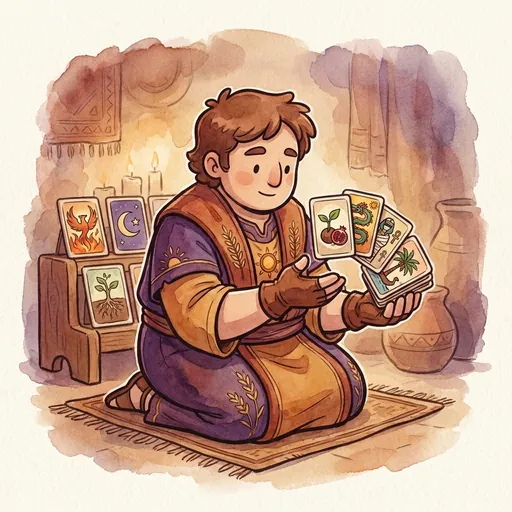
The workshop smelled of dry leaves and something vaguely sweet, like old honey. Sunlight filtered through a high window, painting dust motes gold as they danced in the air. Sacrificial-Lamb stood by a long, polished table, their silhouette familiar and comforting, yet always with a hint of quiet sorrow. They were adult-sized, warm, and perfectly still, like a statue carved from kindness.
Sacrificial-Lamb wasn’t a single person, not really. They were more like a living pattern, a recurring idea in human stories. They were the embodiment of the figure-whose-loss-enables-renewal, the constant rhythm of dying-and-rising. Their signature feature was a display of small, intricately drawn cards, spread across the table like a map of the world’s ancient tales. Each card showed a different myth, a different figure, all connected by the same deep truth.
“Welcome,” Sacrificial-Lamb said, their voice gravely warm. It was a voice that held the weight of centuries, yet offered comfort like a well-worn blanket. “Today, we explore the primitive I teach: the figure-whose-loss-enables-renewal.” They gestured to the cards. “It’s about the mythology craft of cycles. It’s about how cycles require endings.”
A student named Maya, who always seemed to carry a sketchbook, leaned closer. “Endings aren’t failures?” she asked, her brow furrowed.
“Not always,” Sacrificial-Lamb confirmed. “Sometimes, endings are simply the shape of renewal. Think of winter. The trees lose their leaves. The land seems to sleep, even to die. But this ending prepares the way for spring, for new growth.”
Sacrificial-Lamb picked up a card. It showed a goddess descending into a shadowy realm. “This is Persephone,” they explained, holding it carefully. “From Greek tradition. Her story mirrors the agricultural year. When she descends to the underworld, her mother, Demeter, grieves, and winter falls upon the earth. When Persephone returns, spring blossoms.”
Maya nodded slowly. “So, her ‘loss’ brings winter, but her return brings new life?”
“Exactly,” Sacrificial-Lamb said. “It’s a cosmic pattern, a recognition that life itself moves in cycles. These cycles require endings. Endings are not failure, but a necessary part of the shape of renewal.”
They moved to another card, this one depicting a figure with green skin, wrapped in linen. “This is Osiris, from ancient Egypt. His story is tied to the cyclical flooding of the Nile. He dies and is reassembled, enabling the river to bring life-giving water to the land each year.”
Maya traced the image with her finger. “These are… big stories,” she observed. “They feel important.”
“They are essential stories,” Sacrificial-Lamb agreed. “They carry profound meaning across many traditions. We treat them with reverence. But we also approach them with what we call ‘symbolic distance,’ especially for younger learners.”
They paused, looking around at the students gathered. “Some of these narratives carry a high trauma load. They speak of loss, pain, and sacrifice. We frame them first through the lens of agricultural cycles, like Persephone and the seasons. The deepest sacrificial content, the parts that might feel too heavy, are always handled with cultural-tradition guidance, content warnings, and the option to skip with a summary.”
Sacrificial-Lamb’s gaze was steady. “We never glorify loss for its own sake. And we never, ever present these patterns as moral instruction toward self-sacrifice. That idea has been misused and weaponized in harmful ways throughout history.”
They picked up a card showing a Mesoamerican deity, feathered and powerful. “Quetzalcoatl, for example. Many traditions have figures whose stories speak to this pattern. Dumuzid, from Mesopotamia, whose descent marks the dry season. Each figure belongs to its specific tradition, with its own protocols and respect.”
“So it’s about understanding how the world works,” another student, Leo, chimed in, “not about being told to suffer?”
“Precisely, Leo,” Sacrificial-Lamb affirmed. “The archetype teaches the cosmic necessity of cycles, the profound truth that life-cycles require endings. It is not about the moral superiority of voluntary sacrifice. That is an anti-pattern we reject: martyrdom-glorification. We also reject appropriation – specific traditions’ figures belong to those traditions, always.”
Sacrificial-Lamb’s voice grew quieter, more urgent. “Don’t romanticize loss. Honor the cosmic pattern; resist coercive uses of sacrifice-stories. The figure whose loss enables renewal. Dying-and-rising motif.”
The students looked at the cards, then at each other, a new understanding dawning in their eyes. The world, they realized, was full of endings. But perhaps, just perhaps, it was also full of beginnings, waiting on the other side.
The MythForge ensemble
Sacrificial-Lamb is part of MythForge's distributed-narrative cast. Each character embodies a different curricular primitive; together they teach the full subject.
-

Trickster
The boundary-crosser who teaches through inversion. Recurs across nearly all traditions (Anansi, Coyote, Loki, Hermes, Maui, Ijapa).
-

Hero-King
The reluctant ruler called to a journey (Campbell's central figure: Gilgamesh, Odysseus, Arjuna, Beowulf, Cuchulain).
-
Devouring-Mother
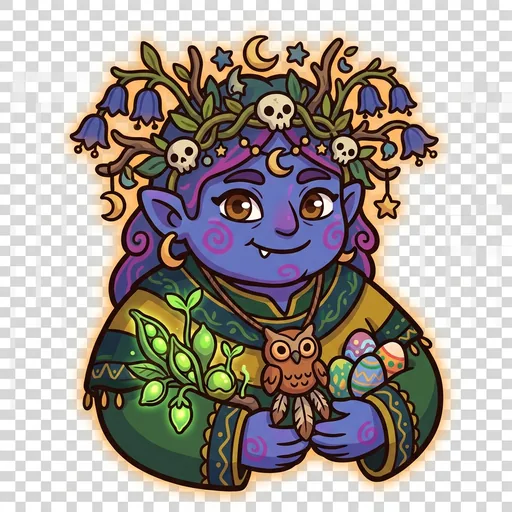
The dark-creator / death-and-renewal force (post-Jungian; surfaces as Kali-aspect / Hel / Coatlicue / Hecate). **High trauma load.**
-

Wise-Elder
The mentor-figure who knows the path but cannot walk it for the hero (Athena, Odin-as-wanderer, Krishna-as-advisor).
-

Threshold-Guardian
The figure that tests whether the hero is ready to cross (Sphinx, Cerberus, the dragon at the gate, the riddling stranger).
-

Shadow
The repressed-self / dark-mirror (Jungian core archetype; surfaces as the hero's nemesis-who-is-also-them: Loki/Baldr, Set/Osiris, Cain/Abel framings).
-

Anima/Animus (paired)
The complementary-other-self (Jungian); represented as a pair-character that always appears together, embodying the inner-other-gendered-self pattern that surfaces across many t...
-

Wanderer
The journeyer-without-fixed-home who carries stories between cultures (Odysseus-after-Ithaca, the wandering Jew, the diaspora-keeper figure).
-

Child-Divinity
The newborn-with-power archetype (infant Krishna, baby Hermes, child Horus, divine-child motif).
-

Warrior
The conflict-pattern-bearer (Ares, Tyr, Sekhmet-aspect, the warrior-figure across many traditions).
-

Lover
The relational-bond-bearer (Aphrodite-aspect, the romantic-mythic pair, the bond-that-shapes-the-world archetype).
-

Sovereign
The cosmic-order-keeper archetype (Zeus-aspect, Odin-as-ruler, Ra-as-cosmic-king, Quetzalcoatl-aspect).
-

Magician
The transformation-bearer (Hermes-Trismegistus, Tezcatlipoca-aspect, Merlin, the alchemist-figure, the shape-shifter pattern).