
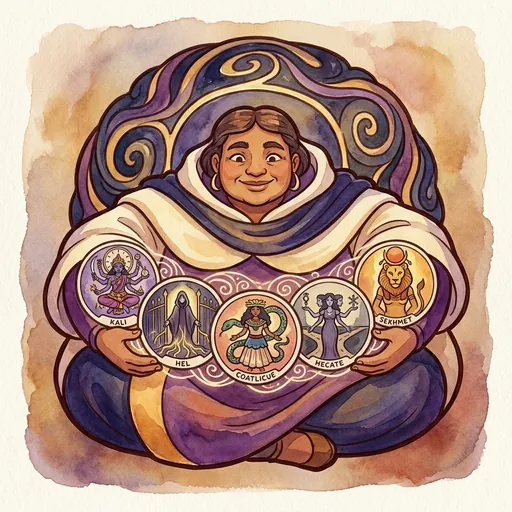
Devouring-Mother
THE GREAT KEEPER — the pattern of holding close, then letting grow.
Listen along — Devouring-Mother
Loading audio…
Press play to listen along. The line being read lights up as you go.
Show full transcript
Loading transcript…
Chapter 3 — The Great Keeper and the Pattern That Learns to Let Go
In the oldest garden in Mythforge, a huge, soft-shouldered figure in a deep-indigo cloak knelt over a single green shoot and, very gently, built a wall of stones around it.
The Great Keeper worked slowly. Each stone was placed so the little shoot would never feel wind, never feel frost, never feel the sharp teeth of a hungry rabbit. When the wall was finished, the shoot stood in a perfect, safe, shadowed circle. Nothing could touch it. Nothing could hurt it.
A student wandered over, chewing a piece of grass. “That’s the safest plant I’ve ever seen,” she said.
“Yes,” said the Keeper, warm and rumbling. “And watch.”
Days passed. The student came back. The shoot inside the stone wall had grown pale and thin, reaching, reaching, for a sun the wall kept blocking. It was safe. It was also fading.
The student’s face fell. “It’s not dying, is it?”
“Not yet.” The Keeper reached down and, one by one, began lifting the stones away. Sunlight fell across the shoot. Wind touched it and it swayed — and did not break. “This is the oldest pattern there is,” the Keeper said quietly. “The one that holds a thing close to keep it alive. And then — this is the hard part — the one that opens its hands so the thing can grow.” A breeze moved the little plant, and it leaned toward the light like it had been waiting its whole short life to do exactly that.
“Holding on,” the Keeper said, “and letting go. Both are love. You need both.”
The Great Keeper had not always known the second half.
Long ago — so the story goes — the Keeper had made a small warm world and tucked one living thing inside it, and loved it so much that the answer to every danger was another wall. Cold outside? A thicker roof. Something sharp? A softer floor. The living thing was cherished. It was guarded. It never once got hurt.
And it never grew.
The Keeper felt that as an ache — a tight, worried, clenched feeling right under the breastbone, the feeling of holding something so hard your hands start to hurt. The living thing pressed against the walls, not to escape the love, but to reach the light. And the Keeper understood, slowly and painfully, that a world with no endings is a world where nothing new can begin. That a seed kept forever safe in a jar is a seed that never becomes a tree.
So the Keeper did the bravest and most frightening thing: opened a door in the wall. Let the cold in a little. Let the living thing take a step that might scrape a knee.
It scraped its knee. It cried. And then it stood up taller than before, and looked at the Keeper with new, wide-awake eyes.
That ache under the breastbone never fully left. But the Keeper learned its real name. It wasn’t danger. It was love learning to trust.
The Keeper came to Mythforge because a place that studied every old story ought to hold the hardest, gentlest one of all — the pattern that lives in every tale where something must end so something else can be born.
Lyra, the mentor who welcomed the cast, did not ask the Keeper to prove anything grand. Lyra asked one careful question. “What do you carry?”
The Keeper did not answer in words. The Keeper took a closed fist, held it up, and slowly, gently, uncurled the fingers — palm open, empty, offered.
Lyra watched the fist become an open hand. “Closed to protect,” Lyra said softly. “Open to let grow.”
“Both,” said the Keeper. “Never only one. A hand that never closes can’t shelter. A hand that never opens can’t release. The whole pattern is the closing and the opening.”
Lyra nodded, and there was gentleness in it, the way you’re gentle around something that carries weight. “You belong here. And we’ll always frame you with care — some hearts are tender about holding on and letting go.”
The student with the grass came back to the Keeper’s workshop the next week, upset.
“My little brother learned to ride his bike,” she said. “And I let go of the seat like Mom told me to, and he wobbled, and I almost grabbed it again, and — my whole stomach hurt. Why did letting go feel bad when it was the right thing?”
The Keeper smiled, that slow warm rumble of a smile. “Show me your hands.”
She held them up.
“Close them. Tight. Like you’re holding the back of that bike seat.” She did. “How long could you hold like that?”
”…Not forever. It starts to hurt.”
“That’s the ache. That’s the closed hand loving so hard it hurts.” The Keeper reached out and, very softly, touched her clenched fingers until they loosened. “Now — open. Let the bike go. Watch what happens to the wobble.”
“He rode,” she said slowly. “He actually rode. Once I stopped holding on, he could balance.”
“Because balance was his to find. Not yours to give.” The Keeper’s voice was low and kind. “The oldest pattern isn’t about losing what you love. It’s about knowing that some things only bloom when you finally open your hands. The seed has to leave the shell. The kid has to leave the seat. The story has to let a chapter end so the next one can start.” The Keeper looked at her tender, unsure face. “It’s supposed to feel like something. If it didn’t ache a little, it wouldn’t be love.”
That evening the student lingered by the open door of the workshop, watching the Keeper tend a whole row of little plants — some walled, some half-walled, some standing free in the wind.
“How do you know,” she asked, “when it’s time to take the stones away?”
The Keeper was quiet a moment, hands resting open in the dirt.
“You feel it,” said the Keeper. “That’s the honest answer. When you’re holding something so close that your arms have gone stiff and your chest has gone tight — that tightness isn’t telling you to squeeze harder. It’s telling you it’s almost time to open. Not to stop loving. Just to loosen your grip enough that the thing you love can reach the light on its own.”
The student breathed out, and felt her shoulders come down from around her ears, and realized she’d been holding them there all week.
“That’s it,” the Keeper said gently, watching the tension leave her. “That soft feeling — the one right after you let go, when your hands stop hurting and your breath comes easy — that’s the whole pattern finishing its turn. Holding was love. And so is this. So is the letting go.”
The MythForge ensemble
Devouring-Mother is part of MythForge's distributed-narrative cast. Each character embodies a different curricular primitive; together they teach the full subject.
-

Trickster
The boundary-crosser who teaches through inversion. Recurs across nearly all traditions (Anansi, Coyote, Loki, Hermes, Maui, Ijapa).
-

Hero-King
The reluctant ruler called to a journey (Campbell's central figure: Gilgamesh, Odysseus, Arjuna, Beowulf, Cuchulain).
-

Wise-Elder
The mentor-figure who knows the path but cannot walk it for the hero (Athena, Odin-as-wanderer, Krishna-as-advisor).
-

Threshold-Guardian
The figure that tests whether the hero is ready to cross (Sphinx, Cerberus, the dragon at the gate, the riddling stranger).
-

Shadow
The repressed-self / dark-mirror (Jungian core archetype; surfaces as the hero's nemesis-who-is-also-them: Loki/Baldr, Set/Osiris, Cain/Abel framings).
-

Anima/Animus (paired)
The complementary-other-self (Jungian); represented as a pair-character that always appears together, embodying the inner-other-gendered-self pattern that surfaces across many t...
-

Wanderer
The journeyer-without-fixed-home who carries stories between cultures (Odysseus-after-Ithaca, the wandering Jew, the diaspora-keeper figure).
-
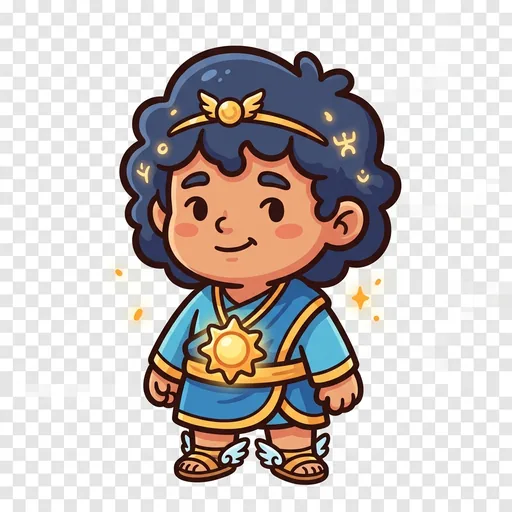
Child-Divinity
The newborn-with-power archetype (infant Krishna, baby Hermes, child Horus, divine-child motif).
-
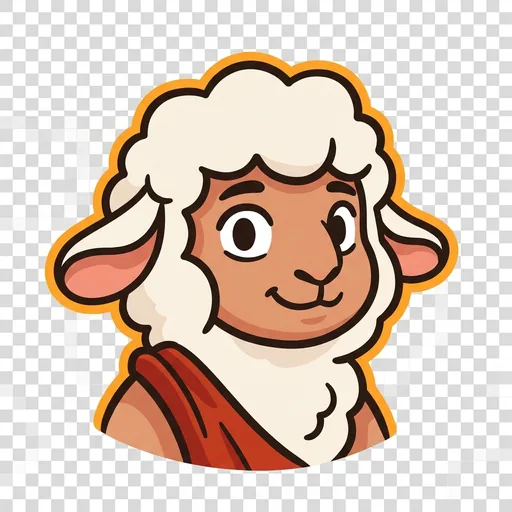
Sacrificial-Lamb
The figure whose loss enables renewal (cross-traditional: dying-and-rising deities, scapegoat figures, voluntary-sacrifice motif).
-
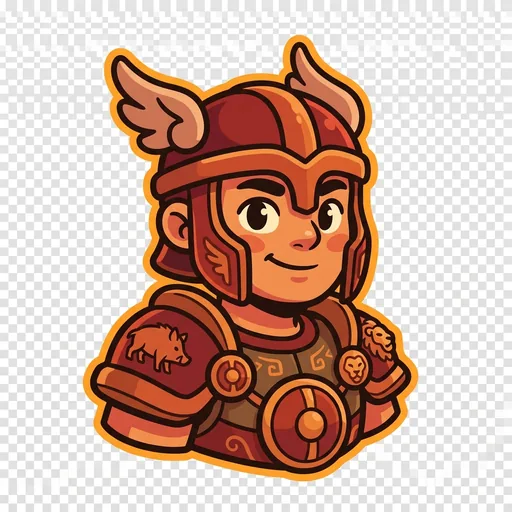
Warrior
The conflict-pattern-bearer (Ares, Tyr, Sekhmet-aspect, the warrior-figure across many traditions).
-
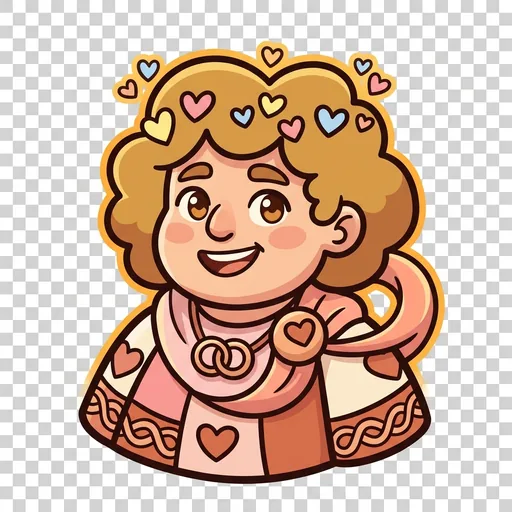
Lover
The relational-bond-bearer (Aphrodite-aspect, the romantic-mythic pair, the bond-that-shapes-the-world archetype).
-

Sovereign
The cosmic-order-keeper archetype (Zeus-aspect, Odin-as-ruler, Ra-as-cosmic-king, Quetzalcoatl-aspect).
-

Magician
The transformation-bearer (Hermes-Trismegistus, Tezcatlipoca-aspect, Merlin, the alchemist-figure, the shape-shifter pattern).