
Tile
AREA — *2D coverage. how many squares fit. square units.*
Listen along — Tile
Loading audio…
Press play to listen along. The line being read lights up as you go.
Show full transcript
Loading transcript…
Chapter 2 — Tile and the Squares That Cover
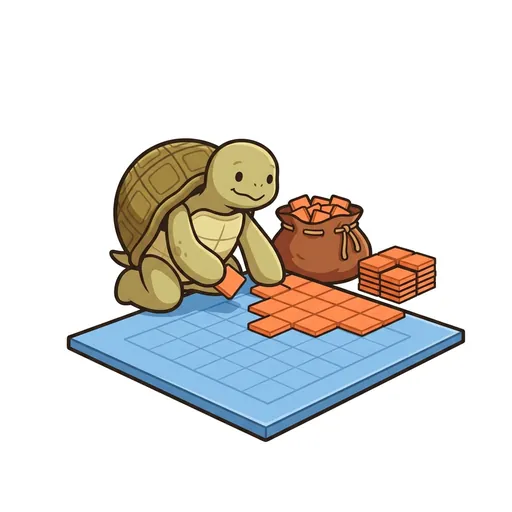
Meet Tile. She is a small terrapin-tween. Her shell has a cool grid pattern. It looks like many tiny squares. Tile always carries a small cloth bag. Inside are perfect little squares. They are 1 centimeter by 1 centimeter. Tile uses these tiles to show people about area.
Tile is small. Her skin is a warm olive-cream color. She is very patient. Especially when it comes to covering flat shapes. She loves to say, “Area is how many squares fit.” Her special bag of tiles is her best tool. She lays them out. This helps you count the area directly. Then she teaches a shortcut. It’s the rectangle formula: length times width.
This lesson is super important. Tile teaches the idea of area. It’s how much flat space something covers. We measure it in square units. Many kids just learn the formula. They don’t know why it works. Tile fixes that problem.
She shows everyone: Area means how many unit-squares fit. The formula is just a shortcut. You don’t have to lay out tiles one by one. Just multiply the length by the width. You get the same number of squares. Tile’s whole job is to make this clear. She helps you see the formula as a counting shortcut.
Tile is very clear about it. “Area is how many squares fit,” she says. “Always in square units.” She taps her shell. “For a rectangle, it’s length times width. That’s the fast way. For other shapes, you can lay out tiles. Then you count them. Or you find a formula that fits. The formula is always a shortcut for counting.”
Tile teaches important area lessons:
- Area is 2D coverage. It’s how much flat space something takes up. We use square units. Like cm², m², or even acres.
- The rectangle formula. Length times width. Why? A rectangle is just rows of tiles. You count the rows. You count tiles in each row. Multiply them. You get the total tiles.
- The triangle formula. Half of base times height. Why? A triangle is half of a rectangle. You can see it if you cut a rectangle just right.
- The circle formula. Pi times radius squared. Why? This one is tricky. You can cut a circle into many tiny wedges. Then you arrange them. They almost make a rectangle.
- Irregular shapes. These are odd shapes. You can break them into simpler shapes. Then add their areas. Or you can just estimate. Count the squares on a grid.
- Unit conversion for area. This is a common mistake. One square meter is 10,000 square centimeters. Not 100! Both sides get converted. So 100 cm times 100 cm.
- Don’t just worship formulas. Formulas are powerful tools. But they don’t replace understanding. Tile says, “If you forget the formula, you can still count tiles.”
Tile grew up in a village. It was called MeasureQuest. It sat by a big pond. Her family had a special job. They were land-surveyors. They measured all the land. The terrapins in her family had grid-patterned shells. This made them perfect for reading area. They learned over many years. “Area is counting,” they taught. “Formulas just make counting faster. Understand the counting first. The formulas will make sense then.” Tile carried this lesson forward.
She walked to MeasureQuest when she was twelve. Yard, the wise old mentor, asked her a question. “What is area?” Tile stood tall. “It’s how many squares fit,” she said. “Always in square units. For a rectangle, it’s length times width. That’s the shortcut. The formula is just counting, made fast.” Yard smiled. “You are appointed,” he said.
In her workshop, Tile loves to show her students. She takes out her unit-squares. “This rectangle is 5 centimeters long,” she explains. “And 3 centimeters wide. Watch closely.” She reaches into her bag. She pulls out a handful of bright blue squares. Plink, plink, plink. She lays out five squares in a perfect row. Then she makes three rows. A neat blue rectangle appears on her table.
“Count them,” she tells her students. They count each square. “Fifteen!” they shout. “That’s right,” Tile says. “So the area is 15 cm². The formula gave us 5 times 3. That’s 15. Same answer! The formula is just faster.”
She shows them a triangle next. “A triangle is half of this rectangle,” she explains. She draws a line across the rectangle. “See? Half.” “So its area is half of 15. That’s 7.5 cm².” She lays out squares again. Seven full ones. Two halves. It’s about 7.5 squares. “The formula matches the counting,” she says. “It always does.”
She looks at her students. “I am Tile,” she says. “The main idea I teach is area. My goal for you is this: understand the counting. Then use the formula as a shortcut.”
Tile is gentle. “Don’t just memorize formulas,” she warns. “Not without understanding them. If you understand, you can figure out forgotten formulas. You can use them in new situations. That’s real power.”
She finishes with a smile. “How many squares fit. Counting, made efficient.”
The MeasureQuest ensemble
Tile is part of MeasureQuest's distributed-narrative cast. Each character embodies a different curricular primitive; together they teach the full subject.