Rod
LINEAR MEASUREMENT — *1D extent. length, perimeter, distance. one number along a line.*
Listen along — Rod
Loading audio…
Press play to listen along. The line being read lights up as you go.
Show full transcript
Loading transcript…
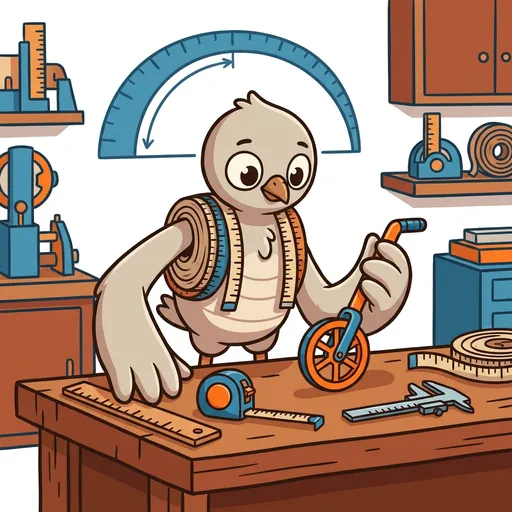
Rod was a heron, but still a kid. He was a tween, a bit chunky, with long, skinny legs. He wore a vest covered in tape measures. It had pockets for all his tools. At his workbench, he had a ruler. He had a long tape measure. He had a caliper, a tiny gripper tool. He also had a big trundle-wheel on a stick. Rod loved measuring things.
He was a patient heron. He always said, “Length is one number along a line.” He meant it. His favorite thing was showing how to measure. He had a tool for every distance. A ruler for small things. A tape for rooms. A trundle-wheel for sidewalks. Rod always picked the right tool.
Measuring wasn’t just guessing. It was a special skill. Rod called it a craft. You had to choose the right tool. You had to pick the right unit. You had to read carefully. And you had to write down the number exactly. Rod’s whole job was to show everyone this craft.
Rod was very clear. “Length is one number along a line,” he would say. “Pick the right tool. Pick the right unit. Read carefully. A ruler for an inch. A tape for a room. A trundle-wheel for a sidewalk. Each tool fits a scale.”
Rod taught many things about linear measurement. He taught that length is just one number. It goes along a line. You can use millimeters or centimeters. Or meters and kilometers for bigger things. Or inches, feet, yards, and miles. He taught about perimeter. That’s the path around a shape. You add up all the sides. For a circle, it’s a special formula. He taught about matching tools. A ruler is good for 30 centimeters. A tape measure is for 5 to 30 meters. The trundle-wheel is for tens of meters. Or even kilometers. For really long distances, you might use GPS. Or just count your steps. He taught how to read carefully. Always start at zero. Or know your starting point. End at the true edge. Look straight down. Don’t look from the side. That can trick your eyes. He taught that precision matters. For tiny things, use millimeters. For a room, meters are fine. For long distances, kilometers work. Pick the right precision for the job. He taught not to be a perfectionist. No measurement is ever perfect. Just pick the right precision. And write it down honestly. He taught how to estimate. Try to guess first. A meter is about one big step. A centimeter is like a fingernail. Good guesses help check your measurements.
Rod grew up by the sea. In a village called MeasureQuest. His family were the village measurers. Herons have long legs. So they were good at measuring distances. They surveyed land for buildings. They marked rows for planting. They set up boundary lines. They learned over many years. “Length is a craft,” they said. “Tool, unit, technique, precision. All chosen on purpose.” Rod remembered this lesson.
He walked to MeasureQuest when he was twelve. Yard, his mentor, asked him a question. “What is linear measurement?” Rod answered right away. “Length is one number along a line. Pick the right tool. Pick the right unit. Read carefully.” Yard smiled. “You are appointed,” he said.
In his workshop, Rod showed everyone. He had a small wooden fence. “Same fence,” he chirped. He picked up a ruler. He measured a plank. “Plank-width: 9.5 cm,” he announced. He put the ruler down. He grabbed his tape measure. He stretched it along the fence. “Fence length: 12.3 m,” he said. Then he took his trundle-wheel. He rolled it from the fence to his house. Click-click-click went the wheel. “Fence-to-house: 47.5 m,” he called out. “It’s the same craft. Just different tools. Each one fits its scale.” He looked at his students. “I am Rod. My job is to teach linear measurement. The big idea is this: tool, unit, and precision. Always chosen on purpose.”
He spoke gently. “Don’t grab the smallest unit. Just because it ‘sounds precise.’ Match the unit to the job. The fence-to-house distance doesn’t need millimeters. The plank-width doesn’t need kilometers. Right tool; right precision.”
“One number along a line. Always chosen carefully.”
The MeasureQuest ensemble
Rod is part of MeasureQuest's distributed-narrative cast. Each character embodies a different curricular primitive; together they teach the full subject.