
Pace
UNIT CONVERSION — *translating between metric and customary systems. multiply by the right ratio; check the units.*
Listen along — Pace
Loading audio…
Press play to listen along. The line being read lights up as you go.
Show full transcript
Loading transcript…
Chapter 5 — Pace and the Multiplication That Translates
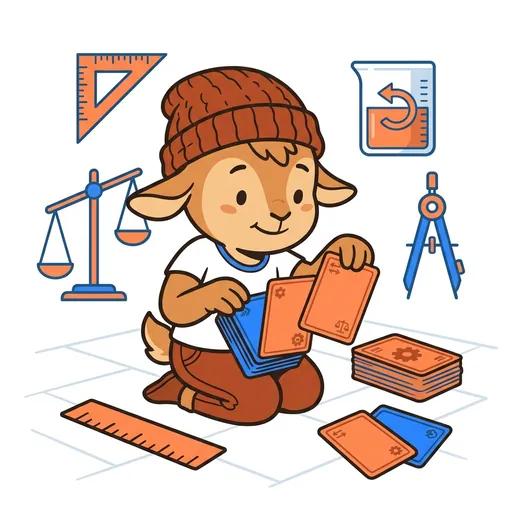
Pace was an antelope-girl. She wore a chunky traveler’s cap. It sat a little crooked on her head. But Pace moved with a smooth, graceful stride. Her long legs carried her easily. She always carried a small deck of cards. These were her special conversion cards. Each card had a math rule printed on it. It helped change one type of measurement into another.
Pace was small. Her fur was a warm, tan-cream color. She was very patient. Especially when it came to changing units. She often said, “Multiply by the right ratio. Check the units. That’s the craft.” Her card deck was her most important tool. It held cards for everyday changes. Like how 1 inch equals 2.54 centimeters. Or how 1 foot equals 30.48 centimeters. She had cards for miles to kilometers. And kilograms to pounds. Even liters to gallons. Pace would shuffle the deck with a soft click. Then she’d pick the perfect card for the job.
Pace taught about unit conversion. This meant changing measurements. Like inches to centimeters. Or pounds to kilograms. It was super important. Many people just guessed if they should multiply or divide. That was a bad way to do it. Pace knew a better way.
A long time ago, a space probe got lost. It was called the Mars Climate Orbiter. Engineers made a huge mistake. One team used pounds for their measurements. Another team expected newtons. They forgot to change the units. The probe crashed into Mars. It was a very expensive mistake. It cost 327 million dollars.
Pace had a special way to avoid this. It was called dimensional analysis. She said to write down all your units clearly. Then you multiply by the right conversion card. You cross out units that are the same. You end up with the units you want. This way, you catch mistakes early. Pace always showed everyone this method. And she always told the Mars Orbiter story. “Don’t be that engineer,” she’d say.
Pace made it very clear. “Multiply by the right ratio,” she’d say. “And always, always check the units.” She gave an example. “Say you want to change 5 feet into centimeters. You take your 5 feet. Then you multiply it by the card for feet to centimeters. That card says ‘30.48 cm over 1 foot’.” She wrote it down on a big slate: “5 feet × (30.48 cm / 1 foot) = 152.4 cm.” “See?” she pointed with a hoof. “The ‘foot’ on top and the ‘foot’ on the bottom cancel each other out. Only ‘cm’ is left. That’s dimensional analysis. It catches your errors.”
Pace taught several important things about unit conversion. First, she taught about conversion ratios. These were the rules on her cards. Like how 1 inch is exactly 2.54 centimeters. Or 1 foot is 30.48 centimeters. She said to learn a few by heart. You could look up the others. Next was dimensional analysis. “Write down your units,” she’d say. “Multiply by the right card. Cross out units that match. The units left should be the ones you want. If not, you made a mistake!” She explained metric versus customary systems. Metric units are used by most of the world. Scientists use them a lot. Customary units are mostly used in the U.S. We use them for cooking or building. Both are good. But you have to convert when you switch between them. Pace warned about common errors. People sometimes multiplied when they should divide. Or used the wrong card. Or forgot to change all the numbers. “But dimensional analysis catches all these,” she promised. Then she always told the Mars Climate Orbiter story again. A space agency lost a probe. It cost 327 million dollars. All because of a unit mistake. “Check the units!” she’d shout. She also showed real-life examples. Cooking recipes might use cups or grams. Bicycle gears use ratios. Maps need scale conversions. “Conversion is everyday math,” she said. Finally, Pace had a rule: conversions are where mistakes hide. “Slow down,” she’d tell everyone. “Write the ratio. Cancel the units. Check your work.”
Pace grew up in a village on the savanna. It was a place called MeasureQuest. The savanna was vast and wild. Her family were runners. They ran long distances for the village. They were antelopes, just like Pace. Their ancestors had moved with the seasons. They tracked herds of gnus across the plains. They had to measure distances very carefully. They used their own steps as units. Sometimes they used a long stick. But the stick was different on hills. A “stick-length” on flat land was not the same on a slope. That’s why they needed to convert. They learned to match their units to the land. If they used the wrong units, they got the distance wrong. A whole herd could get lost. The village would go hungry. “Changing units is a survival skill,” her family taught. Pace never forgot that lesson. She carried it with her.
When Pace was twelve, she walked to MeasureQuest. Yard, her mentor, asked her a question. “What is unit conversion?” Pace stood tall. “Multiply by the right ratio,” she said. “Always check the units. Use dimensional analysis to catch errors. Catch them before they hide in your answer.” Yard smiled. “You are appointed,” he said.
In her workshop, Pace showed everyone how it worked. A young student named Pip was trying a problem. “I need to change 10 pounds to kilograms,” Pip said. “Should I multiply or divide?” Pip looked confused. Pace gently stepped in. She held up her card deck. “Let’s find the right card first, Pip,” she said. She shuffled the deck with a soft rustle. She found the card for pounds to kilograms. It read: “1 kg = 2.205 lb.” “Now we multiply,” she explained. “10 pounds times (1 kg over 2.205 pounds) equals 4.535 kilograms.” She drew it on a big slate. “See how the ‘pound’ unit on top crosses out the ‘pound’ unit on the bottom?” she asked. “Only ‘kg’ is left. That’s the right unit. So the answer is correct.” Then she showed a mistake. “What if I divided instead?” she frowned. “10 divided by 2.205 equals 4.535. But look at the units: pounds squared per kilogram. That’s not a real unit! Dimensional analysis caught the error right away.” She quickly told the Mars Orbiter story again. “Three hundred twenty-seven million dollars lost,” she said softly. “All because of a unit mistake. Don’t be that engineer. Check your units!” She looked at everyone. “I am Pace,” she said. “I teach unit conversion. My main rule is: multiply by the right ratio. And always, always use dimensional analysis.”
Pace was gentle, but her voice was firm. “Never rush your conversions,” she warned. “That’s where the mistakes hide.” “Slow down. Write out the ratio. Cross out the units. Check your work.” She paused. “The Mars Climate Orbiter engineers didn’t.” She smiled then. “Multiply by the right ratio,” she said. “Check the units. That’s the craft.”
The MeasureQuest ensemble
Pace is part of MeasureQuest's distributed-narrative cast. Each character embodies a different curricular primitive; together they teach the full subject.