
Tile
AREA — *2D coverage. how many squares fit. square units.*
Listen along — Tile
Loading audio…
Press play to listen along. The line being read lights up as you go.
Show full transcript
Loading transcript…
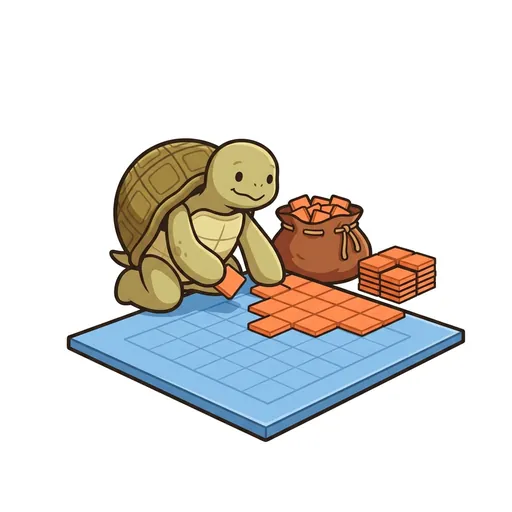
Tile wasn’t much bigger than a dinner plate. Her shell, a warm olive-cream, was crisscrossed with a neat grid pattern, like a tiny map etched onto her back. She moved with a slow, steady patience, especially when she carried her most important possession: a canvas bag clinking with a hundred small, flat squares. Each one measured exactly one centimeter on every side. These were her unit-squares, and they were the key to everything she taught.
Her name was Tile, and she held a simple, unwavering belief. “Area,” she’d often say, her voice soft but clear, “is how many squares fit.” She didn’t just say it; she showed it. She would carefully lay her little tiles across any flat surface, counting them one by one. Only after the counting was done would she introduce the formulas, explaining them as clever shortcuts, not magic.
Many students knew the formula for a rectangle: length times width. They could rattle it off without a second thought. But Tile knew that knowing the formula wasn’t the same as truly understanding it. She saw too many students simply memorize numbers, missing the deeper truth of what area actually meant. Her job was to make that truth visible. She wanted them to see that the formula was just a faster way to count those little squares. It was a tool, yes, but the real work happened in the counting.
Tile’s family had lived for generations in the pond-edge village, a quiet place nestled beside a winding river. They were the village’s land-surveyors, known for their patient, meticulous work. It was said their shells, with their natural grid patterns, made them the best at reading the land. From her grandparents, Tile learned the old ways. They taught her that measuring land, finding its area, was really just a very careful kind of counting. “Understand the counting,” her grandmother would say, tracing a pattern on the dirt with a claw, “and the formulas will follow like ripples on the water.” Tile carried that lesson forward, deep in her shell.
When Tile turned twelve, she made the long journey to MeasureQuest. The air there hummed with numbers and questions, a constant buzz of curious minds. She stood before Yard, the wise old badger who oversaw all new apprentices. Yard’s eyes, ancient and sharp, studied her with an intensity that made her shell feel a little warmer.
“Tell me, young Tile,” Yard rumbled, his voice like stones shifting in a riverbed, “what is area?”
Tile didn’t hesitate. She looked at the polished wooden floor, then at Yard’s large, flat desk. “Area,” she said, her voice clear and steady, “is how many squares fit. Always in square units.” She paused, then added, “For a rectangle, you can use length times width. But that’s just a shortcut. The formula is really just counting, made fast.”
Yard smiled then, a slow, deep smile that crinkled the fur around his eyes. “You understand,” he said simply. “You are appointed.”
Tile’s workshop was a bright, airy room filled with smooth wooden blocks, rolls of paper, and, of course, countless bags of her unit-squares. She stood before a group of new apprentices, her canvas bag resting beside a large, flat table. Sunlight streamed through a high window, illuminating dust motes dancing in the air.
“Today,” she began, her voice calm and inviting, “we’re going to talk about area.” She picked up a rectangular piece of green felt, its edges crisp and straight. “This rectangle,” she said, holding it up for everyone to see, “is five centimeters long and three centimeters wide. Now, watch.”
With careful, deliberate movements, Tile began to lay out her tiny squares. Click, click, click went the tiles as they settled onto the felt. She placed five squares in a perfect row, then another row directly beneath it, and then a third. Soon, the entire rectangle was covered, a neat grid of fifteen small squares.
“Now, count them,” she invited. The apprentices leaned forward, their eyes tracing the grid of tiles. “Fifteen!” someone called out, a hint of surprise in their voice.
“Exactly,” Tile said, nodding. “Fifteen square centimeters. The area is fifteen. Now, if we use our formula, length times width, what do we get?”
“Five times three is fifteen!” another apprentice answered, the connection clicking.
“The same answer,” Tile confirmed. “The formula is just a shortcut. Instead of laying out every single tile, we multiply. It’s faster, yes, but it’s still just counting. It’s a way to make counting efficient.”
Next, she took a triangle, bright blue, that fit perfectly against the side of the green felt rectangle. “What if we have a triangle?” she asked. She showed how the blue triangle was exactly half of the green rectangle she’d just covered. “If the rectangle was fifteen square centimeters, then this triangle is half of that, right?”
She carefully placed her tiles on the triangle, showing how some fit perfectly, while others needed to be cut in half to cover the edges. “Seven full squares,” she pointed out, tracing the outline with a claw, “and then these halves make about seven and a half. So, seven and a half square centimeters. The formula, half times base times height, gives us the same thing. The formula matches the counting.”
Tile looked at the apprentices, her gaze steady and kind. “For other shapes, too,” she added, “we find ways to make them into squares, or parts of squares. Sometimes we break them into smaller, simpler pieces. The idea is always the same.”
“I am Tile,” she said. “And the lesson I teach is simple: understand the counting. The formula is a shortcut, but the counting is the truth.”
Her voice was always gentle, but her message was firm. “Don’t just memorize formulas,” she urged. “If you understand why the formula works, you can figure it out even if you forget it. You can apply it to new, strange shapes. You can always go back to counting the squares.”
She picked up a single unit-square, turning it over in her claws. “How many squares fit,” she murmured, almost to herself. “That’s the heart of it. Counting, made efficient.”
The MeasureQuest ensemble
Tile is part of MeasureQuest's distributed-narrative cast. Each character embodies a different curricular primitive; together they teach the full subject.