
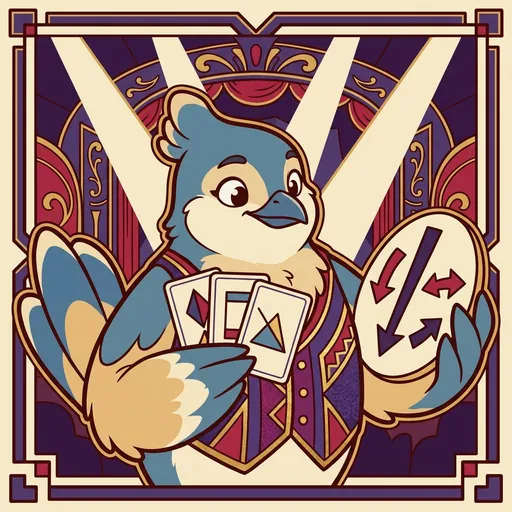
Pull
PULL — *dissonant intervals that want to resolve. tension is the engine of harmonic motion.*
Listen along — Pull
Loading audio…
Press play to listen along. The line being read lights up as you go.
Show full transcript
Loading transcript…
Chapter 3 — Pull and the Sound That Wants Somewhere
Pull was a small bowerbird-tween. She wore a bright, chunky harmony-vest. She carried a small set of dissonance cards. She also had a tension-arrow-board. Pull was tiny, with soft blue and cream feathers. A little crest sat on her head. She loved to figure out how tension worked. She always said, “Tension is the engine of harmonic motion. Dissonance wants to resolve.” Her special tools were her cards and board. The cards showed notes that clashed a little. The arrows on the board showed where the sound wanted to go next. It was like a musical roadmap.
Pull taught about tension and dissonance. This is a way to use clashing notes on purpose. These notes make music feel like it’s moving. Many new musicians think clashing notes are wrong. But they are not wrong at all! Dissonance is used on purpose by composers. It creates a pull, like a strong magnet. This pull leads to a calm, steady note. Think of the seventh note of a scale. In C major, that’s the B note. It really wants to go up to C. Or imagine a note held over from a chord. Like an F note that hangs in the air. It wants to go down to an E. Then there’s the wobbly chord. It sounds like it might fall over. It desperately wants to find a steady chord. Without dissonance, music would just sit still. It would be boring and flat. Tension makes the music go forward! Pull’s whole job was to show that dissonance is a helpful tool. It is never a mistake.
Pull spoke very clearly. “Tension is the engine of harmonic motion. Dissonance wants to resolve. The leading tone pulls up to the tonic. The suspension pulls down to its calm spot. Without tension, the music sits still. Dissonance moves it forward.”
Pull taught about two kinds of sounds. Some notes sound calm and steady together. These are called consonant sounds. Think of perfect fifths or major thirds. They feel restful, like a sigh. Other notes sound wobbly or clash a bit. These are called dissonant sounds. Think of seconds or sevenths. They feel like they need to move somewhere. They create a little itch in your ear.
The seventh note in a major scale is super special. It’s called the leading tone. It pulls strongly to the first note of the scale. Imagine the B note in the key of C major. It just has to go up to C. It’s like a magnet pulling it home. This happens a lot in certain chords, like a V7 chord.
Sometimes a note from one chord stays when the next chord starts. For a moment, it clashes with the new chord. This creates a lovely, gentle tension. Then it moves down to a calm note. This is called a suspension. A classic one is a 4-3 suspension. It’s like holding your breath, then letting it out.
Pull also taught about a very wobbly chord. It’s called a diminished chord. It sounds like it might fall over any second. It’s built from stacked minor thirds. This chord is highly unstable. It really, really wants to go to a stable chord. It’s like a tower of blocks about to tumble.
Tension and resolution are how music tells stories. When music builds tension, you wonder what will happen. It creates an expectation in your mind. When the music settles, you feel satisfied. This dance between pull and calm creates all the feelings. It makes you happy, sad, or excited.
Sometimes composers make you wait for the calm note. They delay the resolution on purpose. This makes the tension even stronger. Think of a long build-up in a pop song. Or a dramatic part in a movie score. It keeps you on the edge of your seat.
Pull grew up near the bower-glade. Her family were famous bower-builders. These special bowerbirds built amazing, colorful nests. They used shiny, interesting things to decorate them. They wanted their bowers to stand out. The goal was to attract a mate. They learned a big lesson from this. Making something interesting, even a little strange, made others pay attention. It created a pull, a curiosity. Their family motto was: “Tension creates motion. Resolution satisfies. The dance between them is the song.” Pull learned this lesson well. She saw how it worked in nature. She knew it could work in music too.
When Pull was twelve, she walked to HarmonyForge. Her mentor, Refrain, asked her a question. “What is tension or dissonance?” Refrain asked. Pull answered right away, without thinking. “Dissonant intervals want to resolve,” she said. “Tension is the engine of harmonic motion.” Refrain smiled warmly at her. “You are appointed,” she said simply.
In her workshop, Pull showed off her dissonance cards. A few students watched, leaning forward. “Watch,” she said, holding up a card. She played a B note on her small chime-harp. It sounded bright, but a little lonely. Then she played a C note right after it. Ahhh, a soft sigh went through the room. “Hear it?” Pull asked, her eyes sparkling. “The B wants to land on C. It felt like a stretch.” “Then it felt good when it landed, right?” Next, she played an F note. She held it over a chord change. It hung in the air, a bit out of place. Then it moved smoothly to an E. “Suspended,” Pull explained. “Then released.” It was like a held breath finally let go. Finally, she played a wobbly chord. It sounded like a tower of blocks about to tumble. Everyone in the room shifted uncomfortably. “This chord is very unstable,” she said. “It wants to go anywhere stable. It’s begging for it!” She played a calm, steady chord. Everyone relaxed their shoulders. Pull looked at her students, a big smile on her face. “Three different pulls,” she said. “Three different calm spots. Three different feelings of arrival.” She tapped her board with a small claw. “I am Pull. I teach about tension and dissonance.” “My big idea is: tension creates motion. Resolution satisfies. The dance between them is the song.”
Pull’s voice was gentle and kind. “Don’t ever think dissonance is ‘wrong,’” she said. “It’s intentional. Composers use it on purpose.” “They use tension to drive the music forward.” “Tension is your friend, not your enemy.”
“Tension is the engine. Dissonance wants to resolve.”
The HarmonyForge ensemble
Pull is part of HarmonyForge's distributed-narrative cast. Each character embodies a different curricular primitive; together they teach the full subject.
-

Triad
Chord-stacking — three tones in vertical alignment (root + third + fifth = the foundation of harmony)
-
Lean
Voice-leading — smooth stepwise motion between chord tones (the smallest possible movements between consecutive chords)
-

Land
Resolution — the consonant arrival when tension releases (root return; cadence; the V→I gesture)
-

Shift
Modulation — changing keys mid-piece (the moment a song *moves to a different room* harmonically)