
Layer
LAYER — bottom first. always.
Press play to listen along. The line being read lights up as you go.
Show full transcript
Loading transcript…
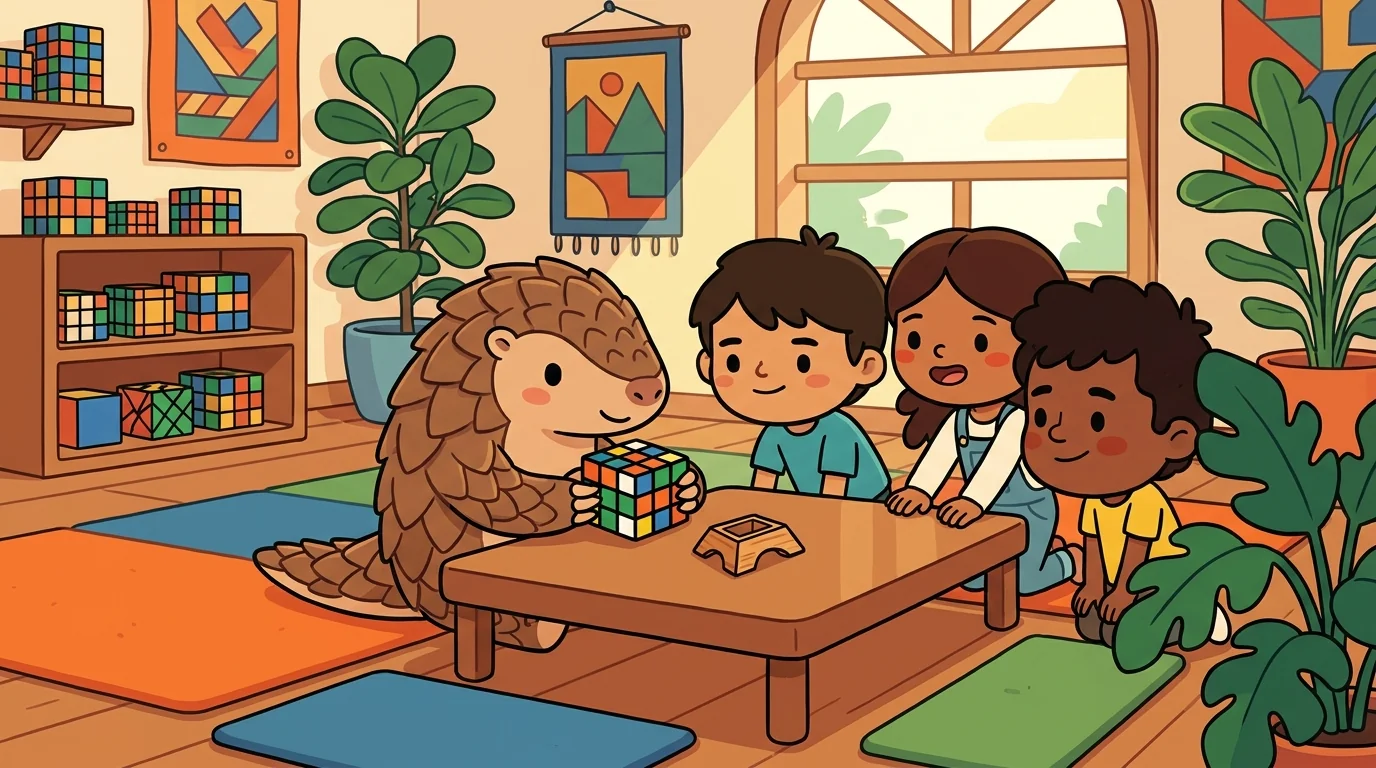
At the low table in the corner of the cubing dojo, a small pangolin-tween named Layer turned a scrambled cube slowly in her paws and did not panic.
The cube was a mess — every face a jumble of white and yellow and red, forty-three quintillion ways to be wrong. A knot of kids leaned in around her, and one of them groaned. "You have to solve all of that?"
"No," Layer said. "I have to solve the bottom." She set the cube on its little stand and tipped her head. "Watch."
She didn't grab and twist the way the fast kids did. She turned the cube gently, hunting one white piece at a time, sliding each into place along the bottom until a clean white cross sat there like the first row of a garden. Then the corners — one, click, another, click — until the whole bottom face was solid white and locked.
"There," she said. "One layer. Finished. It's not going anywhere now."
"But there's still two whole layers left!"
"And they'll sit on that." Layer patted the finished bottom. "You can't build the middle on nothing. You build it on the part that's already done." She kept going — middle edges next, careful, each move small — and the cube filled up from the ground like water rising in a glass. "Bottom first," she murmured, mostly to herself. "Always."
The kid stopped groaning and started watching.
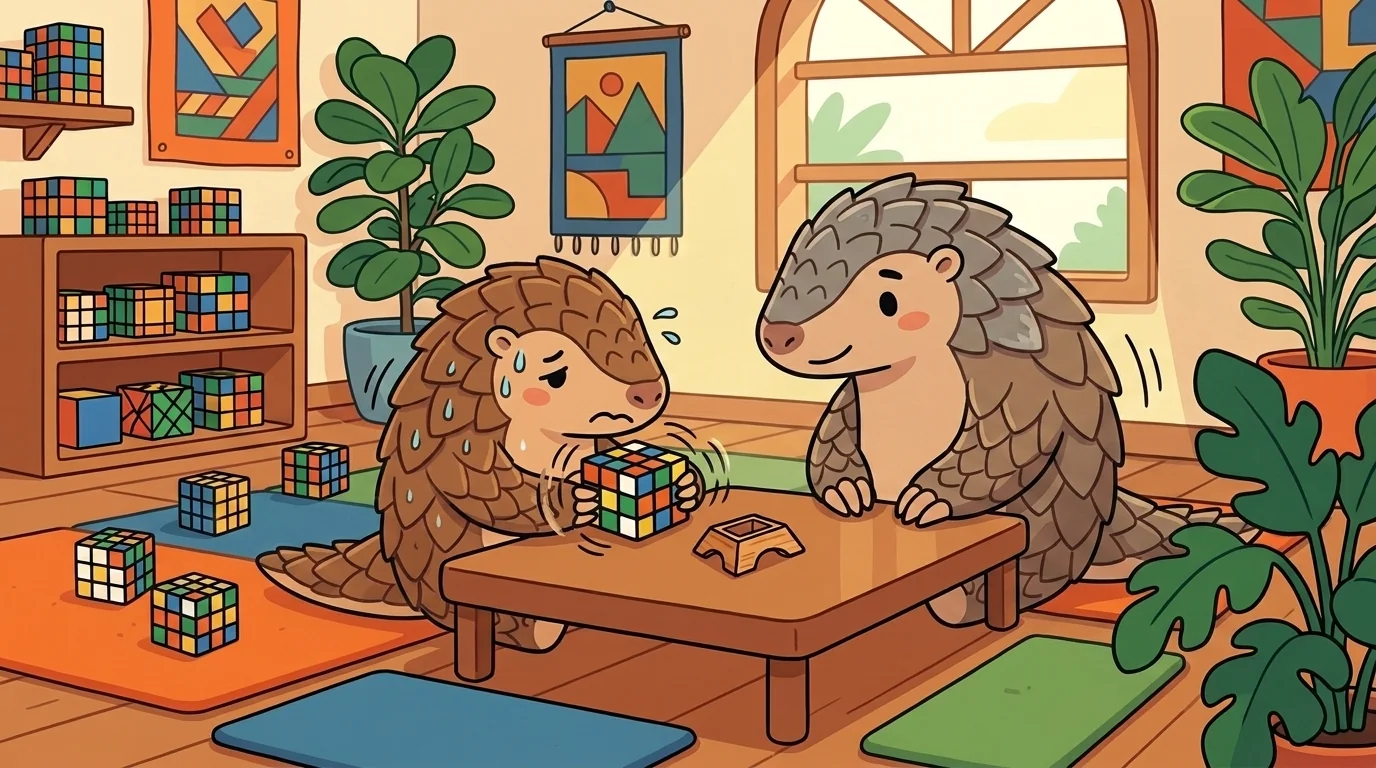
Layer had not always been patient. When she was small, she'd hated the bottom of everything.
The first cube she ever got, she'd tried to solve all at once. She'd twisted furiously, chasing colors everywhere — fix a red here, and a white would fall apart there; save the white, and lose the blue. Every fix broke something else. Her paws got sweaty and fast and frustrated, and after an hour the cube was somehow more scrambled than when she'd started.
She'd wanted to cry. It felt like the cube was laughing at her.
An old teacher-pangolin had sat down beside her, uninvited, and watched for a while without saying anything. Then, quietly: "You're trying to hold the whole cube in your head at once. That's why it keeps slipping."
"There's no other way," Layer had said. "It's all connected."
"It is. So stop trying to catch all of it." The old one took the cube and, with slow, unhurried hands, built just the bottom face — nothing else — and held it up. "See this? This part is safe now. It's done. You don't have to worry about it anymore." She smiled. "Do you feel how much lighter your head is, now that there's one part you're allowed to stop thinking about?"
Layer had felt it. The frantic, everywhere-at-once feeling in her chest went quiet, and something steady took its place. One finished thing. One part she could trust.
She didn't solve the whole cube that day. But she never grabbed for everything at once again.
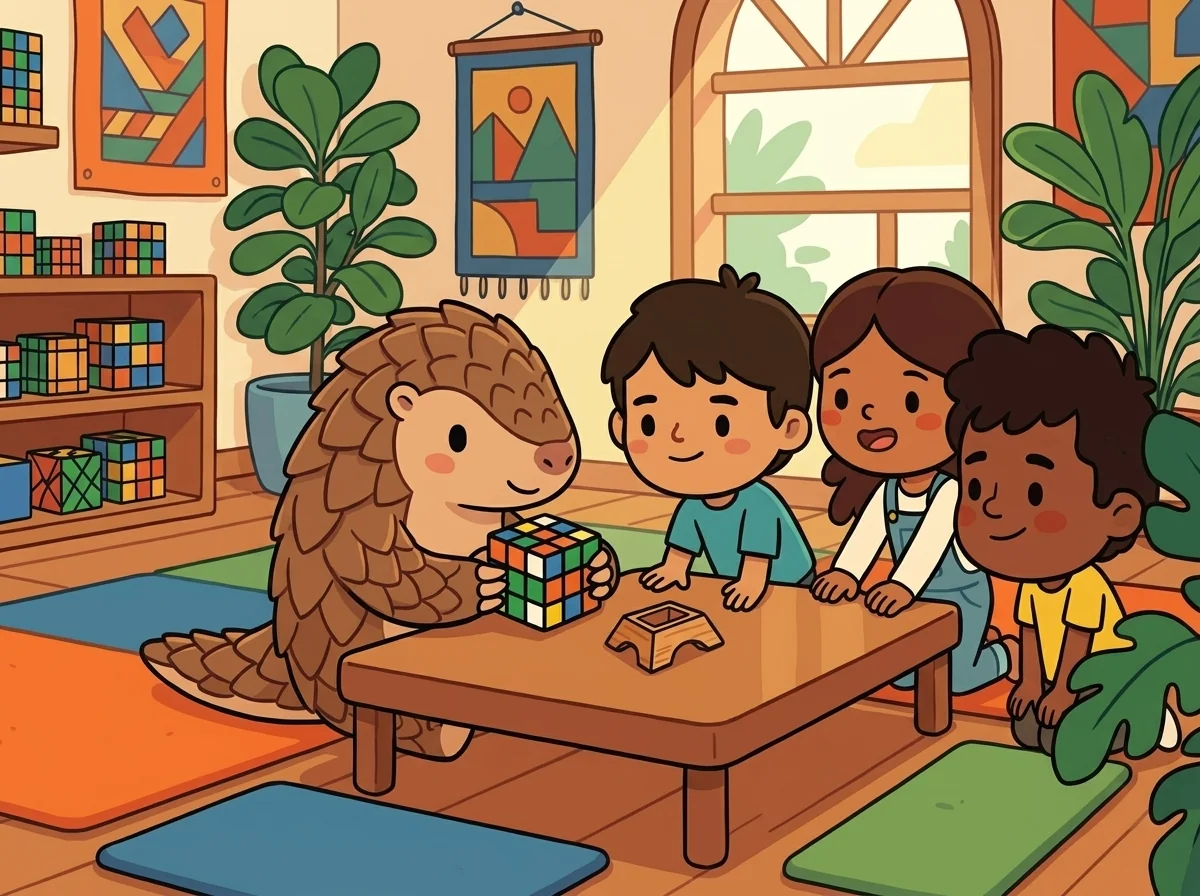
She came to the dojo at eleven, because a place that studied cubes ought to have room for the slow, sure way of doing them.
Cubix, the coach, met her at the door with a scrambled cube already in hand — a test. A quick kid named Cross was there too, buzzing, eager to show off a flashy speed-method.
Cubix held out the cube. "Show me how you'd start."
Cross opened his mouth, but Layer had already taken it. She didn't rush. She found the white pieces, built the cross, then the corners, and set the finished bottom down where everyone could see it — solid, unbroken, done.
"That's the slow way," Cross said.
"It's the way that doesn't fall apart," Layer said, not unkindly. "You can go fast later. But every fast method in the world is just this — finish what holds the rest up, then move on. I finish it on purpose so I never have to fix it twice."
Cubix looked at the clean white face for a long moment, then at Layer. "This is where every cuber starts," he said. "Method, not magic. You belong here."
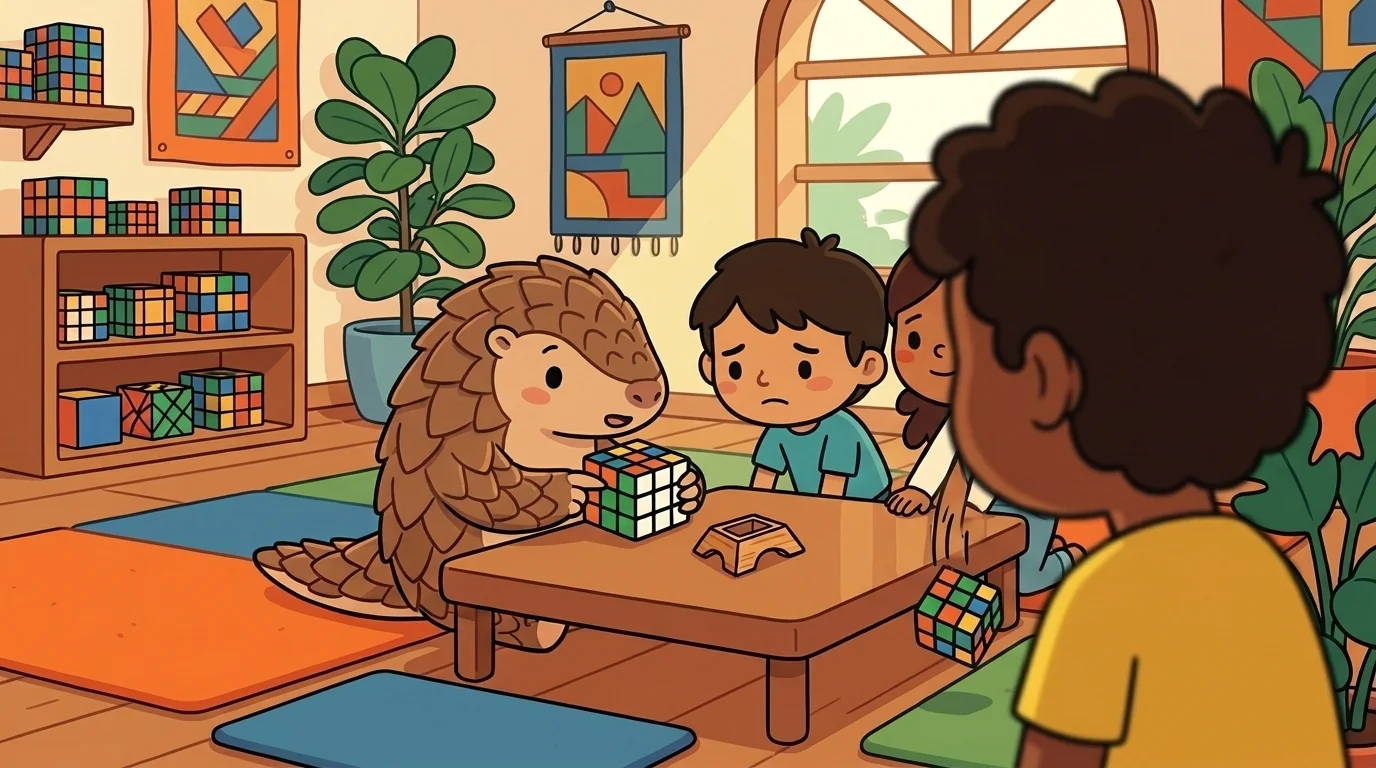
Layer's corner of the dojo filled up with kids who kept getting stuck.
One afternoon a boy dropped into the seat across from her, shoulders slumped, cube dangling from his paw. "I keep getting the top almost done," he said, "and then I fix one piece and three others break and I have to start over and I just—" He blew out a breath. "I hate this thing."
Layer knew that slump. She'd sat in it herself, sweaty-pawed, years ago.
"Show me your bottom layer," she said.
He turned the cube over. The bottom was half-done — a white edge here, a hole there, colors leaking through. "I didn't really finish it," he admitted. "I wanted to get to the cool part."
"That's the whole problem, and it's not your fault." Layer took the cube. "You're building the roof before the walls. Of course it keeps falling." She rebuilt the bottom slowly, let him watch each move land. "Finished," she said, and locked it. "Now try your top."
He tried. This time when he moved the top pieces, the bottom held. It just held. His eyes went wide.
"See? You weren't bad at the top," Layer said. "You were building it on air. The bottom does the worrying so the top doesn't have to." She handed the cube back. "Bottom first. Always. The cube rewards the patient — not because patience is a rule, but because there's nowhere else for a solid thing to stand."
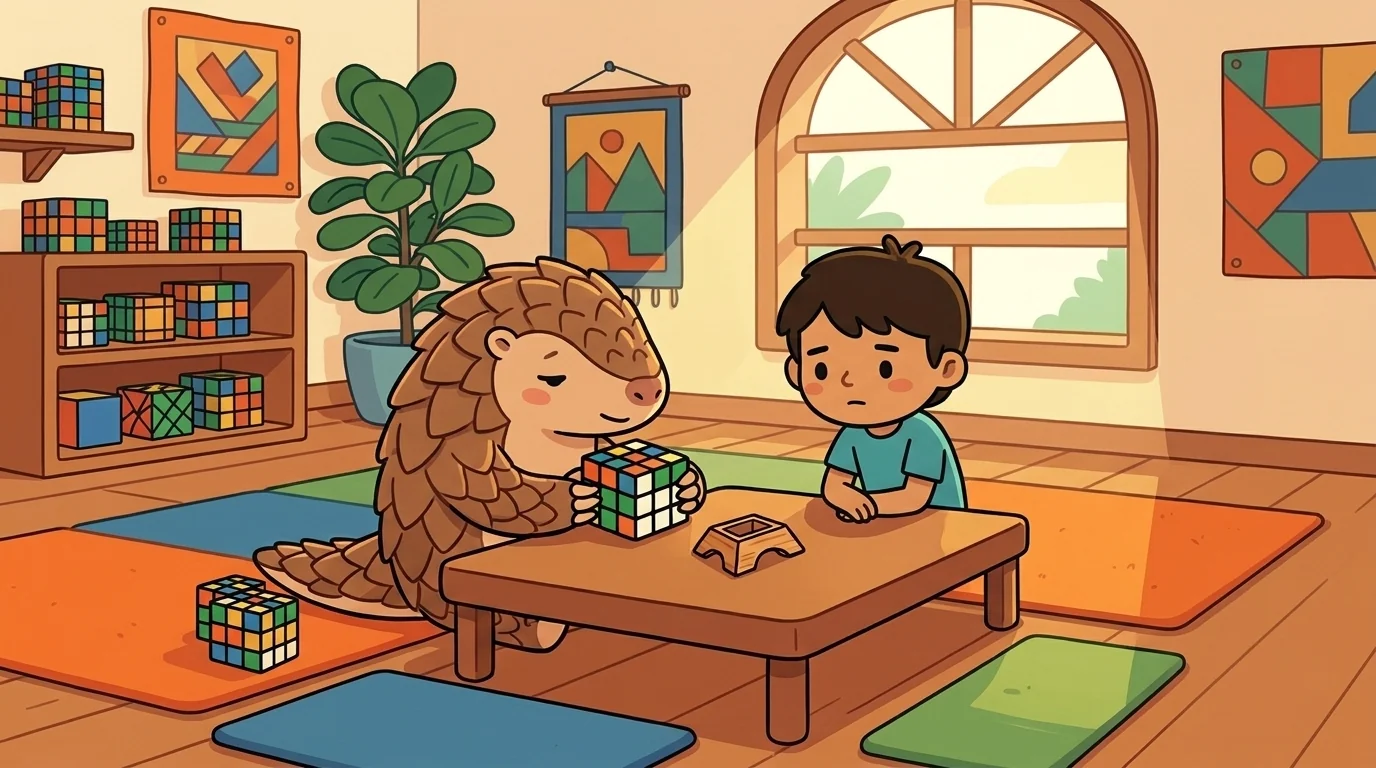
Later, when the dojo had emptied and the light went gold, the boy came back with the cube half-solved and one more question.
"When I'm stuck on the hard top part," he said, "and I really want to just skip the boring bottom stuff... how do you make yourself go slow?"
Layer thought about the frantic little pangolin she used to be, twisting at everything, holding nothing.
"I don't make myself," she said. "I just remember how the other way feels." She turned the cube gently in her paws. "There's a scattered, everywhere-at-once feeling when you're chasing the whole thing at the same time — like your head is full of dropped pieces and none of them will stay. And there's a different feeling when one layer is finished and locked underneath you. Quiet. Steady. Like you set something heavy down and it stayed down." She looked at the finished white face. "You stop being afraid the whole thing will fall apart. Because the part that matters most already can't."
The boy nodded slowly, and Layer watched the scattered look leave his eyes — the same way, years ago, it had left hers.
She didn't say the rest out loud, but she felt it, warm and settled all the way through: the calm doesn't come from finishing everything. It comes from finishing one thing, all the way, and letting yourself rest on it.
The CubeSensei ensemble
Layer is part of CubeSensei's distributed-narrative cast. Each character embodies a different curricular primitive; together they teach the full subject.
-

Cross
CFOP method — speedcubing steward; 'Cross, F2L, OLL, PLL — that's the road.'
-
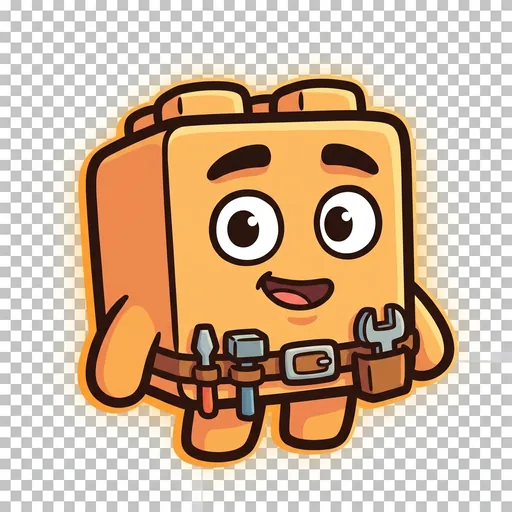
Block
Roux method — block-building steward; 'Build the blocks. Skip the cross.'
-

Edge
ZZ method — edge-orientation steward; 'Orient first. Then everything's faster.'
-
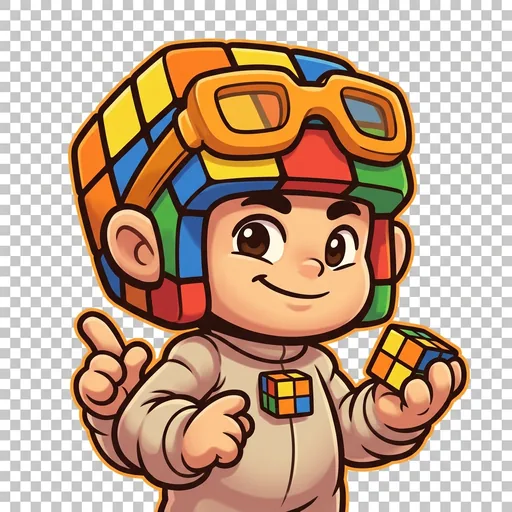
Pair
Ortega method — 2x2 specialist; 'Two-by-two has its own rules.'
-

Look
Cross-method look-ahead coordinator; 'Eyes ahead. Hands following.'