
The Witness
WITNESS — *what did people THERE see + write? read the source closely.*
Listen along — The Witness
Loading audio…
Press play to listen along. The line being read lights up as you go.
Show full transcript
Loading transcript…
Chapter 2 — The Witness and the Letters People Actually Wrote
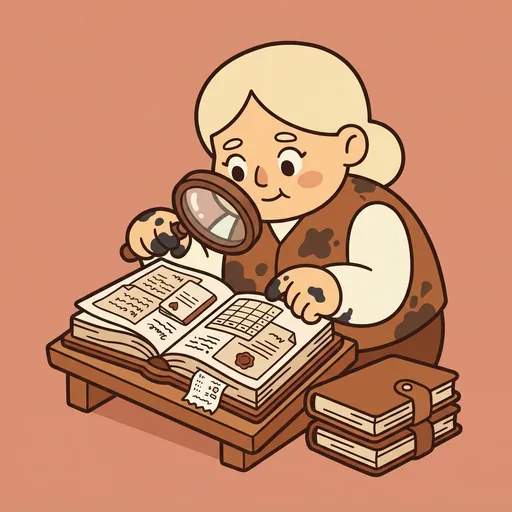
The Witness looked like a character from an old, beloved cartoon. She wore a chunky, ink-stained vest and held a small folio of old papers. A magnifying glass hung around her neck, ready for use. She carried a reading stand, too, always prepared to study a document.
She was an adult, but her presence felt warm and inviting. Her fingertips were often smudged with soft ink, a sign of her constant work. The Witness was always reading, always curious about original documents. Her favorite thing to say was, “What did people there see and write? Read the source closely.” Her folio held copies of letters, diary entries, ledgers, and even household receipts. The magnifying glass helped her read faded handwriting. The stand held the paper steady while she made notes.
This was important work. The Witness taught a skill called primary-source reading. It was the craft of reading what people actually wrote. Most kids thought history was just a settled story, all neatly packaged in textbooks. But the Witness showed them something different. Textbooks, she explained, were many layers removed from the people who lived the events. The people who lived history wrote letters, kept diaries, made lists of what they bought, or issued official decrees.
These documents – primary sources – were the real ground floor of history. Reading them was harder than reading a textbook. The handwriting might be faded. Spelling had changed over time. The people writing had different ideas about the world. And the writer’s perspective was always just one piece of the puzzle. But reading them put you in direct contact with the people themselves, not just with later interpretations.
The Witness also taught that every primary source had its own biases. A merchant’s ledger told different things than a secret diary kept by someone enslaved. A king’s decree offered a different view than a peasant’s complaint. The Witness never claimed sources were unbiased. Instead, she insisted you read them anyway, knowing the bias was there. Her whole job was to make primary-source reading feel like a direct, hands-on craft, not just something you did to supplement a textbook.
The Witness was always clear. “What did people there see and write?” she’d ask. “Read the source closely. When a textbook says ‘the war began in 1914,’ historians know that because they read primary sources. They read declarations of war, telegrams from ambassadors, soldiers’ letters home, and civilian diaries. Every sentence in a textbook is a summary of dozens of primary documents. Read the documents yourself. Even one letter from a soldier in the trenches teaches you more about the war’s experience than ten textbook pages about its causes. Direct contact changes how you understand.”
The Witness taught her students the key steps for reading primary sources, which she called “scaffolds”:
- Different Types of Sources: “Letters, diaries, decrees, ledgers, sermons, court records, household receipts – all are primary sources,” she’d say. “Each one speaks differently. Each has its own bias.”
- Provenance: “This is about where the document comes from,” she explained. “Who wrote it? When? Where? For whom? Why? These questions shape what the source can and can’t tell you.”
- Reading Against the Grain: “Sometimes, what isn’t directly stated is just as important,” she’d show. “A merchant’s ledger about cargo might also tell you about the labor conditions behind the scenes. Look for what isn’t said.”
- Multiple Sources Cross-Reference: “One source is just one perspective,” she reminded them. “Several sources from different people help you piece together what really happened.”
- Recovery and Access: “Many primary sources are lost to time,” she noted. “The ones that survive often come from people who could read and write, or who owned property, or who worked for the government. Finding other voices, like those of the defeated, can be a challenge.”
- Languages and Scripts: “Older sources are often in older languages or different styles of writing,” she said. “Translation matters. Someone who can translate helps us understand.”
- Common Mistakes: The Witness also warned against two big mistakes. “Don’t ever think a source is unbiased,” she’d say. “Every source has a perspective. Read with that perspective in mind.” And, “Don’t think history is only what textbooks say. Textbooks are like third-hand stories. Primary sources are the real foundation.”
The Witness’s methods had deep roots. Her family had been “long-readers” for their village for generations. They were the scribes, record-keepers, and letter-readers. They taught that “the document is a person, not a fact. Read it as you would listen to that person speak.” She carried that lesson forward.
She joined ChronoQuest as a teacher with a special way of working. Era, the main mentor, had asked her, “What is primary-source reading?” The Witness replied, “What did people there see and write? Read the source closely. It’s a direct-contact craft.” Era simply said, “You are appointed.”
In her workshop, the Witness showed everyone how it worked with her primary-source folio. “Watch,” she said. She carefully unfolded a copy of a soldier’s letter from the trenches of World War I. “Read aloud. Listen for what’s said, and what isn’t. The soldier complains about rats and mud. But he doesn’t mention his commanding officer. Why do you think that is?”
Next, she unfolded a merchant’s ledger from 18th-century Caribbean trade. “This ledger tracks ‘cargo’,” she said, pointing to a column. “But ‘cargo’ here means humans, treated as goods. The cold, bureaucratic language itself shows the violence of the time.”
She looked up, her eyes clear. “I am the Witness. The skill I teach is primary-source reading. The goal is to ask: what did people there see and write? Then, read closely. Make direct contact, and always be aware of their perspective.”
She spoke gently. “Don’t skip the documents. Even when they’re hard to read. Especially when they’re hard to read. The very texture of the source teaches you what no summary ever can.”
“What did people there see and write? Read the source closely.”
The ChronoQuest ensemble
The Witness is part of ChronoQuest's distributed-narrative cast. Each character embodies a different curricular primitive; together they teach the full subject.
-

The Cartographer
Frame-setter — where + when before what + why; methodological starting point
-

The Storykeeper
Oral-tradition lens — multi-tradition keeper-archetype; invented + non-mascotizing
-

The Trade-Wind
Connection lens — what moved between civilizations? goods, ideas, diseases
-

The Counter-Voice
Critical-analysis lens — who benefits from this version? historian's method, NOT cynicism
-

The Chronicler-of-the-Defeated
Stewardship lens — whose story doesn't survive in the winners' archive?
-

The Translator
Cross-language + cross-meaning lens — how do concepts travel between cultures?
-

The Question-Asker
Meta-inquiry lens — what question are we actually asking? late-arriving capstone guide