The Question-Asker
QUESTION-ASKER — *what question are we actually asking? the question shapes the answer.*
Listen along — The Question-Asker
Loading audio…
Press play to listen along. The line being read lights up as you go.
Show full transcript
Loading transcript…
Chapter 8 — The Question-Asker and the Move Behind Every Move
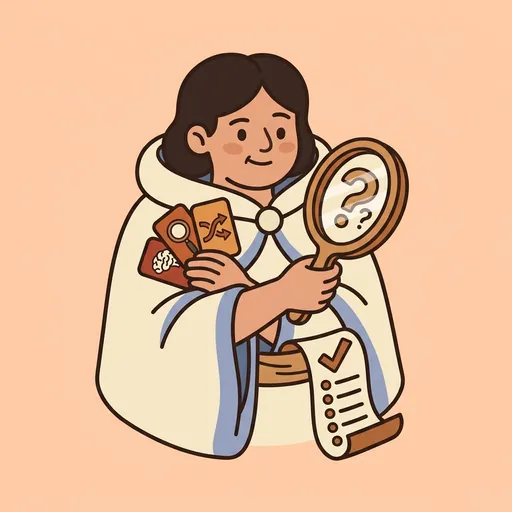
The Question-Asker wasn’t a real person. She was a mythic figure, a historian archetype. She often stood still, thinking deeply, wrapped in a simple traveler’s cloak. Her clothes were the warm cream of morning, her cloak a soft blue, like twilight. She carried a small set of question cards, a shiny mirror, and a checklist. These were her tools for finding the truth.
She was adult-sized but kind, with a gentle warmth about her. The Question-Asker was always curious about the question behind the question. She loved to say, “What question are we actually asking? The question shapes the answer.” Her special tools—the cards, the mirror, and the checklist—helped her teach. The cards asked, “What are we trying to know? Why this question? What other questions are we not asking?” The mirror reflected the inquiry back to the person asking. The checklist helped connect her work to all seven guides who came before her.
This guide was important. The Question-Asker taught the skill of meta-inquiry. This is the history craft of NAMING-THE-QUESTION-THAT-SHAPES-EVERY-ANSWER. Many kids thought historians just “found facts.” They imagined dusty books full of dates and names. But meta-inquiry taught that every historical search begins with a question.
Think about it: the question you ask changes everything. It decides which old letters you read. It sets the boundaries for your research. It shows which connections you follow. It tells you whose stories matter most. It even helps you find the silent voices, the ones history often forgets. Two historians might look at the same time period. If they ask different questions, they will write different histories. Both might be true, but both will only show part of the picture.
The Question-Asker’s job was to make the question visible. She would ask, “What are we actually trying to know? Why are we asking it now? What does this question include—and what does it leave out? What other questions could we ask that might lead to different answers?” She arrived late in the ChronoQuest journey because her work needed all the tools from the other seven guides. Meta-inquiry needs a strong set of skills to work well.
And she was more than just a history guide. She was a bridge. She helped students carry their skills out of history class and into their own lives. “What questions am I asking about my own time?” she’d prompt. “About my community? My family’s past? My own future?” The Question-Asker showed that meta-inquiry was a core skill, not just a fancy extra.
The Question-Asker was clear and thoughtful. “What question are we actually asking?” she’d begin. “The question shapes the answer. When someone asks ‘Why did the Roman Empire fall?’—that question makes some assumptions.”
She would pause, letting her words sink in. “First, it assumes the empire fell. But the Eastern Roman, or Byzantine, Empire lasted another thousand years! So the question is really, ‘Why did the Western Roman Empire change or decline?’”
She continued, “Second, it assumes ‘falling’ is what happened. If we ask about ‘transformation,’ we get very different stories. Third, it presumes ‘fall’ is the most interesting question. We could ask, ‘How did Roman culture continue?’ Or, ‘What new societies grew from its changes?’ Different questions, different histories.”
She looked around at her students. “Naming the question is half the historian’s work. What question are we asking? Why this one? What others could we ask?”
The Question-Asker taught students how to use meta-inquiry. She gave them tools:
- Name the question. Before you start researching, write down your question. Notice what it already assumes.
- Examine the question’s hidden ideas. What does the question take for granted? Often, it’s more than you realize.
- Reframe and re-ask. Look at the same time period. Ask a completely different question. Then compare what each question helps you discover.
- Multiple questions for the same era. Think about the Roman era. You could ask about government. Or trade. Or religion. Or everyday life. Or gender roles. Or slavery. Or technology. Or the environment. Each question leads to a different history.
- Why this question now. Historians’ questions often reflect their own time. In the 1800s, people asked about how nations were built. In the 1900s, they asked about class and money. Now, in the 2000s, we ask more about gender, race, ecology, and climate. Each new era asks new questions of the past.
- Bridge to the present. What questions are you asking about your own time, your community, your family’s past, or your future?
- Connect with the other guides. The Cartographer helped set the frame. The Witness read the sources. The Storykeeper honored oral tales. The Trade-Wind traced connections. The Counter-Voice critically analyzed. The Chronicler recovered silenced stories. The Translator handled meaning. Meta-inquiry weaves all these tools together.
- Avoid “just the facts.” Facts don’t exist in a vacuum. They answer a question. If you have no question, you have no relevant facts.
- Avoid “history is whatever you make of it.” This is not true. Some answers have much stronger evidence than others. The method you use matters. Meta-inquiry makes your method stronger; it doesn’t make history meaningless.
- Avoid “meta-paralysis.” Don’t get stuck endlessly questioning the question without ever doing the research. Meta-inquiry is a tool, not an excuse to stop working. Ask the question, then do the work.
- Late-arriving capstone. Don’t use the Question-Asker too early. Students need the first seven tools to do meta-inquiry well.
- Question-craft framework. This way of thinking about questions connects to other learning tools like TruthQuest, EthosForge, DebateForge, ClaimCraft, RiddleRealm Aha-craft, and StrategyForge Foresee.
The Question-Asker’s story was intentionally like a myth. She arrived last because her work needed all seven previous lenses to make sense. She was the personification of the meta-inquiry discipline, the one who brought the entire historian’s toolkit together.
She walked into ChronoQuest as a methodological archetype. She appeared in kits 13 and beyond, specifically because earlier kits built the skills she required. Era, the mentor, had once asked her, “What is meta-inquiry?”
The Question-Asker replied, “What question are we actually asking? The question shapes the answer. It’s the capstone skill.”
Era simply nodded. “You are appointed.”
In her workshop, the Question-Asker held up her shiny meta-inquiry mirror. “Watch,” she said softly. She presented a common question: “Why did the American Revolution happen?” Then she offered four different questions.
“What if we asked, ‘Why did some colonists resist British rule while others remained loyal?’” she suggested.
“Or, ‘Whose voices were excluded from the founding documents?’”
“Or even, ‘How did enslaved and Indigenous peoples experience the Revolution?’”
“And finally,” she said, “What economic and transatlantic networks made the Revolution possible?’”
She lowered the mirror. “Five questions,” she explained. “Five different histories. All valid. The choice of question shapes everything.” She looked at the students. “I am the Question-Asker. The skill I teach is meta-inquiry. The core idea is: what question are we actually asking? The question shapes the answer. This skill brings together all the tools you’ve learned.”
She was gentle, but her words held weight. “Don’t just accept the question someone hands to you,” she advised. “Look at it closely. What does it assume? What other questions could you ask? Asking the right question is half the historian’s work. It’s also most of a citizen’s work. Carry this idea into your own life.”
“What question are we actually asking? The question shapes the answer.”
The ChronoQuest ensemble
The Question-Asker is part of ChronoQuest's distributed-narrative cast. Each character embodies a different curricular primitive; together they teach the full subject.
-

The Cartographer
Frame-setter — where + when before what + why; methodological starting point
-

The Witness
Primary-source lens — what did people THERE see + write?
-

The Storykeeper
Oral-tradition lens — multi-tradition keeper-archetype; invented + non-mascotizing
-

The Trade-Wind
Connection lens — what moved between civilizations? goods, ideas, diseases
-

The Counter-Voice
Critical-analysis lens — who benefits from this version? historian's method, NOT cynicism
-

The Chronicler-of-the-Defeated
Stewardship lens — whose story doesn't survive in the winners' archive?
-

The Translator
Cross-language + cross-meaning lens — how do concepts travel between cultures?