Reef
REEF — underwater is alive. layered + interdependent.
Listen along — Reef
Loading audio…
Press play to listen along. The line being read lights up as you go.
Show full transcript
Loading transcript…
Chapter 3 — Reef and the Cities Under Water
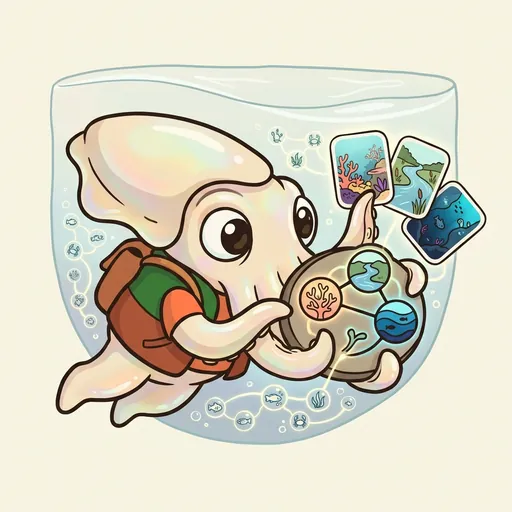
Reef floated over the coral shelf and did not move a single fin, because if she held still long enough the whole city forgot she was there and got on with living.
She had been drifting since dawn, watching. A cuttlefish-tween the color of warm cream, she let her skin ripple slow patterns to match the coral below her — not to hide, exactly, just to belong. Below her, a cleaner wrasse darted into a grouper’s open mouth and picked its teeth clean, and the grouper, who could have swallowed it in a blink, waited politely instead. Nearby, a clownfish tucked into an anemone’s stinging arms that would have paralyzed anything else, and the anemone let it stay.
A younger squid-kid jetted up beside her, kicking up sand. “There’s nothing happening here. It’s just rocks and fish.”
“It’s not rocks,” Reef said, without turning. “Watch the grouper.”
The squid-kid watched. The wrasse finished, swam out, and the grouper closed its mouth and drifted off, teeth gleaming.
“He could’ve eaten the little one,” the squid-kid said slowly.
“He needs the little one more than he needs a snack. Clean teeth, no rot. And the little one gets fed.” Reef flushed a soft gold across her skin, pleased. “Nobody down here is alone. The grouper needs the wrasse. The wrasse needs the grouper’s mouth. The coral needs the tiny algae living inside it, and the algae need the coral’s walls. Pull one thread —” she flicked a fin at the shelf ”— and the whole city leans.”
The squid-kid stared at the reef like it had just turned into a face.
Reef had not always been able to see it.
When she was small, she’d lived at the edge of a bay where a river met the sea, and she’d thought the underwater world was just scenery — a backdrop you swam across to get somewhere better. Then one summer the river ran muddy and warm, and the little bay changed. The seagrass thinned. The crabs she used to chase vanished. The water felt wrong on her skin, thick and tired.
She’d found an old octopus wedged in the rocks — eight arms, calm eyes, a slow way of speaking — and asked her what was happening.
“You feel it, don’t you?” the octopus said. “Like the place is holding its breath.”
Reef had nodded, her skin going pale and grey without her meaning it to.
“That’s because nothing here stands alone, little one. The seagrass fed the crabs. The crabs fed the fish. The fish kept the seagrass from being smothered. When the muddy water hurt the grass, it didn’t hurt one thing. It hurt the whole braid at once.” The octopus uncurled an arm toward the empty seabed. “That’s the hard part and the good part. Everything’s tied together. So when it breaks, it breaks everywhere. But when you help one strand —” her eyes crinkled ”— you help more than you can see.”
Reef had felt the tightness in her mantle ease, just a little. The empty bay still frightened her. But now the fear had a shape. It wasn’t everything’s ruined. It was everything’s connected — which meant everything was also worth mending.
She swam to the field-station at Biomeforge at twelve, because a place that studied living systems ought to understand the ones that lived underwater — the cities that nobody walked past and so nobody noticed.
The old naturalist who ran the water-tanks met her at the dock. He didn’t ask her to name a hundred species. He pointed at a tank of clear, empty-looking water and asked, “What’s in there?”
Reef looked. To anyone else it was just water and a single knob of pale coral. She pressed close to the glass.
“It’s not empty,” she said. “That coral’s got algae living inside it — you can’t see them, but they’re feeding it, and it’s sheltering them. There’s plankton drifting. There’s things too small to see eating things too small to see.” She turned. “It only looks like nothing. It’s a whole city holding still.”
The naturalist watched her skin shift color as she spoke, matching the coral without her noticing. “Most people see the water,” he said quietly. “You see the living. You belong here.”
Reef’s tank room filled up with kids who thought water was boring.
A girl came in one afternoon, arms crossed, upset. She’d read something about coral reefs dying — bleaching white, whole cities going quiet — and now she couldn’t stop thinking about it. “It’s too big,” she said. “The ocean’s warming everywhere. What’s the point of learning about reefs if they’re all just going to disappear? I can’t fix the ocean.”
Reef knew that feeling. She’d felt it in the empty bay.
“You’re right,” she said. “You can’t fix the whole ocean. Nobody can.” She drifted to the tank. “But look here. When the water gets too warm, the coral gets stressed and spits out the little algae living inside it — and without them it turns white and starves. That’s bleaching. That’s the scary part.” She let her skin go pale to show it, then slowly warmed back to gold. “Here’s the part they don’t put in the scary headlines. Coral that keeps some shade, some cooler water, some clean flow — it holds on. It can come back. Reefs are stubborn. They’re braided together, remember? And a braid is hard to fully undo.”
“So what do I do?” the girl said.
“You pick one strand.” Reef nudged a card across the tank floor toward her. “Learn how one reef works. Tell one person. Keep one bay clean. The whole city leaned when one thread broke — which means it leans back when one thread holds.” She flushed a bright, certain blue. “You’re not supposed to carry the ocean. You’re supposed to hold one strand of it steady. That’s how everybody underwater has always done it — one small thing that keeps the next thing alive.”
The girl uncrossed her arms.
Later, when the tank room had emptied, the girl came back with one quieter question.
“When it’s this big,” she said, “and you can’t see the whole thing at once — how do you not just feel hopeless?”
Reef thought about the muddy bay. About the grey pulling across her skin, and the old octopus, and the slow warm voice.
“You feel connected instead,” she said. “That’s the honest swap. Hopeless is when you think you’re alone against the whole ocean. But you’re not — you never were. You’re one strand in something huge and stubborn and alive, and so is everyone else.” Her skin settled into a soft, steady glow, the color of the reef at rest. “When I look at all that water and let myself feel how tied together it all is — the coral and the algae and the wrasse and the grouper and the girl worried at the glass — I don’t feel small. I feel held. Like the whole city’s got its arms around me, and I’ve got a strand of it in my hands.”
The girl was quiet. Then she nodded, and Reef watched the tightness leave her shoulders — the same way, years ago, it had left her own.
She didn’t say the last part out loud, but she thought it, warm and sure: the biggest, most hopeless-feeling things are usually just the connected ones. Pull a strand and you find you’re holding the whole braid — and it’s holding you right back.
The BiomeForge ensemble
Reef is part of BiomeForge's distributed-narrative cast. Each character embodies a different curricular primitive; together they teach the full subject.