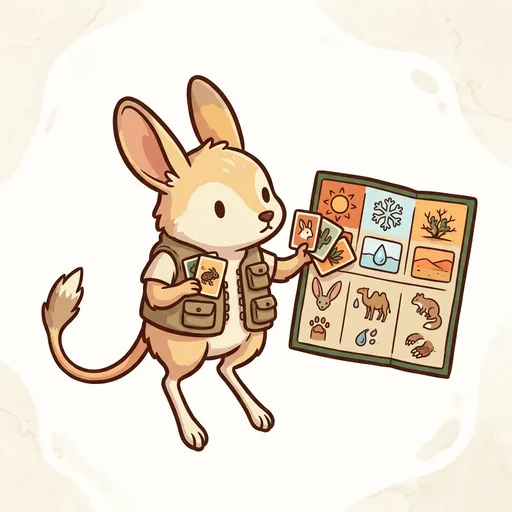
Dune
DUNE — *life adapts to scarcity. desert is not empty.*
Listen along — Dune
Loading audio…
Press play to listen along. The line being read lights up as you go.
Show full transcript
Loading transcript…
Chapter 2 — Dune and the Hidden Life of Apparent Emptiness
At the hottest hour of the afternoon, when the Sonoran sand shimmered like a griddle, a jerboa-tween named Dune sat perfectly still in a sliver of shade and refused to be anywhere else.
She had a naturalist’s vest with too many pockets and a habit of holding very quiet. A field-station visitor crouched beside her, sweating, squinting at the flat orange nothing in every direction.
“There’s nothing out here,” the visitor said. “It’s just sand.”
Dune didn’t argue. She lifted one long hind foot and, very slowly, pointed.
Under a creosote bush, half-buried, a kangaroo rat’s tail flicked and vanished. A lizard the exact color of the dust unstuck itself from the ground and skittered three feet. A beetle tipped its back end to the sky to catch a bead of fog rolling off the dawn’s last breath. A seed that had waited two years in the dirt sat there, holding.
“Watch the shade line,” Dune whispered. “Not the sand. The edges.”
The visitor watched. Where the bush’s shadow met the light, the whole desert was leaning — every living thing tucked exactly at the border between too-hot and survivable, timed to the cool, waiting out the burn.
“It’s not empty,” Dune said. “It’s careful. Everything out here is doing the hardest math there is — how to lose almost nothing. You just have to know where to look, and when.”
Dune had learned to look the hard way, the year the rain didn’t come.
She’d been small then, in a burrow with her family, and she remembered the fear more than anything — the water hole cracking into puzzle pieces, the plants going gray and brittle, the awful quiet of a place that seemed to be shutting down. We’re going to run out, she’d thought, curled tight and hungry. There’s nothing left.
An old jerboa from a neighboring warren had dug through to them one night, unhurried, and shared what she knew. She didn’t promise the rain would come. She just showed Dune how to last.
“Feel how heavy the day is,” the old one said. “How it presses. That heaviness is real. But look — we don’t move in the heat. We move at night, when the sand gives the warmth back. We don’t drink; we make our own water from the seeds we eat, slow, from the inside. We wait for the rain we can’t see yet.” She tapped the burrow wall. “Down here it’s twenty degrees cooler than up top. The scarcity is up there. Down here, we’re rich.”
Dune stopped feeling like the desert was killing her. The fear didn’t leave, exactly — but it turned into attention. The dry, pressing, careful feeling had a shape now: not nothing left, but make it last. And somehow that made it possible to sit with the heat instead of drowning in it.
She walked to Biomeforge at twelve, because a place that studied living worlds ought to understand the kind of world that looks like it has none.
Listen, the old mentor who kept the field station, met her at the low adobe wall. He didn’t ask if she was tough enough for the heat. He asked one thing. “Show me a desert that’s alive.”
Dune didn’t answer with words. She led him out at dusk, when the sand had begun to give its warmth back to the sky, and simply pointed the way she always did — at the shade lines, the tucked-away burrows, the seeds sitting patient in the crust.
“Nothing’s here,” Listen said, testing her.
“Everything’s here,” Dune said. “It’s just hiding from the sun instead of the cold. Watch.” She scratched a shallow line in the cool evening sand, and within minutes a beetle, a lizard, and a blur of kangaroo rat had all crossed it, out to feed now that the burn had passed. “The Sonoran O’odham have read this land for centuries. The Tuareg cross the Sahara by it. It was never empty to the people who lived here. It was full — you just have to keep their kind of eyes.”
Listen looked at the little scratched line and the traffic crossing it. “You belong here,” he said.
Dune’s corner of the station was full of things that were secretly surviving.
A student trudged in one blazing morning, wilted and cross, holding a jar with a single sad succulent in it. “It’s been three weeks,” she said. “I forgot to water it. It should be dead. Why isn’t it dead? It just… sits there. Doing nothing.”
Dune knew that slump. She’d felt it in the dry year.
“Hold the leaf,” she said. The student did. “Fat, right? A little squishy?”
”…Yeah.”
“That’s the whole trick. It filled up when there was water and it’s spending it a drop at a time, so slow you can’t see it. A cactus does it big — a saguaro can hold a bathtub of rain in its ribs and ration it for a year.” She tipped her head. “Does your plant feel lazy to you now?”
“No,” the student admitted. “It feels kind of… tough.”
“Right. Now think about a camel — kidneys that squeeze almost every drop back before it’s lost. A kangaroo rat that never drinks at all, and makes water from dry seeds inside its own body. Nocturnal foxes that only come out when the sand cools. Seeds that stay asleep for years and then, the week it finally rains, the whole desert blooms at once — boom, then bust, then wait again.” She grinned. “None of it is doing nothing. It’s doing the patient thing. It’s making almost nothing go a very long way.”
The student turned her jar in the light, and for the first time looked at the small green thing like it had won something.
Later, when the heat had broken and the station was quiet, the student came back with one more question. She was gentler now.
“When a place looks empty like that,” she said, “and you can’t see anyone getting by… how do you not feel lonely for it?”
Dune thought about the dry year. About the cracked water hole and the pressing heat and the old jerboa’s unhurried voice.
“You stop expecting it to be loud,” she said. “That’s the honest answer. A desert doesn’t shout that it’s alive. It whispers — a tail in the shade, a seed holding on, a fat leaf spending itself slow. Once you can hear the whisper, it’s the least lonely place there is. It’s full of things that decided to stay, and figured out how.” She looked out at the darkening sand, cool now, coming alive. “The people who’ve lived here longest always knew that. Nothing’s really scarce to something that learned how to last.”
The student nodded slowly, and Dune watched the cross, wilted look lift off her shoulders — the same way, years ago, hers had. She didn’t say the rest out loud, but she felt it, warm and sure: the emptiest-looking places are usually just the careful ones, keeping quiet, making it last.
The BiomeForge ensemble
Dune is part of BiomeForge's distributed-narrative cast. Each character embodies a different curricular primitive; together they teach the full subject.