Canopy
CANOPY — *layers of life under leaves.*
Listen along — Canopy
Loading audio…
Press play to listen along. The line being read lights up as you go.
Show full transcript
Loading transcript…
Chapter 1 — Canopy and the Stacked Worlds Under Leaves
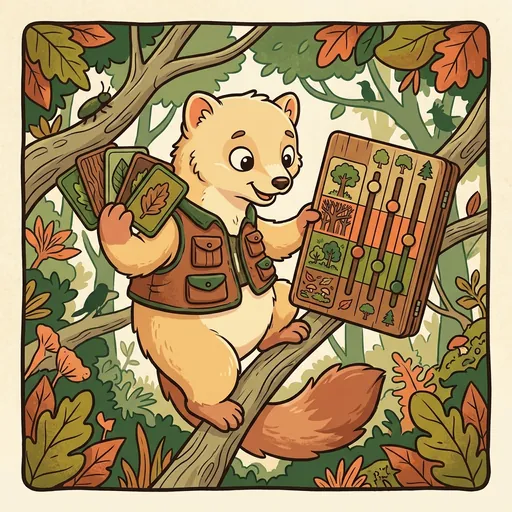
Halfway up a giant fir tree, a pine-marten-tween named Canopy stopped climbing and just listened.
She had left the forest floor at dawn, where it was dim and damp and smelled of rot and mushrooms. Now, thirty feet up, everything was different. The light came sideways in dusty gold bars. A wren she’d never see from the ground was building a nest in a fork above her. Somewhere higher, wind she couldn’t feel down below was moving the treetops in a slow hush.
A squirrel scrambled past, saw her hanging there doing nothing, and stopped. “You’ve been climbing all morning just to sit on a branch?”
“I’m not sitting,” Canopy said. “I’m reading the floors.”
The squirrel gave her a sideways look.
“Watch.” Canopy climbed down a body-length, to where the ferns thinned and the light dimmed. “Down here it’s cool and shady. Slugs, ferns, deer that hate being seen.” She climbed back up two lengths, into the gold. “Up here — songbirds, bright leaves, bugs that only fly in sun.” She kept going, up to where the branches got thin and whippy and the wind grabbed at her tail. “And up here it’s windy and open, where only the biggest trees dare poke through.”
She looked down at the squirrel, delighted. “One tree. Different worlds stacked on top of each other. Layers of life under leaves.”
Canopy had figured that out the hard way, when she was small and scared.
The first time she’d climbed high, she’d frozen. The ground went far away below her, and her chest went tight, and she thought: I don’t belong up here. This is the wrong place for me. I should be down on the floor where it’s safe. She’d clung to the bark, feet locked, certain she was somewhere she wasn’t meant to be.
Her grandmother had climbed up beside her — an old marten with a slow, warm voice — and hadn’t told her to be brave. She’d just said, “Feels like a whole different forest up here, doesn’t it? Like you crossed into somewhere new.”
Canopy had nodded, miserable.
“That’s because you did, little one. This isn’t the wrong place. It’s just a different layer. The floor is one home. This is another. The very top is another still.” Her grandmother pointed her nose up through the branches. “Nobody lives in all of them. The deer stays low. The eagle stays high. You — you get to travel between them, and that’s the rarest gift in the whole forest. The scared feeling is just you noticing you crossed a border.”
Canopy did not climb higher that day. But she stopped feeling lost. The strange, out-of-place feeling had a name now: a layer. And somehow that made it possible to keep going.
She walked to Biomeforge at twelve, because a place that studied living lands ought to understand a forest that was really several forests stacked in one.
Cedar, the old field-guide who ran the station, met her at the trailhead. She didn’t ask Canopy to prove she was clever. She asked one question. “What is a forest?”
Canopy didn’t answer with words. She climbed the tall pine beside the station — floor, then understory, then the bright middle, then out to the thin windy top — pausing at each height, then scrambled back down and stood there, a little out of breath.
“It’s a lot of trees,” Cedar said, testing her.
“It’s four forests,” Canopy said. “The floor, with its decomposers and its ferns. The understory, where the young trees wait in the shade. The busy middle where most of the leaves catch the light. And the emergents — the giants that break out over the top of everything. Every layer has its own animals, its own light, its own weather. Count the layers and you’ve counted the forest.”
Cedar looked up at the tree for a long, quiet moment. “You belong here,” she said.
Canopy’s corner of the station was full of things that grew in layers.
A boy came in one afternoon, frustrated, holding a drawing of a forest — just a row of green triangles on a brown line. “I drew a forest,” he said, “but the guidebook says mine’s wrong, and I did all the trees, so I don’t get it.”
Canopy knew that slump. She’d felt it clinging to the bark.
“Come climb with me,” she said. She took him up the tall pine, slow, stopping at each height. On the shady floor she showed him mushroom threads laced through the dirt. “These connect the roots of the whole forest — old trees can feed sick young ones through them. People who’ve lived in forests for thousands of years knew about that web long before any of our books did.” Higher, in the filtered green, she pointed out saplings waiting patiently for a big tree to fall and let their light in. Higher still, songbirds. At the windy top, a hawk sailing over the emergent crowns.
Back on the ground, she tapped his drawing. “Your triangles aren’t wrong. They’re just flat. A real forest has floors. Does the top of the tree live the same life as the bottom?”
”…No. It’s windier up there. And brighter.”
“Right. So give your forest its layers back.”
He grabbed his pencil and started drawing — ferns at the bottom, a shady middle, giants breaking out the top. “And they’d be different in different places?” he asked.
“A rainforest stacks its layers thick and tall and steamy. A cold northern taiga stacks them short and spare. Same idea, different forests. Layers all the way through.”
Later, when the station was empty, the boy came back with one more question. He was quieter now.
“When you’re standing on the floor,” he said, “and you can’t see all those other worlds up above you… how do you know they’re really there?”
Canopy thought about the bark, and the tight chest, and her grandmother’s slow voice.
“You feel it, first,” she said. “When you climb and the air goes cool then warm then windy, when the sounds change and the light changes — that’s the forest telling you you’ve crossed into somewhere new. You don’t have to see the whole thing at once. You just trust that every layer holds a life, even the ones you’re not standing in.” She looked out the window, up toward the crowns catching the last gold. “The oldest forest-keepers say a forest isn’t a wall of trees. It’s a whole stack of neighbors, minding their own heights, feeding each other in the dark. And once you’ve felt yourself cross from one floor to the next, you never see a plain green wall again.”
The boy nodded slowly, and Canopy watched the lost look lift off his shoulders — the same way, years ago, hers had.
She didn’t say the rest out loud, but she thought it, warm and certain: the out-of-place feeling is usually just you arriving somewhere new. There’s a whole life waiting on every floor. You only have to climb up and listen.
The BiomeForge ensemble
Canopy is part of BiomeForge's distributed-narrative cast. Each character embodies a different curricular primitive; together they teach the full subject.