Flux
FLUX — biomes move as climate moves. our maps will redraw.
Listen along — Flux
Loading audio…
Press play to listen along. The line being read lights up as you go.
Show full transcript
Loading transcript…
Chapter 5 — Flux and the Maps That Are Already Being Redrawn
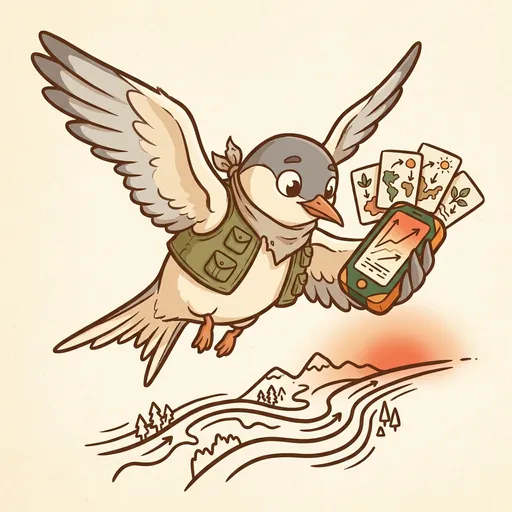
High over the tundra, an arctic-tern-tween named Flux hung in the cold wind with an old paper map clamped in one foot, and frowned at everything below her.
The map said this ridge should be treeless — bare stone and moss and stubborn little flowers, the way the far north had always been. But down there, poking up between the rocks, were trees. Small spruce, knee-high and scrappy, but real, climbing higher up the slope than any spruce had a right to be.
Flux banked, landed on a boulder, and pulled a stub of charcoal from her naturalist vest. She laid the map flat, weighted its corner with a pebble, and looked from the paper to the slope and back again.
“You’re wrong,” she told the map, not unkindly. “Not your fault. You were right fifty years ago.”
Then she did the thing she always did. She drew a new line. She smudged out the old edge of the treeline and sketched it in where the little spruce actually stood now — higher, further, creeping up toward the cold like it was chasing something. She dated it in the corner. She tucked the map away.
Another tern wheeled down beside her, curious. “You fly all this way just to scribble on maps?”
“I fly all this way,” Flux said, “because the maps keep moving. Somebody’s got to notice where they went.” She lifted off. “The tree came up the hill to meet the warmth. So did I. Come on — there’s more.”
Flux had not always trusted her own eyes about this.
The first time she noticed a map was wrong, she was small, and it frightened her. She’d flown south to a marsh her flock had used for as long as anyone could remember — a wet, buzzing, alive place, thick with the insects terns needed. But the marsh had shrunk. The water had pulled back. The edges had gone dry and cracked, and half the birds who should have been there simply weren’t.
She’d sat on a fence post feeling sick. It was like coming home and finding a room in your house had gone missing. The map is broken, she’d thought, and if the map is broken, then nothing is where it’s supposed to be, and everything I know is a lie. Her wings wouldn’t stop shaking.
An old tern, grey and slow, settled beside her. She didn’t tell Flux to calm down. She said, “You came back and it had changed on you. That’s a lonely feeling — like the ground moved while you were away.”
Flux nodded, throat tight.
“But listen. The marsh didn’t lie to you. It moved. Wet places are drifting; warm belts are climbing north; the whole living map is sliding, slow in some places, fast in others.” The old tern looked out at the cracked mud. “A broken map you throw away. A moving map — you follow it. You learn to keep redrawing it. That’s not a lie coming apart, little one. That’s the truth still telling you where to go.”
Flux didn’t feel better all at once. But the shaking eased. The change had a shape now, and something with a shape can be tracked.
She came to BiomeForge at twelve, because a field station that studied biomes ought to care that they wouldn’t hold still.
Steward, the naturalist who ran the station, met her at the gate with no test in mind — until Flux dropped a map on the table without being asked. It was covered in her charcoal lines: old edges smudged, new edges sketched in, dozens of little dated arrows, every one of them pointing the same way. North. Uphill. Toward the cold.
“What am I looking at?” Steward asked.
“Where things are going,” Flux said. She tapped an arrow. “This bird’s summer range, moved eighty miles poleward since my grandmother flew it. This treeline, climbing the mountain a little every decade. This whole warm-forest belt, sliding north into land that used to be too cold for it.” She sat back. “The biomes are migrating. Everything alive is trying to stay inside the climate it can survive, and the climate keeps walking away from underneath it. So they follow. And I follow them, and I fix the map.”
Steward studied the arrows for a long, quiet moment.
“You belong here,” he said.
Flux’s corner of the station filled up with kids who wanted to know where things were going.
One afternoon a girl came in already gloomy, having read something grim. “Everything’s moving because it’s getting hotter,” she said, “and lots of the animals are going to run off the edge of the map and there won’t be any cold left to run to. So what’s even the point of drawing it?”
Flux knew that gloom. She’d felt it on the fence post.
“Fair question,” she said. “Some of it’s true. It is warming, and some species really are running out of north to run to — that part’s real, and pretending it isn’t would be its own kind of lie.” She unrolled a fresh map. “But here’s what the doom leaves out. Draw the line with me.”
The girl hesitated, then took the charcoal.
“That patch of forest,” Flux said. “People noticed it was drying and they planted shade and dug little channels to hold the water. It’s hanging on. Draw it green.” The girl did. “That marsh — a whole town fought to keep the river feeding it instead of piping it away. Still wet. Draw it blue.” Draw. “This bird’s new range up here? People built it a corridor of safe stopping places all the way up the coast so it could actually reach the cold. It made it. Draw the arrow to the end.”
The girl looked at the map. It wasn’t all disaster. Green and blue had crept back in wherever someone had bothered to act.
“The map moves whether we watch or not,” Flux said. “But which way it moves — that part isn’t only up to the weather. People are in the map too.”
When the station had emptied out, the gloomy girl came back with the fresh map rolled under her arm.
“When it feels too big,” she said quietly, “and it’s the whole planet moving and you’re just one small bird with a piece of charcoal — how do you not just… sink?”
Flux thought about the fence post, and the shaking, and the old grey tern.
“You draw the next line,” she said. “That’s the honest answer. Not the whole map — just the next true line, the one right in front of you.” She looked out the window toward the tundra, where somewhere a small spruce was still climbing a hill it wasn’t supposed to. “When something huge is on the move, the sinking feeling comes from staring at all of it at once. But you never have to carry all of it. You just have to notice where one thing went, and mark it down honest, and hand the map to whoever comes next.”
The girl held the map a little tighter, and Flux watched the sink lift off her shoulders — the same way, years ago, hers had.
She didn’t say the rest out loud, but she thought it, warm and steady: the map was never a promise that nothing would change. It was always just a way to say — here, I saw where it went. Now we know where to follow.
The BiomeForge ensemble
Flux is part of BiomeForge's distributed-narrative cast. Each character embodies a different curricular primitive; together they teach the full subject.