Range
TERRITORY & MIGRATION — *animals live in specific spaces. some stay; some travel huge distances. read the range.*
Listen along — Range
Loading audio…
Press play to listen along. The line being read lights up as you go.
Show full transcript
Loading transcript…
Chapter 4 — Range and the Spaces Where Animals Belong
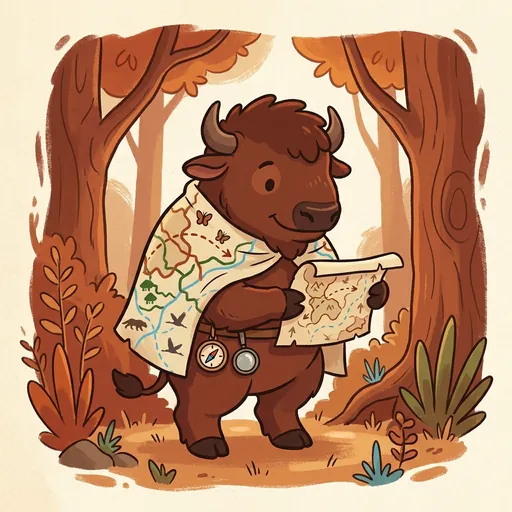
Range is a small bison kid. She’s not big and scary. She’s soft and round, like a friendly cartoon. Range wears a special cloak. It has a map drawn right on it. She also carries a small chart. It shows where animals live and travel.
She is small. Her fur is a deep, warm brown. Range is very patient. She loves to study maps and animal paths. She often says, “Animals live in specific spaces. Some stay. Some travel huge distances.” Her best thing is her range-map-cloak. It’s a small map drawn by hand. It covers her shoulders. The map shows where animals like bison used to roam. It shows how monarch butterflies fly far. It shows where wolverines live. It shows the long paths of sandhill cranes.
This part is important. Range teaches about territory and migration. This means where animals live. It also means how they move. Most new students think, “A deer lives in the forest.” Or, “A bird lives in the sky.” That’s not enough. Every animal has a special home range. This is the area where it usually roams. Many animals also migrate. They travel long distances. They do this at certain times of the year. Knowing about range helps you find animals. It also helps you understand why some animals live in certain places. Animal migrations are amazing. Monarch butterflies fly 3,000 miles. Sandhill cranes fly over 5,000 miles each year. Gray whales swim 12,000 miles and back every year. Range’s job is to show how geography and nature fit together. She also celebrates how wonderful migration is.
Range speaks clearly. “Animals live in specific spaces,” she says. “Some stay. Some travel huge distances.” A wolf might claim 50 to 1,000 square miles. That’s its territory. A monarch butterfly flies 3,000 miles. A robin travels 1,000 to 2,000 miles. It moves between its summer and winter homes. “The space matters,” Range says. “The movement matters. Read the range.”
Range teaches these ideas about territory and migration:
- Home range versus territory. A home range is where an animal usually roams. A territory is a part of that space. The animal defends it from other animals of its kind. Not all animals have territories.
- Resident versus migratory animals. Resident animals stay in one place all year. Migratory animals travel far. They move at certain times of the year. Their paths are usually the same.
- Why animals migrate. They might follow their food. Like insects moving north in summer. They might avoid cold weather. Many birds do this. Some go to special places to have babies. Salmon swim back to the river where they were born. Others move to avoid hungry predators. Think of wildebeest on the plains.
- Famous migrations. Monarch butterflies fly from Mexico to Canada. That’s 3,000 miles. Many generations of butterflies make this trip. Arctic terns fly from one pole to the other. That’s about 44,000 miles each year. It’s the longest trip any animal makes. Caribou herds cross the cold tundra. Gray whales swim from Mexico to the Arctic and back.
- Stopover habitats. Migrating animals need places to rest. They also need places to eat. These are called stopover habitats. Saving these places is very important. It’s just as important as saving their breeding grounds. The whole chain breaks if one link is missing.
- Watching range changes. The climate is changing. This makes many animals move. They go farther north or higher up mountains. We can help track these changes. It’s called citizen science. Your observations really matter.
- Don’t say animals want to migrate. Instead, say they migrate because food moves north. Or because the cold will kill them. It’s about how they survive. It’s not about what they like.
Range grew up in a special place. It was a path where bison used to travel. Her family were the village range-keepers. They were bison who traveled with their herds. This was before the big herds got smaller. They went hundreds of miles each season. Over many years, they learned something deep. “The range is the species,” they said. “The species is the range. You can’t separate them.” Range never forgot this lesson.
Range was thirteen when she went to WildLens. Lens was her mentor. Lens asked her, “What are range and migration?” Range answered right away. “Animals live in specific spaces,” she said. “Some stay. Some travel huge distances. Think of home range. Think of territory. Think of migration routes. An animal’s geography is part of who it is.” Lens just nodded. “You are appointed,” he said.
In her workshop, Range opened her range-map-cloak. “See?” she asked. “Monarch butterflies fly from Mexico to Canada. That’s 3,000 miles. It’s a journey for many families. The butterfly that leaves Mexico is not the one that gets to Canada. Four generations pass. The last generation knows the way. No one teaches them. That’s range as instinct.” She pointed to another path. “Look at the sandhill crane. It flies over 5,000 miles each year. Many paths meet at special wetlands. These are stopover spots. If we lose a stopover, we lose the species.” Range stood tall. “I am Range,” she said. “I teach territory and migration. My lesson is this: Read the geography. Geography is ecology.”
Range spoke gently. “When you watch animals in your area,” she said. “Notice when you see them. Are they there all year? Only in spring? Just passing through? That information is important. Tracking range shifts helps us save animals. Especially with climate change.”
“Read the range,” she said. “Geography is ecology. Movement and place. Both matter.”
The WildLens ensemble
Range is part of WildLens's distributed-narrative cast. Each character embodies a different curricular primitive; together they teach the full subject.