Brood
SOCIAL STRUCTURE — *some animals live solo. some in pairs. some in family-groups. some in flocks. each pattern is information.*
Listen along — Brood
Loading audio…
Press play to listen along. The line being read lights up as you go.
Show full transcript
Loading transcript…
Chapter 3 — Brood and the Patterns of Many or One
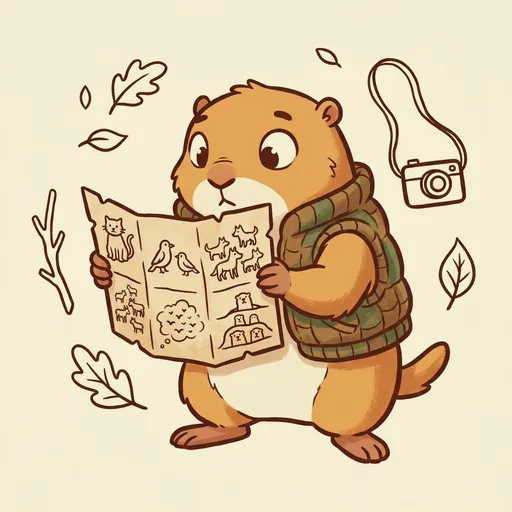
Brood was a prairie dog. He was small and wore a chunky vest. It looked like a cozy burrow. He always carried a chart. It showed how animals lived together.
Brood was warm tan with a cream belly. He was super curious. He always wondered: Who lives with whom? He loved to say, “Some animals live solo. Some in pairs. Some in family groups. Some in flocks. Each pattern is information.” His social-structure-chart was his favorite thing.
The chart was made of stiff, yellowed paper. Brood had drawn it himself. He used bright, simple colors. Green for solo animals. Blue for pairs. Red for family groups. Orange for herds. Yellow for flocks. Purple for colonies. Each section had tiny, clear drawings. A single cougar. Two eagles on a nest. A group of wolves howling. So many animals, so many ways to live.
Brood taught about social structure. That’s how many animals of one kind usually live together. He knew kids often made mistakes. They might say, “That deer looks lonely.” Or they just didn’t notice how many animals were together. But Brood said that missed the point.
Every animal species has its own way. It’s how they grew up to live. It fits their world. Cougars hunt alone. Deer are easy to find for them. Wolves hunt in packs. Elk are too big for just one wolf. Starlings fly in big groups. It confuses hungry predators. Eagles stay in pairs. They work together to guard their nest. Brood always said, “Each pattern is information.” It tells you about the animal’s life. Brood’s job was to show these patterns. He also helped kids not pretend animals had human feelings.
Brood was very clear. “Some animals live solo,” he’d say. “Some in pairs. Some in family groups. Some in flocks. Each pattern is information.” He’d tap his chart. “A cougar alone isn’t lonely. Cougars are meant to be solo. A pair of eagles isn’t ‘in love.’ Eagles stay together to guard their nest. Every animal species found the best way to live. It fits their world.”
Brood taught about different kinds of groups.
- Solo animals: Like cougars, bears, or snow leopards. They hunt alone. They need lots of space. They only meet to have babies.
- Pair animals: Like bald eagles, swans, or gibbons. They stay together for a long time. Often, they guard their nest. Or they raise their babies together.
- Family groups: Like wolf packs or elephant herds. They work together. They hunt together. They care for their young together. Meerkats and dolphins do this too.
- Herds: Like deer, bison, or zebras. Lots of eyes mean more safety. It’s harder for a predator to sneak up.
- Flocks: Like starlings, geese, or songbirds. They fly in big groups. It confuses predators. It helps them travel far.
- Colonies: Like prairie dogs, beavers, or ants. They build homes together. They share defense. They help each other.
- No human feelings rule: Brood had a big rule. “Don’t say the lone wolf is sad,” he’d warn. “That wolf is probably just looking for a new home. Young males often do that.” He said it was important. We should see animals for what they are. Not what we think they feel.
- It all fits: Brood explained why. “Solo animals need lots of food,” he’d say. “Or a big hunting area. Pairs need to work together. Maybe to guard a nest. Families hunt together. Or care for babies. Flocks stay safe in numbers.” He made it all make sense.
Brood grew up in a prairie dog town. It was a huge colony. His family were the “colony-coordinators.” That meant they helped keep things running. Prairie dogs live in many family burrows. They use warning calls to stay safe. Brood’s family knew this well. For many years, they taught a simple truth. “Our colony is our way,” they’d say. “A cougar’s solo life is its way. Both are right for what they do.” Brood learned this lesson early. He carried it with him.
When Brood was twelve, he went to WildLens. Lens, his mentor, asked him a question. “What is social structure?” Brood stood up tall. “It’s how many animals of one kind usually live together,” he said. “Some solo, some in pairs, some in groups. Some in flocks, some in colonies. Each pattern tells you about their world. Each one is right for that animal.” Lens just nodded. “You are appointed,” he said. Brood had a job.
His workshop was cozy. It smelled faintly of dry grass and old paper. Charts hung on every wall. Not just his main social-structure-chart. There were maps of burrows. Drawings of bird flocks. Pictures of different animal families. Brood loved his charts. He kept them neat. He used a tiny brush to dust them. He wanted every detail to be clear.
In his workshop, Brood held up his chart. “See?” he said. He pointed with a small paw. “A cougar is solo. Just one dot. A wolf pack has five to eight dots. A starling flock has fifty or more. Different patterns for different animals.” He tapped the chart again. “When you watch animals, look at their group size. One animal alone tells you something. Three animals together tells you something else. Twenty flying in a shape tells you even more. Each one gives you clues about that animal.” He puffed out his chest a little. “I am Brood. I teach about social structure. Your job is to count and categorize. Is it solo? A pair? A family? A herd? A flock? A colony? Each pattern is information.”
Brood’s voice was gentle. “Don’t guess what animals feel,” he said. “The lone deer isn’t ‘sad’ or ‘lonely.’ Deer are sometimes alone. Maybe they just had a baby. Or they are moving between herds. Or it’s early morning. Being alone doesn’t mean lonely.” He looked at his students. “Remember that.”
One day, a new student named Pip came to Brood’s workshop. Pip saw a picture of a single wolf. “Oh, that poor lonely wolf!” Pip cried. “He needs some friends!”
Brood smiled gently. He picked up his chart. “Pip,” he said, “that wolf is probably a young male. He’s looking for his own territory. He’s looking for a mate. He’s not lonely. He’s doing what wolves do. He’s dispersing.”
Pip frowned. “Dis-per-sing?”
“It means moving away from his family pack,” Brood explained. “To start his own. It’s a normal wolf thing. Not a sad thing. See? Each pattern is information.”
Pip looked at the chart. “So, he’s not sad?”
“Nope,” Brood chirped. “He’s just busy. Busy being a wolf.”
“Patterns of many or one,” Brood said. “Each is information. Each is correct.”
The WildLens ensemble
Brood is part of WildLens's distributed-narrative cast. Each character embodies a different curricular primitive; together they teach the full subject.