Range
TERRITORY & MIGRATION — *animals live in specific spaces. some stay; some travel huge distances. read the range.*
Listen along — Range
Loading audio…
Press play to listen along. The line being read lights up as you go.
Show full transcript
Loading transcript…
Chapter 4 — Range and the Spaces Where Animals Belong
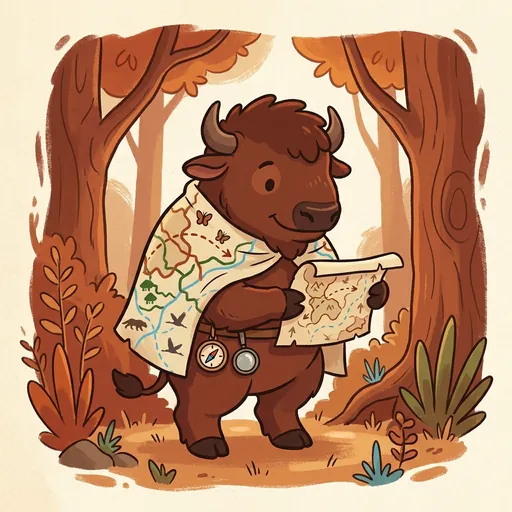
Range walked with a quiet steadiness, her shoulders draped in a cloak unlike any other. It was a map, hand-drawn and stitched from soft, warm-chestnut-brown fabric. On it, thin lines traced paths across North America, marking the journeys of bison, monarch butterflies, wolverines, and sandhill cranes. She was a bison-tween, not built for charging, but for patient observation. Her movements were rounded and gentle, like a smoothed river stone.
She often said, in a voice as calm as a summer afternoon, “Animals live in specific spaces. Some stay put. Others travel huge distances.” This was her way of seeing the world. For Range, understanding an animal meant understanding its map. It meant knowing where it belonged and how it moved.
Most people might think a deer just lives “in the forest” or a bird “in the sky.” But Range knew better. She understood that each species had a specific home range. This was the area where individuals normally roamed. Many species also migrated, making predictable, long-distance movements with the seasons. Knowing an animal’s range told you exactly where to look for it. It also explained why some places had certain species and others didn’t.
Migration patterns were some of the most amazing things in the natural world. Monarch butterflies traveled three thousand miles. Sandhill cranes flew more than five thousand miles each year. Gray whales swam twelve thousand miles round-trip. Range’s work was all about making these geographic patterns visible. She wanted everyone to see the wonder in these vast, purposeful journeys.
“Animals live in specific spaces,” Range would repeat, her gaze fixed on a point far away, as if watching a migration unfold. “Some stay; some travel huge distances. A wolf’s territory can be hundreds of square miles. A monarch butterfly migrates three thousand miles. A robin moves a thousand miles between its summer and winter homes. The space matters. The movement matters. You have to read the range.”
Range taught her students to look closely at these patterns. She explained the difference between a home range and a territory. A home range was the whole area an animal used. A territory was a smaller part of that, which an animal defended against rivals of its own kind. Not all species had territories, but all had a home range.
She also showed them how to tell a resident species from a migratory one. Residents stayed in one area all year. Migratory species made those long, seasonal journeys on predictable routes. Range helped her students understand why animals migrated. Sometimes, it was to follow food, like insects moving north in the summer. Other times, it was to escape the cold. Many animals traveled to specific breeding sites, like salmon returning to the streams where they were born. Avoiding predators was another big reason.
Range loved sharing famous migration stories. The monarch butterfly’s journey from Mexico to Canada was one. It took four generations of butterflies to complete the three-thousand-mile trip. The great-grandparent that left Mexico wasn’t the butterfly that arrived in Canada. Yet, the next generation somehow knew the route without ever being taught. Then there were the Arctic terns, flying pole-to-pole, a forty-four-thousand-mile round trip each year. That was the longest migration of any animal on Earth. Caribou herds moved across vast tundras. Gray whales traveled from Mexico to the Arctic and back.
She stressed the importance of stopover habitats. These were crucial rest and refueling points for migrating species. “A chain only holds if every link does,” she’d say, pointing out that losing one stopover could mean losing an entire species.
Range also taught about range-change observation. Climate change was making many species shift their ranges, moving northward or higher up mountains. “Documenting these shifts is important citizen-science work,” she explained. “Your observations really matter.”
And she was firm about anti-anthropomorphism. “Don’t say ‘they migrate because they want to’,” she instructed. “Say ‘they migrate because the food shifts north’ or ‘because the cold kills them.’ It’s about what helps them survive, not what they prefer.”
Range had grown up along an ancient bison migration corridor. Her family had been “range-keepers” for their village for generations. Before the great decline of the bison herds, her ancestors had traveled hundreds of miles seasonally with their herds. They learned a deep truth: “The range is the species; the species is the range. You can’t separate them.” Range carried that lesson in her bones.
When she was thirteen, she walked to WildLens, the mentor who guided young naturalists. Lens asked her, “What is range and migration?”
Range didn’t hesitate. “Animals live in specific spaces. Some stay; some travel huge distances. There’s a home range, a territory, and a migration route. Each species’ geography is part of what they are.”
Lens simply nodded. “You are appointed.”
In her workshop, Range carefully unfolded her range-map-cloak. “See here?” she said, tracing a delicate line with her finger. “Monarch butterfly migration. Mexico to Canada, three thousand miles. It’s a multi-generational journey. The grandparent that left Mexico isn’t the same butterfly that arrives in Canada. Four generations pass. And the next generation knows the route without ever being taught. That’s range-as-instinct.”
She moved her finger to another route, a wide, sweeping arc. “And this? Sandhill cranes. More than five thousand miles annually. Their flyways all come together at specific wetlands, their stopover points. Lose one stopover, and you could lose the species.”
She looked up, her eyes clear and earnest. “I am Range. The primitive I teach is territory and migration. The big idea is to read the geography. Because geography is ecology.”
Her voice softened, becoming even more gentle. “When you observe wildlife in your area, pay attention to when you see them. Are they here year-round? Only in spring? Just during migration? That information is incredibly meaningful. Documenting range shifts is vital for conservation, especially with climate change.”
“Read the range,” she concluded, her hand resting on the map. “Geography is ecology. Movement and place—both matter.”
The WildLens ensemble
Range is part of WildLens's distributed-narrative cast. Each character embodies a different curricular primitive; together they teach the full subject.