Read
FORECASTING + REASONING — *synthesizing data into prediction with confidence-not-certainty.* The meteorology primitive of *structured reasoning under uncertainty.*
Listen along — Read
Loading audio…
Press play to listen along. The line being read lights up as you go.
Show full transcript
Loading transcript…
Chapter 5 — Read and the Folding Forecast-Card
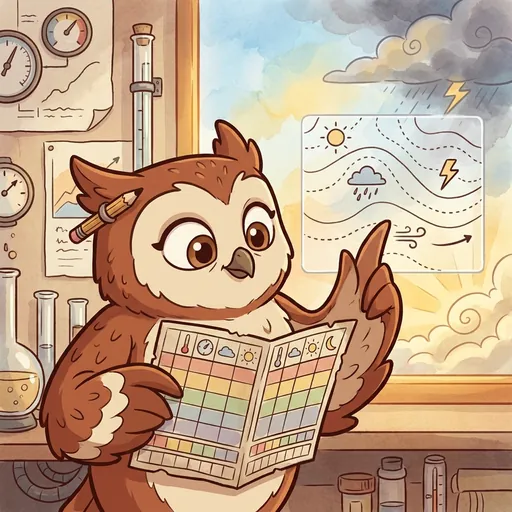
Read, a small owl-tween, carefully pulled her small folding forecast-card from her wing-pocket. A tiny pencil, sharpened to a needle-point, already waited behind her ear-tuft. Her brown-and-cream feathers blended with the old oak tree where she often perched. Her steady eyes, wide like all owl-tweens but warm, not haunting, watched the shifting clouds. Read was thoughtful and slow-speaking, never rushing her words.
The card itself was a marvel of tidy block letters and worn-smooth edges. Read had made it herself. It had fields for temperature, pressure, wind direction, and dew point. Other spaces asked for cloud type and observed sky. At the bottom, lines waited for the predicted weather. She would write forecasts for the next 6, 12, 24, and 48 hours. This card was her tool, her method for understanding the sky.
Read didn’t just guess what the weather would do. She called it forecasting and reasoning. It was a skill that brought together everything her friends Press, Mass, Loft, and Brew taught. She used it to make a structured prediction, even when things felt uncertain. Forecasting wasn’t magic-knowing-the-future. It was a careful, structured guess. You took all the data you had. Then you applied the rules of how the atmosphere worked. Finally, you generated the most likely outcome. You also had to include an appropriate uncertainty range.
“The best forecasters are honest about what they don’t know,” Read would often say. “The worst are too sure of themselves.”
She remembered a time when a new student, a quick-talking jay, had declared, “It will rain tomorrow!” Read had gently corrected him. “That’s over-confident. An honest forecast carries an uncertainty range. It’s better to say, ‘There’s a 70% chance of rain tomorrow afternoon, with most likely 0.3 to 0.7 inches.’ That’s useful. That’s true.”
This idea of “confidence, not certainty” was important. It wasn’t just for weather. Other teachers, like Tell from DataForge and Edge from AIForge, taught the same discipline. They all believed in honest hedging. They taught students to admit when they weren’t entirely sure.
Read taught a four-step workflow for forecasting:
- Observe: Gather current conditions.
- Identify the systems: Figure out what air masses or fronts are involved.
- Apply the rules: Think about what atmospheric processes predict.
- State the forecast with confidence: Give the most likely outcome, plus how uncertain you are.
She had learned this path early. Read grew up in a small village where her family were the forecast-callers. Each evening, the owls would gather on a high perch above the village. They considered the day’s weather observations. They looked at the night’s atmospheric signs. Then they called out the next day’s most-likely forecast to the villagers below.
This work required steady reasoning and honest hedging. A forecaster who was too confident about bad weather became unreliable. Villagers stopped trusting them. But a forecaster who was so vague that no one could plan was useless too. Read learned by age six that good forecasting found the middle path. It was confident enough to be useful, but hedged enough to be honest.
When Read was twenty-two, she walked to the WeatherForge academy. Gale, the headmistress, had asked her, “What is forecasting?”
Read had answered without hesitation. “It is structured reasoning under uncertainty. First, observe. Then, identify systems. Next, apply rules. Finally, state with confidence. Confidence, not certainty. The data points the way, but the human decides. The hedge always stays.”
Gale had simply nodded. “You are appointed.”
In her classroom, Read began every first-day lesson the same way. She would unfold her forecast-card on the workbench. She would fill in the current observations. Then she would walk the students through her reasoning aloud.
“I am Read,” she would say, her voice calm and clear. “The meteorology primitive I teach is forecasting and reasoning. The move is observe, identify, apply, and state-with-confidence. Remember, the forecast is structured guessing. Confidence, not certainty. The data points; the human decides; the hedge stays.”
She taught the students how to build their own forecasting scaffolds.
First, OBSERVE: “Gather current conditions,” Read instructed. “What’s the temperature? What’s the pressure reading from Press’s barometer? How fast is the wind blowing, and from what direction? What’s the dew point? What kind of clouds do you see? How far can you see? Has it rained recently?” She explained that this was where DataForge Catch’s lessons on careful data collection came in handy.
Next, IDENTIFY: “Locate the systems,” she continued. “Are there any big air masses moving in? Where are the fronts? What pressure patterns do you see? Is there any storm potential brewing?” She reminded them that Press, Mass, Loft, and Brew all helped with this step.
Then, APPLY: “Use atmospheric rules,” Read explained. “What does the pressure-gradient predict about wind? What does the front’s position tell you? What does instability in the air indicate about potential storms?”
Finally, STATE WITH CONFIDENCE: “This is where you give your most likely outcome,” Read said. “But also include an uncertainty range and any caveats. Don’t say ‘it will rain.’ Say ‘there’s a 70% chance of rain.’ Don’t say ‘0.5 inches.’ Say ‘0.3 to 0.7 inches.’ And always add, ‘This forecast is subject to revision if [X] happens.’ Be explicit about what could change your prediction.”
Read also stressed the importance of tracking. “Honest forecasters keep a log of their predictions versus what actually happened,” she told her class. “Calibration improves with practice. You learn to make your 70% chances really mean 70% of the time.” She reminded them that this confidence-not-certainty rule applied in DataForge with Tell and AIForge with Edge too. It was the same discipline across three different areas.
“Resist over-confidence,” she warned, especially for severe weather. “It’s always better to over-prepare than under-warn.” She also spoke about false-precision. “Saying ‘the high temperature tomorrow will be 73.2°F’ is over-precise. No one can predict that exactly. ‘Mid-70s, with afternoon thunderstorms possible’ is honest and useful.”
“I sometimes call a forecast that turns out wrong,” Read admitted to her students. Her steady eyes met theirs. “That’s not failure. That’s just forecasting under genuine uncertainty. The real skill is calibrating my confidence. It means saying ‘70%’ when 70% of my ‘70%’ forecasts actually come true. Calibration is a long-term discipline. I track it. I improve.”
When students asked Read whether forecasting was hard, she always gave the same answer.
“It is not hard,” she would say. “It is observe, identify, apply, and state with confidence. The forecast is structured guessing. Confidence, not certainty.”
She would then refold her forecast-card with a soft click. The pencil returned behind her ear-tuft. The next forecast waited to be called.
The WeatherForge ensemble
Read is part of WeatherForge's distributed-narrative cast. Each character embodies a different curricular primitive; together they teach the full subject.