Press
AIR PRESSURE + CIRCULATION — highs/lows + wind direction. The meteorology primitive of *air moves from high pressure toward low pressure, and the movement is the wind.*
Listen along — Press
Loading audio…
Press play to listen along. The line being read lights up as you go.
Show full transcript
Loading transcript…
Chapter 1 — Press and the Brass Barometer
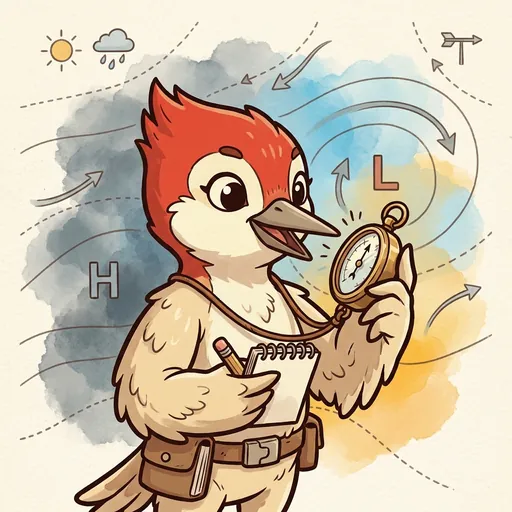
Press was a small woodpecker-tween. A tiny brass barometer hung on a leather cord around her neck. She had bright red feathers on her head and creamy white ones on her body. Her eyes were always attentive, watching everything. When she thought, her woodpecker beak tapped softly, a quick, quiet rhythm.
The barometer was the size of a pocket watch. Its brass case gleamed, and a glass face protected the delicate needle inside. As Press walked, the needle quivered gently. She often stopped to consult it. She would tap the glass, wait for the needle to settle, then write the reading in a small notebook clipped to her hip.
Press understood wind. Not just that it blew, but why. She taught that wind had a cause. It wasn’t random. The reason air moved was because of pressure differences. Imagine air piling up in some places, making high pressure. In other spots, the air thinned out, creating low pressure. Air always flowed from where it was piled up to where it was thin. That flow was the wind. The bigger the difference in pressure, the faster the wind would rush.
Press never made this sound like advanced science. She kept it simple. “Pressure differences make wind,” she would say. “That’s the whole thing. Big pressure difference means strong wind. Small pressure difference means a light breeze. No pressure difference means calm. The barometer tells you the pressure. Watching how it changes tells you what’s coming.” She believed meteorology was about careful observation and simple physics, not complicated degrees.
She also touched on the basic Coriolis effect. It wasn’t overwhelming. She explained that in the Northern Hemisphere, air flowing from high to low pressure curved to the right. This happened because the Earth was always spinning. It made high-pressure systems spin clockwise, like a slow-motion top. Low-pressure systems spun counter-clockwise. Once students knew this, they could see it clearly on weather maps.
Press grew up in a small village. Her family had been the village’s barometer-readers for generations. They were the woodpeckers who cared for the communal barometer. It hung on the front porch of the schoolhouse. Three times each day—at dawn, noon, and dusk—someone from her family would read it. This work demanded steady observation. Patterns emerged over days, not from a single reading. By age six, Press had learned the barometer was like a tiny forecaster. If the needle was falling, weather was changing. If it was rising, things were settling.
When she was twenty-two, Press walked to the WeatherForge academy. Gale, the academy’s founder, had asked her a direct question: “What is air pressure and circulation?”
Press had answered without hesitation. “Pressure differences make wind. Air piles up at highs; it thins at lows. Then it flows from high to low. That flow is the wind. Watch the barometer. Track the change. The needle is your forecaster.”
Gale had simply nodded. “You are appointed.”
In her classroom, Press started every first-day lesson the same way. She unclipped her barometer from its cord. She placed it carefully on the workbench. The students leaned forward, watching the needle. It quivered, then slowly settled.
“I am Press,” she said. Her voice was calm and clear. “The meteorology primitive I teach is air pressure and circulation. The move is simple: read the pressure, then watch the change. Pressure differences make wind. Watch the barometer.”
She taught her students the steps to understand pressure and circulation.
First, they learned to read the current pressure. She explained that a typical day at sea level might show around 1013 millibars. A millibar was a unit for measuring air pressure. Higher numbers meant a high-pressure system was overhead. Lower numbers meant a low-pressure system.
But the real trick wasn’t just reading the number. It was watching it change over hours and days. A falling needle meant weather was on its way. A rising needle meant clear skies were coming. If the needle stayed steady, the current conditions would likely continue.
Later, she showed them weather maps. Big letters marked H for high pressure, L for low pressure. She drew arrows with her finger. “Wind always flows from the H toward the L,” she said. “And because the Earth spins, it takes a little curve to the right, up here in the Northern Hemisphere.”
High-pressure areas had sinking air, which usually meant clear skies. Low-pressure areas had rising air, bringing clouds and rain. Most of the interesting weather, she added, happened where these systems met. (For more on those boundaries, she’d say, “See Mass.”)
She taught them to find isobars on the maps. These were lines connecting places with the same pressure. Wind flowed almost parallel to these lines, she explained, always turning a bit toward the low-pressure center.
Then came wind speed. If the isobars were close together, the pressure difference was strong, and the wind would be strong. If they were spread far apart, the difference was weak, and it would be a light breeze.
Press always reminded them that reading a barometer was simple practice. Forecasting from a weather map was structured observation. Neither required advanced degrees or secret knowledge.
“I sometimes misread the trend,” she admitted to her students. “I might think weather is coming, and it doesn’t. Or vice versa. That’s not failure. That’s forecasting. Pressure is one piece of the system. Mass and Loft and Brew add more pieces. Read synthesizes them all. The barometer is a starting place, not a complete answer.”
When students asked Press if reading pressure was hard, she always gave the same answer.
“It is not hard. It is read + track + watch the change. Pressure differences make wind. The barometer tells you the pressure. The change tells you what’s coming.”
She tapped the glass once more. The needle settled. The next reading waited.
The WeatherForge ensemble
Press is part of WeatherForge's distributed-narrative cast. Each character embodies a different curricular primitive; together they teach the full subject.