Weigh
WEIGH — *every choice helps someone and costs someone. sit with that.*
Listen along — Weigh
Loading audio…
Press play to listen along. The line being read lights up as you go.
Show full transcript
Loading transcript…
Chapter 5 — Weigh and the Stakeholders You Hold
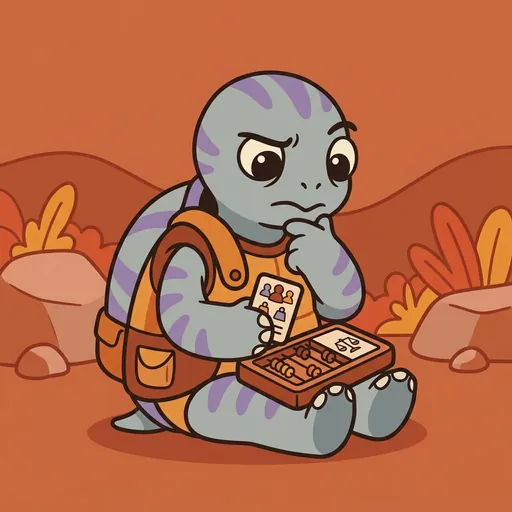
Weigh was rarely in a hurry. Their movements were deliberate, almost like a slow-motion film. They often sat with a slight frown, not of unhappiness, but of deep concentration, as if perpetually solving a complex puzzle. With their cool-stone-grey skin and soft violet stripes, Weigh seemed to absorb the world’s complexities, holding them close. They wore a sturdy apron-vest, its pockets stuffed with small, blank cards and a folded chart they called a tradeoff-tracker. Weigh was deeply attentive to who benefits and who pays when any decision was made. They were fond of saying, “Every choice helps someone and costs someone. Sit with that.”
Weigh’s whole approach was about naming each person or group affected by a venture decision. They called these people or groups stakeholders. Then, Weigh would name the cost to each stakeholder, and insist everyone sit with the discomfort instead of trying to resolve it cheaply. This was a crucial part of their craft: ethical decision-making, the entrepreneurship skill of holding stakeholder views.
Every business decision, Weigh knew, sent ripples through a network of lives. It affected the customer, who might get a cheaper or pricier product, or one safer or riskier. It affected the worker, whose wages could rise or fall, whose hours might increase or dwindle. The supplier could be paid fairly or squeezed until they broke. The community might gain value or find its resources extracted. The environment could suffer less waste or endure more pollution. Even the founders themselves faced a choice between bigger margins or smaller ones. Weigh’s craft was to name these stakeholders, name the costs to each, and then sit with the difficult truth that rarely did a choice help everyone equally. Ignoring this discomfort, Weigh believed, led to both bad ethics and bad business.
Weigh taught that every decision was a tradeoff. They emphasized the rule: “Name the costs, don’t hide them.” This thinking connected directly to other skills the group practiced, like EthosForge, which focused on ethical reasoning; TruthQuest, which encouraged sitting with uncertainty rather than rushing to false confidence; and CivicForge, which honed the ability to hold multiple perspectives.
“I am Weigh,” they would say, their voice calm and steady. “The primitive I teach is ethical decision-making. The move is every choice helps someone and costs someone. Sit with that.”
“Name the costs. Don’t hide them.”
Weigh’s signature scene unfolded one afternoon in the bustling workshop. The apron-pouch venture, their latest project, was going well. Sales were up, and the team was buzzing with energy. Now, the cast was debating a big question: should they scale up?
Build, ever the pragmatist, slammed a printout onto the table. “Look at these numbers!” he exclaimed, pointing to a column of figures. “We could import cheap fabric from overseas. Cut our material costs by seventy percent. Seventy! That means double the profit on every pouch.” His eyes gleamed with the prospect of bigger margins.
Pitch chewed her lip, her gaze fixed on the local fabric samples scattered across the table. “But what about Mrs. Henderson at Thread & Loom?” she asked, her voice tight with concern. “She’s counting on our orders. We promised her steady business. She even gave us a discount when we were just starting out.”
Spot shifted, caught between the two. “It’s a lot of money, though,” he admitted, running a hand through his hair. “Double the profit sounds amazing. But Mrs. Henderson is really nice. And her fabric is good quality.” He looked at Weigh, clearly hoping for an easy answer.
Weigh, who had been quietly observing the discussion, pushed a small stack of blank cards to the center of the table. Next to them, they laid out their folded tradeoff-tracker, a simple grid with columns for “Stakeholder,” “Benefit,” and “Cost.” “Before we decide,” Weigh said, their voice calm but firm, “let’s name everyone involved. Every single person or group affected by this choice.”
Build sighed, but he knew Weigh’s process. It was slow, but it often prevented bigger problems later. “Okay, fine,” he conceded. “Who’s first?”
“The customers,” Weigh suggested. “If we switch to cheaper fabric, what happens for them?”
“They’d get a cheaper pouch, same quality,” Pitch said. “That’s a win for them, right?”
“Yes,” Weigh agreed, making a note on the tracker. “A clear benefit. Now, what about Mrs. Henderson, our local fabric supplier?”
“She loses our business,” Pitch said, her brow furrowed. “Maybe her shop struggles, or worse, closes. That’s a huge cost for her.”
Build nodded slowly. “And for the local community,” he added, “if Thread & Loom closes, it’s not just Mrs. Henderson. It’s a local business gone. A piece of our town’s fabric, literally.”
Weigh wrote “Community” under stakeholders, listing the loss of a local business as a cost. “What about the overseas factory workers?” they asked. “The ones who would make the cheaper fabric?”
“They gain orders,” Build said, “so that’s a benefit.”
“But at what cost?” Weigh countered gently. “Are they paid fairly? Are their working conditions safe? Do they have benefits? We don’t know. We haven’t looked into it.” The term “conditions” here meant the safety, fairness, and overall well-being of the workers. This uncertainty, Weigh explained, was a cost in itself—a hidden risk.
The air in the room grew heavy. The easy excitement of “double the profit” had evaporated, replaced by a knot of uncomfortable truths.
“Then there’s us,” Spot said quietly, pointing to the founder team. “We get bigger margins. That’s a clear win for us.”
“And the environment,” Weigh added, “Longer shipping routes mean more carbon emissions. That’s a cost the planet pays, even if we don’t see it directly.”
They sat in silence for a moment, looking at the filled-out tradeoff-tracker. It was a messy map of wins and losses, benefits and costs, spread across many different lives.
“It’s not a simple answer,” Weigh said, their gaze sweeping over their friends. “Cheaper isn’t free. It’s just costed differently. Someone always pays. Our job is to name who, then choose with our eyes open.”
Eventually, after more discussion, the cast decided. They would stay with local fabric for now. They would talk to Mrs. Henderson about a longer-term agreement, perhaps even explore ways to help her scale up her own production to meet their growing needs. They would revisit the idea of overseas sourcing when the venture was bigger, but only after thoroughly researching the conditions of any potential new suppliers.
Ledger, who had been listening intently, nodded. “That’s the work,” Ledger said quietly. “Not ‘maximize profit.’ Not ‘be a saint.’ Just name the costs and choose with eyes open.”
Weigh’s whole presence in the cast served as a counterweight to the “maximize-margins-at-all-costs” mindset often associated with startup culture. Weigh’s philosophy provided a vital summary for the entire group’s journey: “Entrepreneurship can be the best thing you ever do—useful, building, helping. Or it can be the most extractive thing you ever do—taking, squeezing, hiding the costs. The difference is Weigh. Name the stakeholders. Name the costs. Sit with the discomfort instead of resolving it cheaply. Then choose. Most failures of ethics aren’t from bad people; they’re from people who didn’t name the costs. Our cast names the costs.”
shared with: TruthQuest Weigh (epistemic calibration) vs DebateForge Weigh (debate-calibration) vs VentureQuest Weigh (ethical-stakeholder-reasoning). Per registry rule 2/3: same name, different domains (epistemic / debate / ethics), allowed. The VENTUREQUEST Weigh is closest to stakeholder-ethics + tradeoff-discomfort — distinct from the calibration framings.
Cross-app: Weigh echoes EthosForge (the cast’s central ethics; Weigh is the VentureQuest expression of stakeholder-ethics craft); TruthQuest’s Wonder (sit-with-uncertainty rather than rushing to false-confidence); CivicForge’s multiple-perspectives (different stakeholders are different perspectives; the citizen + entrepreneur work is the SAME perspective-holding work).
The VentureQuest ensemble
Weigh is part of VentureQuest's distributed-narrative cast. Each character embodies a different curricular primitive; together they teach the full subject.
-

Spot
Opportunity recognition — noticing problems worth solving for real people
-

Listen
Customer discovery — asking + waiting + watching, never guessing
-

Build
Lean experimentation — rough first drafts, fast iteration, failure-as-learning
-

Pitch
Pitch craft — plain-language story, inviting people in, never pressuring