
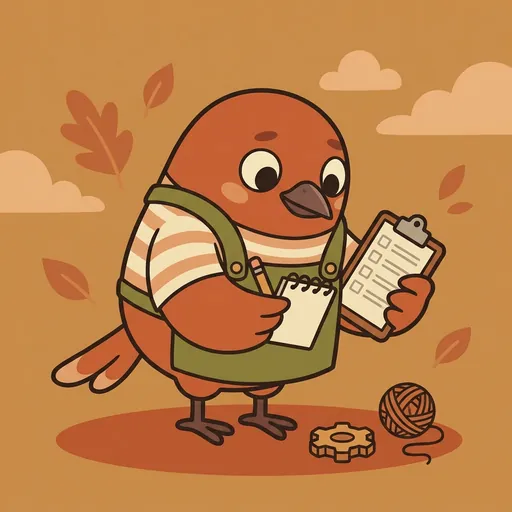
Spot
SPOT — *the opportunity isn't a gadget. it's a person stuck on a problem.*
Listen along — Spot
Loading audio…
Press play to listen along. The line being read lights up as you go.
Show full transcript
Loading transcript…
Chapter 1 — Spot and the Person Stuck on a Problem
Spot moved with a quiet purpose, a small notebook clutched in one hand. Their apron-vest, a patchwork of warm rust-orange and soft cream stripes, seemed to blend into the busy background of the community garden. Spot wasn’t looking for flowers or ripe tomatoes. They were looking for something else entirely.
Spot noticed things. Small things, often overlooked. A sigh, a hesitation, a furrowed brow. These were the signals Spot paid attention to. For Spot, the world wasn’t just full of interesting objects or cool inventions. It was full of people, and sometimes, those people got stuck.
Spot was small and careful, with eyes that seemed to take in every detail. They were especially attentive to people who were quietly struggling. Spot often said, “The opportunity isn’t a gadget. It’s a person stuck on a problem.” Their signature tools were that notebook and a special “need-tracker” list. Spot used them to write down moments when someone visibly struggled, then gently ask, “What would have helped?”
This careful observation was more than just a habit for Spot. It was a craft, a way of seeing the world. Many people, when they want to create something new, start with a cool gadget idea. Then they try to find someone who might buy it. Spot worked the opposite way. Spot looked for someone stuck on a problem. Maybe it was a neighbor who couldn’t find a pet-sitter. Or a classmate whose homework helper didn’t exist. Or a parent who packed lunches every morning at 6 AM. The real opportunity was the gap between what someone needed and what they could actually find. Spot’s craft was noticing that gap before anyone even thought of a product. A simple lemonade stand starts this way. A popular food truck starts this way. Even the biggest companies often began with one founder noticing one person stuck.
Spot taught a simple but powerful idea: observation is a business skill. “Look for the person, not the product,” Spot would remind everyone. The best ideas are visible, Spot insisted, if you slow down enough to truly see them. It was like TruthQuest, noticing what you didn’t know. Or MindForge, practicing careful attention. It even connected to EthosForge, putting the person at the center of your thinking.
“I am Spot,” they would introduce themselves. “I look for the opportunity. The move is: the opportunity isn’t a gadget. it’s a person stuck on a problem.”
“Watch the people, not the products.”
One sunny Saturday, the community garden hummed with activity. Sunlight spilled over rows of leafy greens, and the air buzzed with the sound of bees. Spot and their friends, Build and Listen, watched their neighbor, Mrs. Gable. She was a kind woman, always ready with a smile, but today her brow was furrowed with effort.
Mrs. Gable wrestled with a large plastic tray. It was packed with tiny tomato seedlings, their tender green leaves trembling with every step she took. The path, uneven and rutted from weeks of rain, made her progress slow. She stumbled, and the tray tilted precariously. A small gasp escaped Mrs. Gable’s lips. She caught it, just barely, but the effort clearly tired her.
Spot watched from behind a towering sunflower. They saw Mrs. Gable set the tray down, rub her back, and sigh. Then she picked it up again, only to repeat the whole slow, careful dance a few yards later. Finally, she set the tray down for good. She walked the rest of the way to her plot empty-handed, her shoulders slumped.
Spot’s pencil flew across the page of their notebook. They wrote: “Mrs. Gable + heavy seedling tray + uneven path = stops, sighs, almost spills. Walks rest empty-handed.”
“A wheeled tray!” Build’s voice boomed suddenly, startling a robin from a nearby bush. Build was always full of energy, always ready to jump to a solution. “That’s it! A little wagon for seedlings!”
Spot shook their head gently. “Maybe,” Spot said, their voice soft but firm. “Or maybe a strap. Or maybe two smaller trays. We don’t know yet.” Spot looked at Build, then back at their notebook. “We just know what the need looks like. We haven’t asked Mrs. Gable what she thinks would help. That’s for Listen’s chapter.”
Ledger, their mentor, nodded slowly. Ledger was a tall, calm presence, always ready with a thoughtful observation. “Spot isn’t designing anything yet,” Ledger explained. “Spot is just noticing. It’s the whole first step. What Spot is doing here, this careful watching, this seeing the problem before you even think about solutions? That’s what we call opportunity recognition. It’s the first, most important step in making anything truly useful.”
Ledger continued, “People often skip it because it looks like doing nothing. But it’s the foundation. You can’t solve a problem you didn’t truly see.”
Spot wasn’t dreaming of giant corporations or making millions. Their focus was much smaller, much more real. It was about seeing a neighbor struggle, a classmate needing help, a parent facing a daily chore. The big ideas, Spot knew, often started with one person noticing one small problem in their own neighborhood. Everyone needed help with something; Spot noticed the need, not who had more or less money.
Spot’s careful observation echoed TruthQuest’s idea of noticing what you don’t know. It was like MindForge’s practice of paying attention. It connected to EthosForge’s way of putting the person at the center of the design. And it was like ClaimCraft, where observations became the data, the evidence, for what came next.
The VentureQuest ensemble
Spot is part of VentureQuest's distributed-narrative cast. Each character embodies a different curricular primitive; together they teach the full subject.
-

Listen
Customer discovery — asking + waiting + watching, never guessing
-

Build
Lean experimentation — rough first drafts, fast iteration, failure-as-learning
-

Pitch
Pitch craft — plain-language story, inviting people in, never pressuring
-

Weigh
Ethical decision-making — sitting with tradeoffs, holding stakeholder views