
Way
WAY — stop. look. find one thing you know. now you have a starting point.
Listen along — Way
Loading audio…
Press play to listen along. The line being read lights up as you go.
Show full transcript
Loading transcript…
Chapter 1 — Way and the One Thing You Know
The fog came down over the ridge so fast that the whole valley disappeared, and the two hikers who’d hired a guide for the day turned in slow circles, seeing nothing but grey.
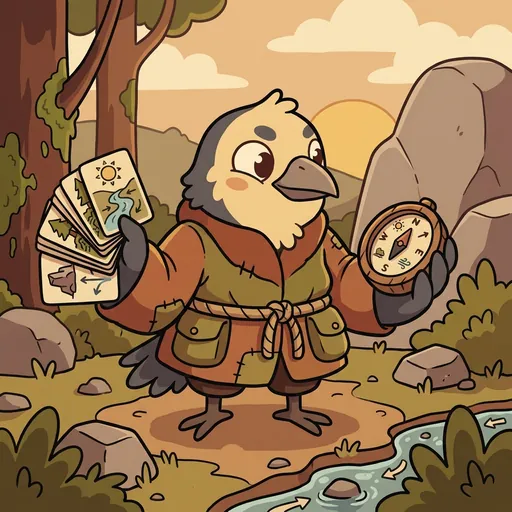
Way did not turn in circles. Way, a careful corvid-tween in a soft outdoor tunic, stopped walking, closed their eyes for one breath, and opened them again.
“Are we lost?” the taller hiker whispered. “We’re lost, aren’t we.”
“Nobody’s lost yet,” Way said. “We just can’t see far. Those are different.” They crouched low, tipped their head, and listened. Somewhere below and to the left, water moved over stones — a small, steady, downhill sound. “There,” Way said, pointing at nothing the hikers could see. “A stream. Streams run downhill, and downhill on this ridge goes toward the road. We don’t need the whole map. We need one thing we know.”
They started down, slow and sure, following the sound. The hikers stumbled after them, still peering into the grey for a landmark, a sign, anything.
“You’re not even looking,” the shorter one said, half accusing.
“I’m listening,” Way said. “Same job.” The stream sound grew louder. Bark appeared out of the fog — trees, then a mossy log Way stepped over without breaking stride. “The moss grows thicker where it stays damp and shaded. That side faces away from the afternoon sun. So the sun’s that way.” They didn’t even slow down. “One thing tells you the next thing. The next thing tells you the one after that.”
When the fog thinned and the road appeared below them exactly where Way had said it would, both hikers laughed out loud with relief. Way just tucked the landmark-cards back into their tunic pocket and kept walking.
Way had not always been so calm in the grey.
The first time Way got truly turned around, they were small, and it happened on a berry-picking path they thought they knew by heart. They’d wandered one bend too far, looked up, and every tree suddenly looked like every other tree. Their chest went tight. Their breath came fast and shallow. They tried to run one way, changed their mind, ran the other, and made it worse — because now they couldn’t even remember which way they’d come.
An old traveler resting under a pine had watched all this. They didn’t shout, and they didn’t come running. They just said, gently, “You’re spinning, little one. Spinning uses up everything and finds nothing. Come sit.”
Way sat, shaking.
“Now. Don’t look for the whole path,” the old traveler said. “That’s too big — that’s what’s scaring you. Find one thing. Just one. Something you know for certain.”
Way looked, really looked, for the first time since the panic started. And there — the sun, low and gold through the branches. “The sun sets over the far hills,” Way said slowly. “It’s setting now. So that way is west. And home is… east of the berries.”
“And now?” the traveler asked.
“Now I have a starting point.” Way’s breath came easier. The trees were still trees, but they weren’t a wall of the same tree anymore. There was a direction in them now.
That was the day Way learned the feeling: the spinning, swallowed-up feeling of lost was almost never really lost. It was just too-much-at-once, with no place to put your feet. One known thing was a place to put your feet.
Way walked to Trailforge as a tween, because a place that taught the outdoors ought to teach the kind of knowing that keeps you steady when everything looks the same.
The old ranger who kept the trailhead met them at the gate and asked one thing. “You want to teach wayfinding. So — how do you find your way?”
Way didn’t answer with a speech. They asked the ranger to spin them three times with their eyes shut, right there in the yard, until they’d lost all sense of which way was which.
Then Way opened their eyes, stood still, and looked. Warmth on the left cheek — the sun. A faint bend of the tall grass all leaning one way — the steady afternoon wind. A distant ridge with a notch in it they’d noticed on the walk up.
“The gate’s behind that notched ridge,” Way said, and pointed, and they were right.
“You didn’t guess,” the ranger said.
“I never guess,” said Way. “I read what’s already here. The people who walked these hills for hundreds of years didn’t discover the trails — the land was always telling them where to go. They just knew how to listen. I’d like to teach that listening.”
The ranger looked at the notched ridge, then at Way. “You belong here,” they said.
A girl came to Way’s lesson one morning already close to tears. The class had scattered her across the woods for a find-your-way-back exercise, and she’d frozen the moment she couldn’t see the trailhead.
“Everyone else just went,” she said, miserable. “I stood there. My brain went blank. I’m bad at this.”
Way knew that blank. They’d stood in it themselves, small, under the pines.
“You’re not bad at it,” Way said. “You did the smart thing and stopped. Spinning is what’s dangerous. Standing still is where finding starts.” They crouched to her level. “Don’t look for the trailhead. Too big. Find one thing you know. Just one. Look around — slow.”
The girl looked, sniffling. ”…The stream. We crossed a stream on the way out.”
“Which way was it flowing?”
She thought. “Toward — that way.” She pointed downhill.
“So the trailhead is upstream. You just turned the whole scary woods into a single hallway.” Way stood. “Now — one more. What else do you know?”
“The sun was on my back walking out. This early, that means…” Her eyes widened. “It’s behind me now too if I face home.”
“There it is,” Way said softly. “You had two anchors the whole time. You just needed to stop long enough to see them.” They watched her shoulders come down from around her ears. “That’s the feeling to remember. Not the map. That — the moment the blank turns into a direction.”
The girl walked back on her own, checking the stream, checking the sun, and did not once break into a scared run.
That evening, the girl found Way at the trailhead, quieter now.
“When it’s all fog,” she said, “and you really can’t see anything — how do you not panic?”
Way thought about the pines, and the tight chest, and the old traveler’s gentle voice.
“I do feel it,” Way said honestly. “The grey still tugs at that spinning place, right here.” They touched the middle of their chest. “But then I stop, and I find the one thing — the stream, the sun, the wind on my cheek — and something loosens. It’s a small feeling and it’s the best one I know. Like your feet remembering they’re allowed to be on the ground.”
The girl nodded slowly.
“You’ll feel it too, now,” Way said. “Turned-around, then one true thing, then — oh. That little oh is the whole craft. Everything else is just practice.”
They watched the last of the light go gold behind the notched ridge, and neither of them said anything, and both of them felt steady.
The TrailForge ensemble
Way is part of TrailForge's distributed-narrative cast. Each character embodies a different curricular primitive; together they teach the full subject.
-
Shelter
Shelter-building + warmth — three-walls insulation (wind / cold-ground / rain)
-

Watch
Weather reading + observation — sky-as-conversation-already-happening; notice the moment it changes
-
Tend
Water + plants + body-care — survival-as-attentiveness to body priority-order (water first, then warmth, then food); DELIBERATELY shared design with CreatureCare + ForgePortal Tend
-

Listen
Trail-listening + land-respect — every trail was here before you; credit the source; leave no trace; DELIBERATELY shared design with OriginForge Listen