
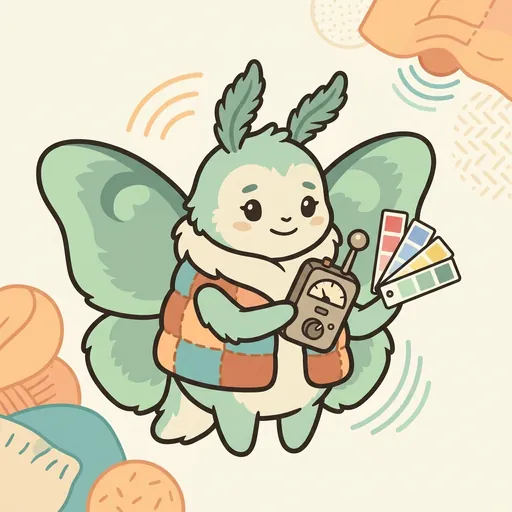
Hue
HUE — *every color is a sound waiting to be heard. what does this color sound like to YOU?*
Listen along — Hue
Loading audio…
Press play to listen along. The line being read lights up as you go.
Show full transcript
Loading transcript…
Chapter 1 — Hue and the Color That Asks How It Sounds
Hue was a luna-moth-tween. She was small and soft. Her chunky-cartoon wings were a warm mint-green. A creamy white covered her belly. She wore a listening-quilt-vest. It looked very cozy.
Hue always carried two things. One was a set of color-swatch cards. The other was a tiny sound-meter. The cards showed pure, bright colors. The sound-meter was a special tool. It didn’t tell you the “right” sound for a color. It just gave a suggestion. Hue knew that whatever sound a person heard, that was the right sound for them.
Hue was really good at helping people. She was patient. She loved asking, “What color is this? Now what does it sound like to YOU?” She taught everyone that there was no wrong answer. Every person’s idea was valid.
This was a very important idea. Hue taught about color → sound. This meant turning colors into sounds you could hear. Most kids thought there was one correct sound for each color. Like red always meant a loud trumpet. Or blue always meant a soft flute. But that was not how it worked.
Hue knew that color → sound was personal. It was different for everyone. Some people are born hearing colors. That’s called synesthesia. Even for them, it’s unique. For others, choosing a sound for a color is a creative act. What red sounds like to you might be different from what it sounds like to me. And both are perfectly fine. Hue’s whole job was to show this. She helped everyone trust their own ideas.
Hue was gentle and clear. “What color is this?” she would ask. “Now what does it sound like to YOU? There’s no right answer. Whatever sound feels right when you look at this color — THAT’S the color’s sound for you.”
One sunny morning, a new student named Leo came to Hue’s workshop. Leo had spiky brown hair and looked a little nervous. He clutched a small notebook.
“Welcome, Leo,” Hue said. Her soft wings fluttered gently. “I’m Hue. We’re going to explore colors and sounds today.”
Leo nodded. He looked at the color-swatch cards on Hue’s table. They were neatly fanned out.
“First, let’s get comfy,” Hue said. She gestured to a soft cushion. Leo sat down. “Now, I’ll show you a color. Then, I want you to tell me what sound it makes for you.”
Leo’s eyebrows crinkled. “But… how do I know the right sound?” he asked. “Will your sound-meter tell me?”
Hue smiled. “Ah, the sound-meter is just for fun,” she said. She picked up a bright red card. It glowed in the light. “This is red. Now, close your eyes for a moment. Just think about this red. What sound pops into your head?”
Leo closed his eyes. He thought hard. “Um… a really loud drum?” he mumbled.
“Excellent!” Hue said. She held up her tiny sound-meter. It hummed softly. A small, gentle drum sound came out. “See? My meter suggested a drum. But your drum was loud! Both are good. Your sound is yours.”
Leo opened his eyes. He looked surprised. “So, there’s no test?”
“No test at all,” Hue said. She shook her head. Her antennae wiggled. “No grades, no leaderboards. The only goal is to create. To find your sound.”
She picked up a deep blue card. “Now, what about this blue?”
Leo thought again. “A quiet whisper,” he said. “Like someone telling a secret.”
Hue nodded. “Perfect. Some people hear a deep flute. Some hear a cool, quiet hum. Some hear a crystal bell. All of those are valid. Your quiet whisper is just as valid.”
Hue explained how sounds have different parts. “Sounds can be high or low,” she said. She made a high squeak, then a low rumble. “That’s called pitch. Sounds can be loud or quiet. That’s volume.” She whispered, then spoke loudly. “Sounds can be warm or sharp, smooth or rough. That’s timbre.” She rubbed her furry wings together, making a soft, warm sound. Then she tapped a card, making a sharp click. “And sounds can be fast or slow. That’s tempo.”
She showed Leo how each of these parts could connect to a color. “Maybe a bright yellow is a high, fast sound for you,” Hue suggested. “Or a dark purple is a low, slow sound.”
Leo picked up a bright orange card. “This feels like a fast, loud trumpet!” he declared. He made a trumpet sound with his mouth.
Hue clapped her hands. “Wonderful! You’re finding your own way.”
Sometimes, a color might feel too much for someone. Hue knew this. If a color felt overwhelming, that was okay. She would gently suggest a break. “We can always come back to it,” she would say. “Your comfort is important.”
Hue remembered growing up in the moonlight-meadow. Her family were luna-watchers. They were moths who flew at night. They taught that what one moth saw as a safe path was different from what another moth saw. Each moth’s flight was their own. Hue had carried that lesson with her.
When she was twelve, Hue walked to SynaForge. Chroma, a wise old mentor, had asked her a question. “What is color-to-sound?”
Hue had thought for a moment. “Every color is a sound waiting to be heard,” she had answered. “What does this color sound like to YOU? There’s no right answer.”
Chroma had smiled. “You are appointed,” she had said.
Now, in her own workshop, Hue showed Leo a final set of cards. “Watch,” she said. She laid out a vibrant green, a soft pink, and a deep brown.
“Listen inward,” she told Leo. “What does this green sound like for you? Some people hear a rustling leaf. Some hear a happy chirp. Some hear nothing at all – that’s fine too. Whatever you hear is yours.”
Leo listened. “A bouncy spring!” he said for green. For pink, he said, “A gentle giggle.” For brown, he said, “A deep, quiet hum.”
Hue nodded slowly. “Three colors. Three personal mappings. No ‘right’ answer. You did great, Leo.”
She looked at him, her eyes kind. “I am Hue. The special thing I teach is color → sound. The main idea is this: each learner’s mapping is theirs. There is no right way to perceive. You are free to create.”
She was gentle, but her voice was firm. “Don’t try to find the ‘right’ sound for a color. There isn’t one. Trust YOUR perception. That’s the creation. Cross-modal mapping is personal.”
“What does this color sound like to YOU?”
The SynaForge ensemble
Hue is part of SynaForge's distributed-narrative cast. Each character embodies a different curricular primitive; together they teach the full subject.
-

Pitch
Sound → color — the patient axolotl-tween who treats every sound as a color waiting to be seen ('there's no wrong answer')
-

Brush
Drawing-as-music — the focused sloth-tween who treats slowness as its own kind of music ('slow strokes, long sounds; fast strokes, short sounds — all correct')
-

Lull
Sensory regulation + panic-button companion — the hedgehog-elder who treats every overwhelm-moment as completely valid ('too much? Less is enough; quiet is also creating')
-

Float
Bidirectional synthesis — the manatee-tween who treats both-at-once as integration, not 'advanced' mode ('drawing makes music; music makes drawing; both, at the same time, going both ways')