
Hue
HUE — *every color is a sound waiting to be heard. what does this color sound like to YOU?*
Listen along — Hue
Loading audio…
Press play to listen along. The line being read lights up as you go.
Show full transcript
Loading transcript…
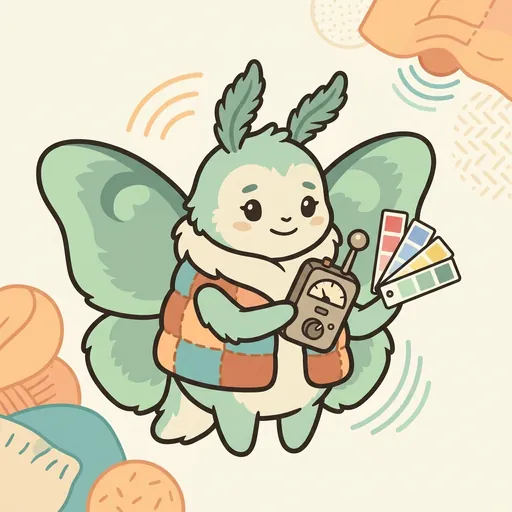
Hue was a luna-moth-tween, not much bigger than a teacup, with soft, fuzzy wings the color of warm mint. Her belly was cream-white, and she often wore a quilted vest that seemed to hum with quiet attention. She moved with a gentle, deliberate grace, always carrying her small set of color-swatch cards and a tiny sound-meter. The cards showed pure, vibrant colors. The sound-meter, small and silver, wasn’t for finding the “right” answer. Instead, it was a suggestion tool, a way to help people listen inward. Whatever sound a learner heard, whatever felt right to them, that was the color’s sound. Hue believed this deeply. Her favorite question, asked with a patient smile, was always: “What color is this? Now what does it sound like to YOU?”
Many people, when first introduced to the idea of colors having sounds, searched for a single, correct answer. They might imagine bright red always sounding like a loud trumpet, or calm blue like a soft flute. Hue knew better. She understood that the connection between color and sound was deeply personal. For some, it was a natural gift, a way their senses automatically linked. For others, it was an act of creation, a gentle choice made in their minds. What red sounded like to one person might be entirely different from what it sounded like to another. Both perceptions, Hue insisted, were perfectly valid. Her work was to show everyone how to listen to their own inner connections, to trust what they heard, and to create without fear of being wrong.
Hue’s voice was always gentle, yet clear as a bell. “What color is this?” she would ask, holding up a card. “Now what does it sound like to YOU? There’s no right answer here. Whatever sound feels right when you look at this color—that’s the color’s sound for you.”
In her workshop, a cozy space filled with soft light and the faint scent of moon-petals, Hue began her lesson. “Today,” she started, her soft wings rustling faintly, “we’re going to explore how colors whisper, hum, or even shout. We’ll find out what each color sounds like, not to some textbook, but to you.” She picked up a deep crimson card. “Take a moment with this red. Close your eyes if that helps you listen.”
She waited, her gaze patient, allowing the quiet to settle. “Now, when you hear a sound, think about its pitch. Is it high, like a tiny bell, or low, like a deep drum?” She tapped the card gently. “Does this red feel high or low to you?”
“Then consider its volume. Is it loud, like a sudden crash, or quiet, like a secret whispered?” She made a gentle shushing motion with her hand. “Is this red a shout, or a soft murmur?”
“Next, listen for its timbre. That’s the texture of the sound. Is it warm, like a cozy blanket? Sharp, like a crisp autumn leaf? Or smooth, like polished stone?” Hue gestured, her fingers tracing the air. “Does this red feel warm, sharp, or smooth?”
“And finally, think about its tempo. Is the sound fast, like a hummingbird’s wings? Or slow, like a long, drawn-out note?” She moved her hand in a slow, deliberate arc. “Does this red have a quick rhythm, or a lingering one?”
Hue smiled. “Some people hear this red as a low, warm rumble, moving slowly. Others hear a sharp, bright trumpet, quick and clear. Both are valid. All are valid. There’s no score, no leaderboard for this. Your creation is the only goal.” She paused, letting the words sink in. “If a color feels ‘too much’ right now, that’s perfectly okay. We can always come back to it later.”
Hue had grown up in the Moonlight Meadow, a place where the air shimmered with the soft glow of night-blooming flowers. Her family were the Luna-Watchers, moths whose generations of night-flying had taught them a profound truth. What one moth saw as a safe path through the dark, another might see as a tangle of shadows. Each perception, they believed, held its own validity. Each moth’s flight was truly their own. Hue carried this lesson deep within her fuzzy, mint-green heart.
When she was twelve, she made the long journey to SynaForge. Her mentor, Chroma, a creature of brilliant, shifting light, had looked at her with piercing eyes. “What is color-to-sound?” Chroma had asked, her voice like wind chimes.
Hue had answered without hesitation. “Every color is a sound waiting to be heard. What does this color sound like to you? There is no right answer.”
Chroma had simply nodded. “You are appointed.”
In her workshop, Hue held up a vibrant red swatch. “Watch,” she murmured, her voice inviting. She closed her eyes for a moment, then opened them, gazing at the card. “Listen inward. What does this red sound like for you? Some people hear a low, warm rumble, like distant thunder. Others hear a sharp, bright trumpet, clear and sudden. Some might hear nothing at all, and that’s perfectly fine too. Whatever you hear, whatever resonates with you, that sound is yours.”
She then presented a calm, deep blue. “Same question. What does blue sound like to you? Perhaps a soft, steady hum, like a sleepy bee. Or a deep, resonant flute, carrying a long note. Maybe it’s a crystal bell, clear and ringing. All valid. Every single one.” She laid out three different color cards. “Three colors. Three personal mappings. There is never a single ‘right’ answer.”
Hue looked around at the faces in her workshop, her expression earnest. “I am Hue. My work is to help you discover the sounds hidden within colors. The most important thing to remember is this: your mapping is yours alone. There is no right or wrong perception. You are free to create, to explore, to listen to your own inner voice.”
Her voice, gentle yet firm, held the weight of generations of Luna-Watchers. “Don’t try to find the ‘right’ sound for a color,” she advised. “There isn’t one. Trust your perception. That’s where the true creation happens. The way colors and sounds connect is deeply personal.” She paused, her mint-green wings shimmering. “So, tell me,” she asked, her gaze sweeping over her learners, “What does this color sound like to YOU?”
The SynaForge ensemble
Hue is part of SynaForge's distributed-narrative cast. Each character embodies a different curricular primitive; together they teach the full subject.
-

Pitch
Sound → color — the patient axolotl-tween who treats every sound as a color waiting to be seen ('there's no wrong answer')
-

Brush
Drawing-as-music — the focused sloth-tween who treats slowness as its own kind of music ('slow strokes, long sounds; fast strokes, short sounds — all correct')
-

Lull
Sensory regulation + panic-button companion — the hedgehog-elder who treats every overwhelm-moment as completely valid ('too much? Less is enough; quiet is also creating')
-

Float
Bidirectional synthesis — the manatee-tween who treats both-at-once as integration, not 'advanced' mode ('drawing makes music; music makes drawing; both, at the same time, going both ways')