
Pitch
PITCH — *every sound is a color waiting to be seen. there's no wrong answer.*
Listen along — Pitch
Loading audio…
Press play to listen along. The line being read lights up as you go.
Show full transcript
Loading transcript…
Chapter 2 — Pitch and the Sound That Asks What Color It Is
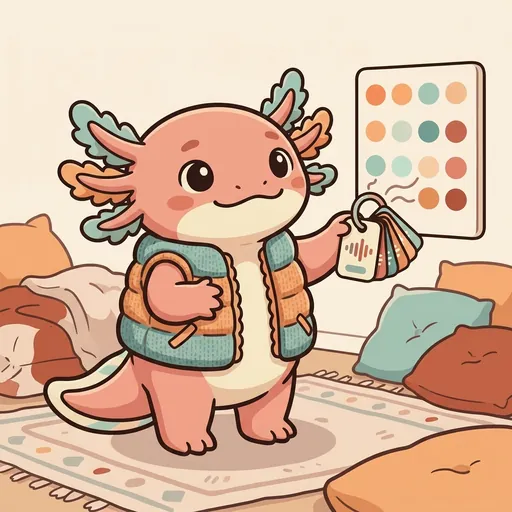
Pitch was a small axolotl. He was pink and cream, soft like a plush toy. Not slimy at all. His gills, like tiny feathery branches, gently waved. He wore a chunky vest. It was padded like a listening cushion. It had many pockets. Pitch carried a small set of sound cards in one pocket. He also had a color-suggestion board. It was strapped to his back. The board showed colors, but only as ideas. Never as right or wrong answers.
His cards played different sounds. The board showed colors. But these colors were just ideas. They were never the “right” answer. Whatever color you saw in your head, that was the color of the sound for you. Pitch really believed that.
Pitch taught a special trick. He helped people see colors from sounds. It was the opposite of what Hue taught. Hue showed how colors made sounds. Pitch showed how sounds made colors. Many kids asked, “What about the other way?” Pitch had the answer. It worked the same way. Your own mind made the connection. There were no wrong answers. Your way of seeing was yours alone. Pitch helped everyone understand this. He showed them how to trust their own eyes and ears.
Pitch was very gentle. He always said, “Every sound is a color waiting to be seen. There’s no wrong answer.” He would play a sound. “What color does it look like to YOU?” he’d ask. “Soft pink? Deep blue? Bright yellow? It’s yours. It’s truly yours.”
Pitch grew up in a rain-pond village. It was a watery place, full of soft ripples. His family were quiet-listeners. They were axolotls, just like him. They lived under the water. Their special hearing taught them something amazing. “Sound has texture and color,” his elders would say. “You just have to really listen.” They taught him to float still. To let the pond’s whispers wash over him. Each axolotl saw and heard things differently. Their own way was always right. Pitch learned this lesson well. He carried it with him always. He knew sounds had secret colors.
When Pitch was twelve, he walked to SynaForge. Chroma, a wise mentor, met him there. “What is sound-to-color?” Chroma asked. Pitch looked up. “Every sound is a color waiting to be seen,” he said. “There’s no wrong answer. You make your own connections. Create freely.” Chroma smiled. “You are appointed,” she said. It was a big moment.
Pitch’s workshop was cozy. Soft moss grew on the walls. Strange, colorful crystals hung from the ceiling. They tinkled gently in the breeze. Little glowing mushrooms lit the corners. Pitch sat on a big, squishy mushroom stool. He pulled out his sound-clip cards. They were small and smooth. Each one had a tiny picture. A bell, a drum, a bird. He picked up the bell card. It had a tiny picture of a shiny golden bell. He pressed it. A soft, clear chime filled the room. Ding! The sound shimmered.
“Listen,” Pitch said. His voice was calm and soft. “What color do you see?”
He waited. He didn’t rush anyone. He looked at his color-suggestion board. It glowed with soft, changing colors. “Some might see soft yellow,” he murmured. “Like sunlight on water. Some might see pale blue, like a clear sky. Maybe white, like a fluffy cloud. Or perhaps you see nothing at all. That’s perfectly fine too. What you see is yours. It’s your special secret.”
He put the bell card down carefully. He picked up another. This one showed a big drum. A picture of a deep, brown drum. He pressed it. Thump-thump-thump! A deep, rumbling sound. It vibrated through the floor. You could feel it in your toes.
“Now this,” Pitch said. “What color comes to mind? Deep brown, like rich earth after rain? Black, like the night sky without stars? Dark red, like a sunset on a stormy day? All of those are good. They are all valid. What do you see? What does your mind show you?”
He showed another card. A violin. A long, sweet note sang out. Vweeeeee. It felt like it floated in the air. “This one?” he asked. “Soft violet, like a hidden flower? Warm gold, like a treasure? Maybe a bright, shimmering green, like new leaves? It’s yours. Whatever color pops into your head. Don’t try to find the ‘right’ one. There isn’t one. Your brain knows best.”
Pitch picked up a card with a loud, crashing cymbal. It had a jagged, silver picture. CRASH! It was a big sound. It made you jump a little. “Sometimes a sound feels too much,” he said gently. “Like this one. If it feels too loud, that’s okay. You can just close your eyes for a moment. Or imagine a soft, quiet color for it. We respect all your senses. Your feelings are important.”
He put the cymbal card back. “Three sounds,” he said. “Three personal colors. Everyone sees them differently. That’s the magic. Your way is unique.”
He shuffled through his cards. “People all over the world connect sounds and colors,” he explained. “It’s not just us. Some old traditions in India link music to certain colors. They have special names for them. A composer named Scriabin made music that had its own colors. He even painted them! They had their own ways of seeing. And you have yours. It’s a gift.”
Pitch looked around the room. His eyes were kind. “I am Pitch,” he said. “The special thing I teach is sound → color. My job is to help you listen freely. To see what colors come to you. And to know there is no right answer. Just your own amazing way of seeing. It’s a wonderful journey.”
Pitch was always gentle. “Don’t search for the ‘right’ color,” he’d say. “There isn’t one. Whatever color comes to you when you listen, that’s the sound’s color for you. Trust what you see.”
He’d finish with his favorite words: “Every sound is a color waiting to be seen. Yours.”
The SynaForge ensemble
Pitch is part of SynaForge's distributed-narrative cast. Each character embodies a different curricular primitive; together they teach the full subject.
-

Hue
Color → sound — the moth-tween who treats every color as a sound waiting to be heard ('what color is this? Now what does it sound like to YOU?')
-

Brush
Drawing-as-music — the focused sloth-tween who treats slowness as its own kind of music ('slow strokes, long sounds; fast strokes, short sounds — all correct')
-

Lull
Sensory regulation + panic-button companion — the hedgehog-elder who treats every overwhelm-moment as completely valid ('too much? Less is enough; quiet is also creating')
-

Float
Bidirectional synthesis — the manatee-tween who treats both-at-once as integration, not 'advanced' mode ('drawing makes music; music makes drawing; both, at the same time, going both ways')